Review: King of Scars by Leigh Bardugo

Alexis: Read 3/24/19

I loved the first half of this book. I loved Nikolai’s internal (and sometimes external) battle within himself. I enjoyed learning more about Zoya: her past, her innermost feelings, her motivations. And at first, I rejoiced in Nina’s chapters, especially after her ending in Crooked Kingdom.

King of Scars is told in third person from various perspectives, including Nikolai, Zoya, Nina, and a man named Isaak. I’m glad Bardugo decided on third person, as I think it worked perfectly for the world in Six of Crows, and ultimately served a better purpose than the first person of the Shadow and Bone Trilogy.

I enjoyed the masterful worldbuilding and name dropping of characters from previous books. Bardugo has really cemented the Grishaverse. And I really enjoyed how the plot was building. However, the second half started to meander. Zoya ended up being the primary character, rather than Nikolai himself. The book’s title is literally Nikolai’s nickname, and yet he sometimes gets lost in the sea of other characters.

I honestly wanted to skip over Isaak’s chapters; I felt like his information could have been revealed later and it would have served the book better, even if the the reader wouldn’t get to know him as a character. But I really just didn’t care about him.

Nina’s chapters began to feel drawn out. As much as I enjoy her as a character, I found myself wanting to stay with Zoya and Nikolai’s storylines. I almost wanted Nina’s chapters to be separated from the rest of the story, maybe as its own short book.

My primary concern, besides Nikolai not being as center stage as I wanted him to be, was where the plot ended up. It was building up to such a great place, but then the ending ruined it for me. I’ll avoid spoilers here and go more into that below.

This book definitely felt like a follow-up to the Shadow of Bone trilogy, which I didn’t like nearly as much as the Six of Crows duology. I was hoping for more of a Six of Crows feel, with the masterfully crafted plot and characters. I just wish the book had only switched in POV from Nikolai to Zoya and that the plot was…different. Even with my mixed feelings, I still love the characters and Bardugo’s world, and I flew through this book.

The first half of the book: 5 stars. Second half: 3 stars

VERDICT: 4 stars

 
SPOILERS BELOW:

I felt like most of the plot reveals in the second half of the book were a little too coincidental. Hanne just happens to be the daughter of Brum? The Saints just happen to be alive with the answers to a greater power for Zoya? And the biggest of all: the Darkling’s comeback. It felt like a cop-out to me. I wanted something as equally as dark to be the main antagonist, but I wanted something different. The Darkling’s story was supposed to be over. With all the tumultuous politics going on, I just felt like the ending could’ve gone in a different and better direction.


Review: Nevermoor by Jessica Townsend

Nevermoor is the first installment in a series about Morrigan Crow, who was born on Eventine, the unluckiest day. Morrigan is cursed to die on midnight of her eleventh birthday. Morrigan is blamed for every misfortune in the town, and she’s kept at arm’s length from everyone, including her family. Before the clock can strike midnight on Eventide, she’s swept away to a magical land called Nevermoor by an equally magical man, Jupiter North. Jupiter prepares Morrigan to compete in four trials that, if she’s successful, will grant her entrance into the legendary Wundrous Society.  

Before reading this, I’d heard Nevermoor compared to Harry Potter, and this is true in a lot of ways (although let’s be honest, nothing can ever truly compare). Nevermoor feels like a mix of The Sorcerer’s Stone and The Goblet of Fire, because of Morrigan’s introduction to magic at age 11, and the trials being like a less deadly Triwizard Tournament. The magic system is difficult to summarize. It feels more eclectic than The Wizarding World. I’ve also heard Nevermoor called a mix of Harry Potter and Alice in Wonderland, which I’d call accurate. We also know that there is going to be a special magic school down the line. Jupiter is also a very Dumbledore-y character, as her mentor, and someone who is obviously keeping secrets from Harry. I mean, Morrigan.

Moving on from Harry Potter!

Townsend is a great writer. Nevermoor is fantastically and colorfully written. It’s clever, hilarious, and by far the most creative fantasy I’ve read in a long time. It has great worldbuilding, but still leaves much more to be explored in later books.


I love Morrigan as a character, which is one of the reasons Nevermoor is so compulsively readable. Before Nevermoor, she has never known love. She has been shamed and ostracized by her family for her entire life. She just wants a place to belong. As I mentioned before, It did get a little annoying that Jupiter keeps her in the dark for so much of the book (ahem, Dumbledore) but I understand why that this needs to happen plot-wise. The villains are sufficiently creepy and well-developed, as are the quirky host of characters in the Hotel, and Morrigan’s two close friends, Hawthorne and Jack.

Despite the fact that it’s middle grade, Nevermoor tackles dark themes, such as abuse and death. There’s also a lot of commentary for adults that I never would have picked up on as a kid, such as the discussion of illegal immigration. There’s a scene on page 428 when the Wunderground is experiencing technical difficulties that mirror the MTA subway delay announcements so much that they had me cracking up.

Most importantly, Nevermoor is filled with memorable magic and a story that I can’t wait to keep reading! My one concern is that it’s going to be difficult for the following books in the series to live up to the standard of book number one!


VERDICT: 4.5 out of 5 books

Review: Caraval by Stephanie Garber

Alexis: Read 3/2/19

Unfortunately, I found Caraval so much worse than The Night Circus. I know a lot of comparisons have been drawn between the two books, so I thought I would give you my own.

The Night Circus is beautifully written, with lush and lyrical descriptions, but is very slow moving and has a sparse plot. I can’t say the same thing about Caraval’s writing. It felt middle-grade (and not in a creative way) and cliché. However, it is fast-paced and there is a layered plot. Both books have insta-love, though I have to say the relationship in Caraval actually felt more convincing.

So let’s delve more into Garber’s writing. Throughout the book, she relies on one particular, peculiar type of metaphor: the insert color was insert emotion. Here’s an example: “…a blaze of shimmery gold, the color of magic and wishes and promises of things to come” (14). Here’s another: “A ruby welt bloomed across his cheek. The color of rage and punishment” (45). Here’s a third: “…a rich cerise—the color of seduction and secrets” (660).

I usually love repetition, whether in motifs, anaphora, etc. But the repetition of these metaphors drove me crazy. They’re cliché and terrible and made me say “really??” out loud too many times. And none of them even made sense!

Another thing that drove me crazy was that half of the plot was predictable. You know from the beginning that Scarlett is going to get together with Julian. There was only one plot point towards the end that I didn’t see coming.

As for the characters, I only liked Julian, but only because he’s the only character with somewhat of an interesting personality. He’s your classic “dark and handsome but is he good or bad?” type of guy with Edward-Twilight caramel eyes: “light brown, the color of caramel and liquid amber lust” (172). The descriptions of him were super cringey.

I found Scarlett to be too whiny and annoying, and Donatella wasn’t much better. Even their names seemed to get in the way of the story; it was as if their names drew too much attention from it. It doesn’t help that Scarlett’s name is also a color, so her name is thrown around with all of the cringey color metaphors. One of the characters even says of Scarlett, “You’re so dramatic, you would’ve made a fantastic performer” (308). And god, was he right.

The dialogue doesn’t have any subtext. I absolutely hated that Governor Dragna is described as dragon-like. And I could’ve cared less about the plot of this book.

I think the one word that sums up this book is cringeworthy. I really wanted to like it, I enjoyed how the book opened up with letters, and I initially though Garber’s worldbuilding was good (in the first 10 pages). But this obviously wasn’t the book for me.

VERDICT: 1 and ½ out of 5 books

Review: Ruin and Rising by Leigh Bardugo

Alexis: Read 2/20/19

Ruin and Rising was certainly the best book of the Shadow and Bone Trilogy. I disliked Alina’s character in the first two books, and I felt like she became a more complex character in this one. Additionally, Mal had zero personality in the first two books, and he felt more real to me in Ruin and Rising, as well.

Everyone can agree with me here: Nikolai is still the most vibrant character. He has a sparkling personality and he knows what he wants. He echoes the beginning of Bardugo’s masterfully crafted characters in the Six of Crows series.

As for the plot, I feel like the first half of the book meanders. There’s a whole host of secondary characters that I didn’t really care about, except for Genya.

And time for an unpopular opinion: I don’t like the Darkling. He’s creepy, manipulative, and honestly rapey. His beauty doesn’t make up for that.

SPOILERS BELOW:

Okay, so I really enjoyed the plot twists in the second half of the book. Mal being the third amplifier? Nikolai getting turned into a monster? I didn’t see either of those coming, and it made the book more exciting!

The ending felt very Hunger Games to me: boy and girl get together and live a nice, normal life together, where they can grieve together forever. I honestly didn’t mind the ending, as I think it was the happiest ending for Alina and Mal. But Alina losing her power was anticlimactic and confusing. It felt unnecessary. Plus, she had such a good character arc by Ruin and Rising that I felt it was unfair for her to return to how she was in the beginning of the series.

Despite some of my issues with this book, I really enjoy the Grishaverse and I couldn’t put this book down. I enjoyed seeing Bardugo’s writing style evolve!

VERDICT: 4 out of 5 books

Alexis’ Library Haul: Part 2

Alexis: The little snow that we got turned into mush and then rain, so I was able to get my library books! Here’s a library haul part 2.

  • Ruin and Rising by Leigh Bardugo
  • The Afterlife by Thomas Pierce
  • Caraval by Stephanie Garber
  • The River of Doubt by Candice Millard

For a change of pace, I’m intersecting my fantasy reads with some different genres! Even though I love fantasy and YA fantasy, I’m tired of the same tropes being recycled (I’m looking at you, love triangle). Sometimes I need to take a break and read something different. 

Review: Shadow and Bone; Siege and Storm by Leigh Bardugo

Alexis:

I’ve dedicated this past week to reading the first two books in the Shadow and Bone Trilogy, and hopefully I can get the last book from the library next week!

I read the Six of Crows Duology last year and I absolutely loved it, so I was looking forward to reading the first books in Bardugo’s Grishaverse.

I seem to agree with everyone else (at least on Goodreads) that the second book in the trilogy is better than the first. I was surprised to find that the first book relied on some tropes, the most prevalent of which is the love triangle. However, I thought that Shadow and Bone did a great job when it came to worldbuilding and introducing the Grisha’s powers. 

The second book’s plot is much more intricate than the first. It honestly reminds me of The Hunger Games. Politics come into play, and Alina starts to become a powerful symbol of hope. I enjoyed the new characters that were introduced, but I felt like Mal’s character wasn’t as strong as he was in the first book. However, Bardugo’s keen sense of humor comes out more in the second book.

Minor spoilers below:

One of the biggest issues I have with the two books is the way that male characters interact with Alina, which, unfortunately, only gets worse in Siege and Storm. Multiple male characters touch and kiss Alina without her consent, and the way the Darkling interacts with her makes me sick. In Siege and Storm, no one respects that Alina and Mal are in a relationship, and she gets kissed and even gets marriage proposals. I understood all of this happens for plot reasons, but here Alina is, in a different love triangle than in the first book, and she even enjoys the attention from Nikolai.

I feel like I say this in every review, but despite my issues with the books, I did enjoy reading them. I love the Grishaverse and I’m interested to see where the third book goes. I just can’t help comparing this series to the Six of Crows Duology. It’s interesting to see how much Bardugo’s writing has evolved.

Shadow and Bone: 3 out of 5 books

Siege and Storm: 4 out of 5 stars

Review: The Lie Tree by Frances Hardinge

Alexis: Read 2/4/19

“There was a hunger in her, and girls were not supposed to be hungry. They were supposed to nibble sparingly when at table, and their minds were supposed to be satisfied with a slim diet too.”

The Lie Tree is both about revenge and finding yourself. It manages to be a murder mystery book while exploring themes of science vs. religion, paleontology, family, and, of course, lies.

The book follows Faith, the 14-year-old daughter of a reverend/scientist, who moves to an island with her family. Throughout the story, she struggles with being a complacent girl in 19th century England while battling her desire to be seen and heard as a person with a brain and scientific ambitions. This was my favorite part of the book. I loved reading about Faith’s navigation through 19th century society and ideals. I felt and understood her frustrations as she dealt with being called useless. I also appreciated that Hardinge explored how her petticoats and corset always got in the way; it just felt very real to me. And, as the book progressed, I loved reading about her showing off her cleverness and proving to her mother, and the men in the book, what she can do.

Faith’s character was a little hard for me to like. I rooted for her to win, even through her ill-fated motives and her willingness to lie. I thought that the unlikability of the characters served the dark nature of the story and the Lie Tree well. However, at times, I found the story hard to get through because of this, and also because the plot was a little slow. Despite this, Hardinge is still a poetic writer and I enjoyed her descriptions and the murder mystery storyline.

VERDICT: 3 ½ out of 5 books

Alexis’ Library Haul

Alexis:

Library haul time! These are some of my most anticipated reads on my #tbr list.

  • Shadow and Bone by Leigh Bardugo
  • Siege and Storm by Leigh Bardugo
  • The Lie Tree by Frances Hardinge
  • In the Midst of Winter by Isabel Allende

Anna and I went to a coffee shop and got some work and writing done today. And then we went to Ulta, my second favorite store after Barnes and Noble.

I’m starting with In the Midst of Winter since it’s currently 28 degrees outside and dropping! I’ve always loved Isabel Allende’s writing style and I’m enjoying the beginning of the book.

Review: The Gilded Wolves by Roshani Chokshi

Alexis: Read 1/25/19

I couldn’t help but compare The Gilded Wolves to Six of Crows by Leigh Bardugo. The heist plotline and the similarities in the gang of characters made it impossible. Prepare for a long review; I have a lot to say about this book!

Pros:

The Gilded Wolves is packed with detailed information. The story is set in an alternative 1889 Paris in which certain people can Forge, or magically manipulate objects, metals, and/or plants, etc. I have to admit Paris is not one of my favorite cities, but I really enjoyed the setting for the book. Chokshi did a great job of exploring the city’s history, both the good and the bad, and I thought she described the city well. Her descriptions of the Eiffel Tower, mostly from Zofia’s point of view, were unique and interesting.

I enjoyed reading the snippets of Séverin’s past. Overall, Zofia was my favorite character because of her uniqueness. Plus, it was refreshing to read about a woman scientist and mathematician.

This book is an interesting mix of history, science, and mythology. I really enjoyed the mythology, as the book explored Greek, Roman, and Egyptian mythology. I loved the diversity of the characters; it painted a more accurate portrayal of Paris in 1889 and helped give the characters unique backgrounds and perspectives. I also enjoyed Chokshi’s descriptions and appreciated that she tackled themes of racism, prejudice, and identity.

Cons:

Though the voices of the characters were each distinct, I only really started caring about Zofia and Enrique once I reached the halfway point of the book. They felt the most real to me. There was a death at the end of the book, and, unfortunately, I didn’t find myself caring about it as much as I wanted to.

I wasn’t really a fan of Hypnos. Though I appreciated the diversity his character brought, he felt like a stereotypical gay character to me, and I had a hard time understanding his motives and his character.

Though I loved the blend of topics, sometimes this book felt more sci-fi to me than historical fantasy. I also felt like the book wasn’t as deep as I wanted it to be. I almost wish Chokshi will write a prequel to this; a lot of events happened before the start of this book.

I have to mention that it took me a while to get into the story. The beginning was a little too chaotic, and I found myself having to re-read paragraphs to make sure I understood what was happening. The Order confused me. I also felt like the climax of the book was a bit rushed. Though I enjoyed Chokshi’s writing style, the overabundance of adverbs irritated me (that’s my English major coming out!) “‘You lied to me,’ she said loudly.” “‘Ready?’ she said brightly.” “‘I know,’ said Hypnos solemnly.”

Despite my issues with the book, I did enjoy reading it, so. . .  

VERDICT: 4 out of 5 books

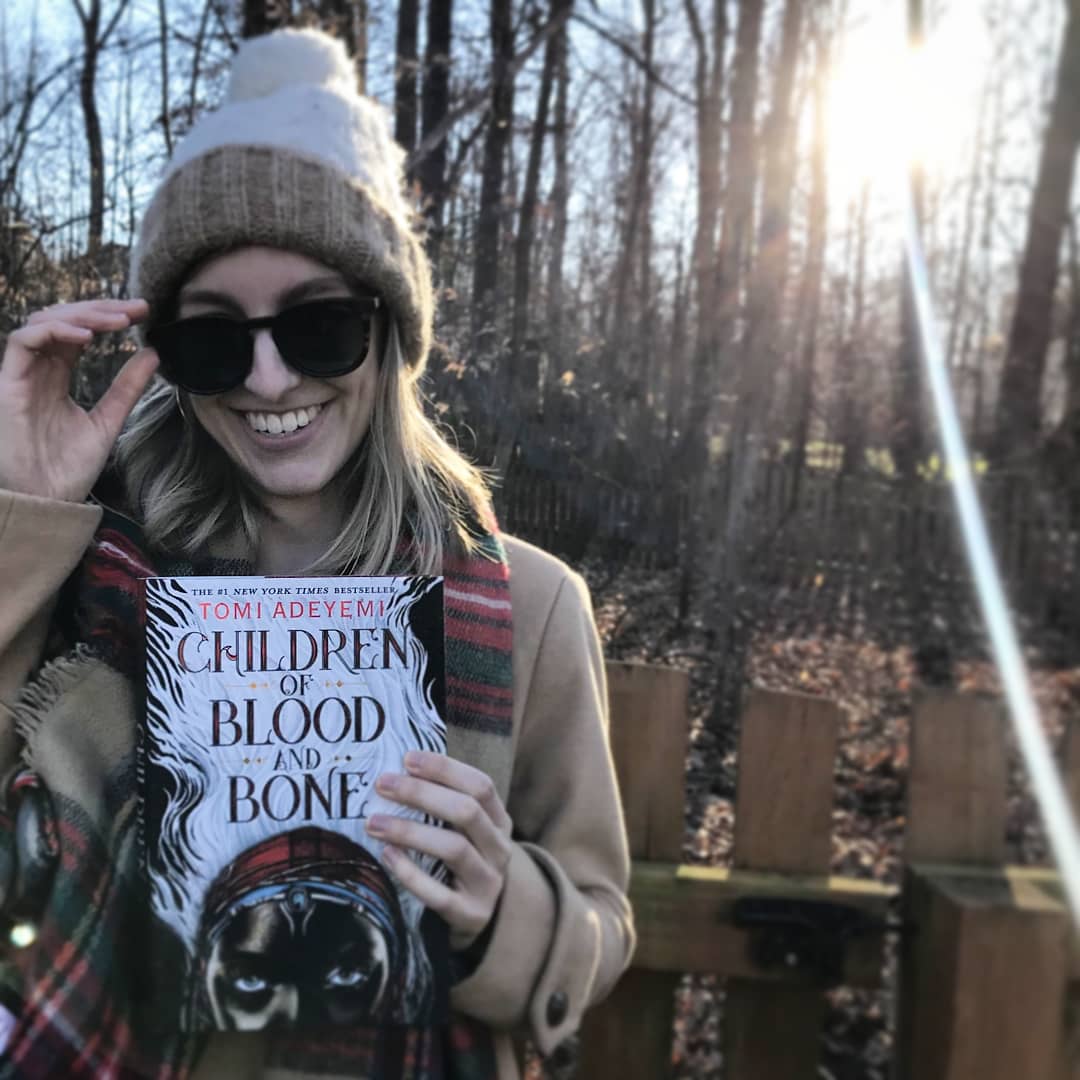
Review: Children of Blood and Bone by Tomi Adeyemi

Alexis: Read 1/9/19

Children of Blood and Bone, despite being a thick book, is super fast-paced. The plot is always moving, which I appreciated as I read. Adeyemi does a good job of explaining how the magic system works, and I enjoyed learning about all the gods and the maji’s connections to them. Sometimes multiple perspectives can be hard to pull off, but I really enjoyed reading from all the different perspectives, and the shifts never pulled me out of the book.

As for the characters, I’ll be honest: I’m not a huge fan of Zélie. She sometimes felt like a Katniss Everdeen character. However, I connected more with her as the book went on. I enjoyed Inan’s character until about halfway through the book. As for Amari and Tzain, I always enjoyed reading from their points of view. At times, the plot was a bit predictable, but not enough that I didn’t continue to enjoy reading the story. There was a love-at-first-sight storyline, and though I normally hate this YA trope, I thought Adeyemi used it to her advantage.

About a quarter way through this book, I realized something: parts of this book mirror Avatar: The Last Airbender.

Zélie is very similar to Katara. When she is young, her mother is killed in a raid because she possessed magical powers. Zélie possesses these same powers and she grows up wanting revenge. She has an older, non-magical brother, Tzain, who just wants to protect her. Zélie meets an Aang-like character, Amari: a girl who was trained how to fight from an early age, but who needs to learn to get past her peaceful side.

Amari’s older brother, Inan, the prince, has a good heart but is misguided. He wants his father’s approval but he has to betray those he loves in order to achieve it, just like Zuko. The father is definitely a Fire Lord Ozai type of character.

There is a temple “made of air” which connects maji to their gods. This temple was mostly destroyed in a raid in which a genocide happened.   

Despite these similarities, Children of Blood and Bone is an original book. I I loved the diversity and the magic based on Nigerian mythology. I also admired Adeyemi’s creativity—the characters ride on giant, horned lions and leopards, called lionaires and snow leoponaires.

Overall, this book was wholly engrossing and I had a hard time putting it down. And for that reason I can’t rate it any less than 5 books. I’m excited for the sequel!

VERDICT: 5 books