Review: Wild Beauty by Anna-Marie McLemore

Alexis holds a hardcover copy of Wild Beauty in one hand while standing in front of a fence and a forest.

Alexis:

Happy Friday, everyone! This week felt like it flew by.

I’ve just been consuming books lately, so I’m a little backed up on book reviews. But it’s time to talk about Wild Beauty.

I’ve been meaning to read McLemore’s books for a while now; she’s known for her magical realism books and her lyrical writing. And one of the best aspects of this book is her lush, lyrical writing. I love the way she describes the flowers and the gardens of La Pradera. I love magical realism, and reading this book often felt like reading a dream.

The plot: The Nomeolvides women are not like other women. They can create flowers with only their hands—but they’re also cursed. They can’t leave their magical garden estate of La Pradera without getting sick. And on top of that, if they fall in love too deeply, their loves disappear into thin air. But then a boy named Fel appears at La Pradera one day. And Estrella, one of the Nomeolvides girls, tries to help him figure out who he is and where he came from. 

I liked the bixeual representation, and the collection of girls was fun to read about, even if they tended to blend together. I do wish I got to know Estrella’s character even more; Fel was definitely the standout character to me, and the only one who felt like he had a real backstory and motivation. 

As much as I enjoyed McLemore’s writing and imagery, this book was very, very slow moving. And I don’t mind slow-moving, character-driven books. However, oftentimes, this book didn’t read like a book. I’m not sure what it felt like most of the time; maybe a long-form narrative poem? 

Besides the chapters from Fel’s POV, this book has no plot until the last quarter or so. And what surprised me was that the plot was amazing. It was so interesting, and made so much sense in the context of the book, that I found myself a little annoyed. Why didn’t McLemore weave this plot in earlier instead of describing flowers or the girls dancing and conversing for the hundredth time? The ending was powerful, and the way the plot unraveled was wonderful. I just wish it was present in more of the book. 

VERDICT: ⭐⭐⭐/5

Pub day spotlight: The Temple House Vanishing by Rachel Donohue

Anna: Happy publication day to The Temple House Vanishing by Rachel Donahue! Thank you @algonquinbooks for sending me an arc of this book in exchange for an honest review.

Set in a boarding school in an old Victorian house in Ireland, scholarship student Louisa quickly becomes enamored by classmate Victoria and their charismatic art teacher, Mr. Lavelle. Louisa struggles to fit in with her rich classmates, but as she becomes closer to Victoria and Mr. Lavelle, something even darker is underfoot. 

25 years later, an unnamed journalist investigates Louisa’s disappearance. It’s widely accepted that Louisa willingly ran away with Mr. Lavelle, but as the journalist becomes more entangled with the case, it’s clear something much worse happened.


The Temple House Vanishing evokes major My Dark Vanessa and The Likeness vibes. This is a quick, smart, and atmospheric read that explores love, friendship, obsession, race, class, and the ways in which men in positions of power take advantage of young women. I did find the perspective from the journalist a little lacking and would have liked more character development there. We learn little about her own life, besides that she grew up on Louisa’s street and Louisa once babysat her. The only thing we know is that she is a workaholic. I thought something might happen with her intern, who gets a lot of dialogue, but that turns out to be a dead-end in the plot. Then there is also an artistic choice in the epilogue involving a ghost that I found a little strange and a bit cheesy.

But overall, I can’t say no to a spooky boarding school mystery, and this is another one of those.

Review: Betty by Tiffany McDaniel

Anna: If you’re looking for an emotional coming-of-age story I highly recommend Betty. Set in Appalachian Ohio, Betty and her five siblings live with their mother and Cherokee father in a dilapidated house surrounded by racism, poverty, and family secrets. This is also fiercely feminist novel, which I love. 

Betty is about sisterly love, nature, and cycles of trauma and abuse in families. When she is eleven, Betty discovers a deadly family secret that shapes the course of her life. Despite the difficult themes, this book is beautifully and lyrically written. Betty’s dad, Landon, and his storytelling the love of nature he encourages in his children are a driving force of the novel. Her mom, on the other hand, is violent and unpredictable, a product of years of being the victim of violence herself.

This is also an own-voices story, as Tiffany McDaniel is the descendants of Cherokee ancestors, and the characters in Betty are fictional accounts of real family members

Major trigger warning for sexual violence 

VERDICT: 4.5 stars

Review: Disability Visibility: First-Person Stories from the Twenty-First Century edited by Alice Wong

Anna: Why do we read? For entertainment, yes, but part of that enjoyment comes from the thrill of briefly living in and therefore learning about an experience that’s not your own. My favorite books as a kid featured fantasy worlds like Hogwarts and Narnia. As a mature reader, I still find myself reaching for different worlds, but I’m less interested in fantasy. I’m more interesting in learning about the every day lives of other people around the world.

That being said, when I kept hearing about Disability Visibility I realized there was a huge gap in my reading experience.

Disability Visibility is an essay collection edited by the activist Alice Wong. I do not identify as a disabled person, so please take my words with a grain of salt. But this book came highly rated and recommended by disabled people in the bookish community.

This book gives space to an amazing amount of different voices. The essays are about prejudice, misrepresentation in the media, accessibility, advocacy, and perhaps most importantly, just being a disabled person.

This collection also got me thinking about just how many “first person” narratives I’ve really read about disability, both fiction and nonfiction. It’s no new thing that disability has long been misrepresented in the media, especially in the issue of own voices representation. As a teenager I, unfortunately, consumed what I now call “trauma porn”, which romanticized illness and disability and killed off characters, promoting the harmful ideas that disabled bodies are better off dead. This included The Fault in our Stars and Me Before You, the movie adaptation of which casted an able-bodied actor for the role of a quadriplegic.

Now, I try to research authors before reading books, to make sure I read own voices stories. We also like to think that we’re slowly moving toward a more accepting and accessible society. I know that being an ally is more than slapping closed captions on my Instagram stories and reading just one book about disability. But I hope this is just the beginning of my disability reading and learning journey.

Review: Lost in the Never Woods by Aiden Thomas

Alexis:

Well, my laptop stopped charging, and I had to wait to get a new charging port. It’s hard updating a blog without my laptop! Thankfully, it’s all fixed now, so time for another book review!

Lost in the Never Woods is a modern day Peter Pan retelling that takes places when Wendy turns eighteen years old. A string of child disappearances all keep coming back to her, only reminding her of when her own two little brothers disappeared years ago without a trace. And then Peter Pan shows up in Wendy’s town.

I enjoyed Thomas’ writing style in Cemetery Boys, and I likewise enjoyed it in this one. It was spookier and less lighthearted than Cemetery Boys, while keeping the heartwarming magic of Peter Pan. 

The basic plot reminded me of the middle grade series Peter and the Starcatchers, which I read when I was younger, so I think if you enjoyed that series, you’ll like this book. I liked the themes of childhood and trauma that Thomas explores; this book focuses a lot more on Wendy’s trauma and emotions than plot. I’m also always a sucker for a book featuring spooky woods.

My one main critique is that the final plot reveal at the end wasn’t my favorite. Also, the characters weren’t as well-rounded as I would have liked. There’s a smaller spoilery critique that I’ll include down below. But overall, I enjoyed this one. 

VERDICT: ⭐⭐⭐⭐/5

SPOILERS BELOW:

Okay, so Peter Pan romance, right? I don’t have a problem with that except, well, Peter is a child. He goes through a weird growth spurt in this book and ends up being physically around Wendy’s age by the end, but mentally, I believe he was still around 13? I don’t know, it was a little weird having them have a romance at the end when Peter just ends up going back to being a child. As much as I love romance, I almost wish this book had focused more on friendship rather than a really slow burn romance.

Real Talk & a Half-Review: The Once and Future Witches by Alix E. Harrow

Alexis:

Do you think DNFing is talked about enough in the book/literary world? Or do you think it’s perceived as being too negative a topic?

I don’t DNF books often. I only do if I A) really can’t stand the writing style/topic or B) if I lose interest in the story. But I always strive to be as honest as I can when it comes to my reviews. When I read a book, I can’t ignore the fact that I have a creative writing background, so things that some readers can get over/don’t think are a big deal, I often can’t ignore.

All that being said, since I really enjoyed The Ten Thousand Doors of January, I was looking forward to reading Harrow’s new book.

Unfortunately, finishing this book just feels like a chore. I got halfway through, and I found myself not caring about what happens to the main characters.

The Once and Future Witches follows three estranged sisters in the 1890s in a city called New Salem, the City Without Sin, after the original Salem burned down. The sisters join the suffragette movement and attempt to bring back the lost magic of witches. 

While I admire that this book focuses on sisterhood, magic and fairy tales, and the advancement of women, I was never sucked into the story. Despite all three sisters having interesting backstories, they don’t feel well-rounded on the page, and for some reason, I only found myself caring a little about Beatrice/Bella’s character, but not enough about the others to continue reading. 

I don’t mind a slower pace in books; in fact, The Ten Thousand Doors of January has a fairly slow pace. But The Once and Future Witches feels insufferably slow to me. While I love Harrow’s imagery, the writing in this book feels repetitive. The plot seems to move in circles rather than in a line. And important information was revealed later rather than earlier. 

This is a historical fantasy book, set in the 1890’s, as I mentioned previously. But the book is in present tense, despite the beginning being in past tense…? The present tense just doesn’t fit, and I think it was a strange choice. 

And finally, there are some uncomfortable moments for me when it comes to race. Obviously, in 1890’s America, race was a huge issue. I know that “colored” was the term used back then, so why do I feel uncomfortable reading it every time? Maybe because this is a historical fantasy book, which automatically means it’s set in an alternative timeline/alternate history (like New Salem).

Juniper, one of the sisters, curses like a sailor, which again, doesn’t seem to fit in the story. But I’m sure women cursed in the past, right? Oh, definitely. But I know for a fact that “hot damn” was not around during that time period. Most of the curses she spews sound extremely modern, and it takes me out of the story. So if Juniper can swear in a modern way, why couldn’t “colored women” simply be changed to black women? And the fact that Harrow described a Sioux woman as a “clay-colored woman” only made me feel even more uncomfortable. One of the sisters, Beatrice, is heavily involved with a character named Cleo, a black woman, and clearly she is all for equality, but it still doesn’t erase the smaller, uncomfortable details. 

Have you read this one? Do you agree or disagree with me? Maybe other readers will have a different experience; books are up for interpretation, after all.

Review: Stitching Snow by R.C. Lewis

Alexis:

I absolutely loved parts of this book, but other parts bored me.

The first fifty pages didn’t rope me in, but once Essie leaves the cold planet of Thanda, the story becomes much more interesting.

Essie’s character is by far the most interesting part of the story. She’s a strong but well-rounded character, and it’s rare to find a heroine who loves math, coding, puzzles, and mechanical engineering, not to mention cage fighting, in a book. Once we begin to know her character better, her motivations are clear, and her past is interesting. And I absolutely loved her misfit drones, especially Dimwit, a shining character on the page (despite being a drone!). 

I enjoyed how this was a retelling of Snow White. It was fun piecing together all of the sci-fi versions of the fairytale, but the fairytale pieces didn’t distract from the story, only added interesting twists. 

However, I wish the worldbuilding and imagery were more drawn-out. I initially liked Dane’s character, but it was like I could only glimpse him on the page. Even though he was basically in every scene, he started to feel like a background character.  Lewis did a great job describing Essie’s “stitching,” or coding, but when it came to images of the characters or the world, sometimes it fell flat.

That being said, I still enjoyed it overall! 

VERDICT: 🍎🍎🍎.5/5

TW: Kidnapping, child abuse, rape, murder/death, war

Anna’s January Wrap Up

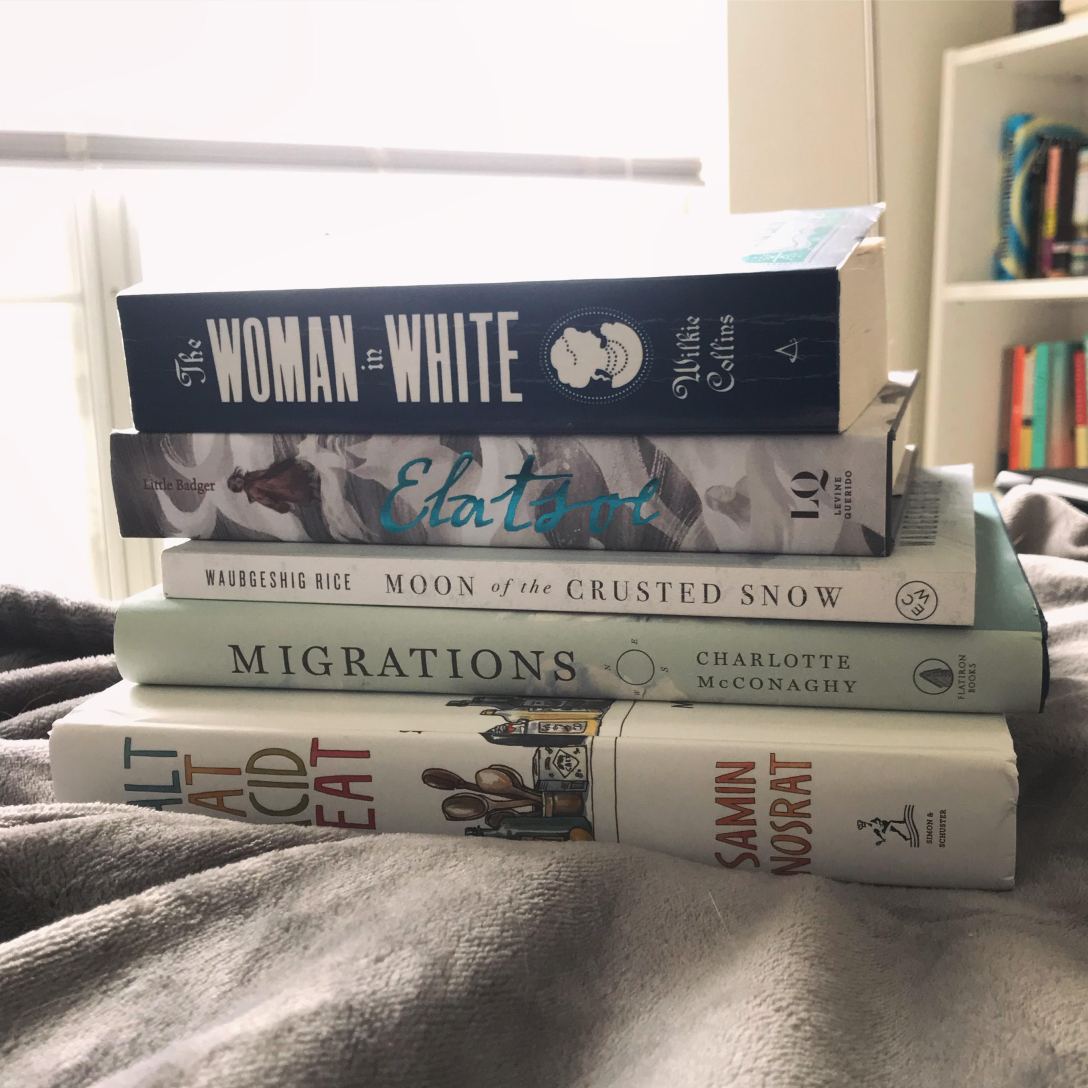
Between continuing to distance from others and the wintery weather, my reading was a major comfort and escape this month. I’m also happy with the diverse genres and authors I was able to read this month. I read two nonfiction books (one memoir and one cookbook), and two books by Indigenous authors, both of which work in favor of my 2021 reading goals. Here’s what I read: 

The Woman in White: Started off the year with an atmospheric, satisfying classic mystery. 

Elatsoe: Spooky magical YA by an Indigenious author. My only criticism is that this read VERY young to me. 

Moon of the Crusted Snow: actually a literary dystopian as promised (unlike Migrations) Written by an Indigenous author.

Migrations: The low point of my reading month. Do not recommend this one. Read my review.

Salt Fat Acid Heat: Mastering the Elements of Good Cooking: This made-to-be-read cookbook changes the food game! Check out my review.   

After the Eclipse: A Mother’s Murder, a Daughter’s Search (audiobook; not pictured); A heartbreaking memoir about the author’s mother’s murder. Also a criticism of the explorative nature of true crime as a genre. 

Review: Salt Fat Acid Heat: Mastering the Elements of Good Cooking by Samin Nosrat

Cookbook surrounded by cooking materials

VERDICT: 4 stars

Anna: This book will truly change how you cook! 

Salt Fat Acid Heat is a cookbook that is meant to be read. It first teaches you the science behind the four basic elements of cooking- salt, fast, acid, heat. There are then recipes in the back to put your skills to practice.

This book teaches you how to season from within with salt, how to properly use fat as a cooking medium or as a seasoning, how to balance meals with acid, and, finally, how to transform food with heat. 

My husband and I both love to cook, and we read this back to back, cover to cover. Samin inspired us to make immediate changes to our kitchen by investing in some new staples, reorganizing, and immediately putting her recipes and tips to the test.

Some tips of hers that I’ve been putting into practice are: to salt ahead of time and for as long as possible, to let meat come to room temperature before cooking, and to always heat my pan before adding anything. I’ve always been a fan of roasting veggies, but her simple tip of briefly boiling vegetables instead has been revolutionary!

My only complaint with this cookbook is that it is very meat-heavy. There are dozens of chicken recipes, specifically, which seems to be a favorite of Samin’s. To each his or her own, but as someone who favors vegetarianism, I’m a little disappointed with the overwhelming emphasis on meat.

Even so, I highly recommend you pick this up if you want to spice up your cooking!

Review: Migrations by Charlotte McConaghy

book with river behind it

VERDICT: 2 stars

Trigger warnings: Suicide, Sexual Assault

I’ve wanted to read Migrations since before its release. It has great ratings on Goodreads, which proves that you need to take ratings with a grain of salt. I did, however, see a 1 star review from a trusted reviewer. Because of the dystopian aspect, I wanted to read this for myself.

I was disappointed. 

The actual style of the writing is the only thing I liked about this book. It’s lyrical yet concise. But there are glaring holes in the world building and the plot. Then there’s the biggest problem-Franny.

Migrations alternates between two timelines: the past and present. In the present, almost all animals have gone extinct in the world. There aren’t many fish left, and people who still fish are hated. Franny worms her way onto a fishing ship to follow the last migration of Arctic Terns. She tells the captain she is an orithinogist, and that she thinks the Arctic terns will lead them to fish. She is right, for the most part, so she stays on the boat.

We are introduced to Franny’s tumultuous childhood in Ireland. Her mom disappeared when she was young, and she lived with her father’s mother in Australia. Back in Ireland, Franny sits in on at University and meets the love of her life- Insta love style. She and Niall marry immediately, but very quickly it’s a struggle for Franny to stay. 

Franny is the most unlikable narrator I have ever encountered. There is nothing redeeming about her. She is so chaotic that she’s not even a believable character. And the author’s excuse for her behavior? She’s a “wanderer”. She’s unable to stay in one place. Why? It’s in her blood.

SPOILERS: Franny’s defining character trait is violence. She sleepwalks and attempts to strangle Niall in her sleep. She’s in jail for  murder, and it’s unclear if it was on purposeful or not. She also managed to kill two more people over the course of the present narrative. And yet. Franny is a wonderful swimmer and saves multiple people from drowning over the course of the story as well. Her character is completely unpredictable but predisposed to destroy and leave. 

In the past, we know that Franny served time in prison. It’s eventually revealed why. She (accidently?) rammed headfirst into another car, killing Niall and the woman in the other car. Franny claims she did it on purpose. Then she reveals that she saw an owl, which distracted her from the road. Franny is an unreliable narrator, so we don’t really know. Which brings me to my next point. 

Niall, Franny’s husband, is seemingly okay with the fact that Franny will just leave him when she feels she has to. By the end, we are made to understand their relationship is like this-Franny is a wild thing, possibly a bird, possibly something else. She is untamed. Niall is a scientist and by trapping Franny, he’s able to study her closely. But Franny, being a wild thing, kills him in the end.

Franny succeeds(?) in following the birds to their last migration. destroying everything else around her in the process. She plans to spread Niall’s ashes into the sea there. She also plans on killing herself. She spreads the ashes, and then submerges herself, fully intending to end it. But she doesn’t. The book ends with her being released from prison for the second time of her life. Her dad, who has never been part of her life and who is a convicted killer herself, is waiting to pick her up. They drive off together.

Then there’s the complete and utter lack of worldbuilding. This is apparently set in the not-so-far future in which climate change and human behavior has made most animals in the world extinct. For some reason, fishermen have received the bulk of the blame for this act (maybe because there are still some fish in the ocean? It’s not very well explained). This could have been such a rich world and the extinction of the animals could have added another layer to Franny’s story. Instead, the state of the world is barely acknowledged throughout the story. 

Overall: With more developed worldbuilding, maybe I could have forgiven some of Franny’s erratic behavior in this book. Or maybe not. Either way, I don’t recommend reading this. Migration’s book description first reminded me of one of my favorite books, The Lightkeepers by Abby Geni. After reading Migrations, they can’t be compared. Save yourself the pain and read the Lightkeepers instead.