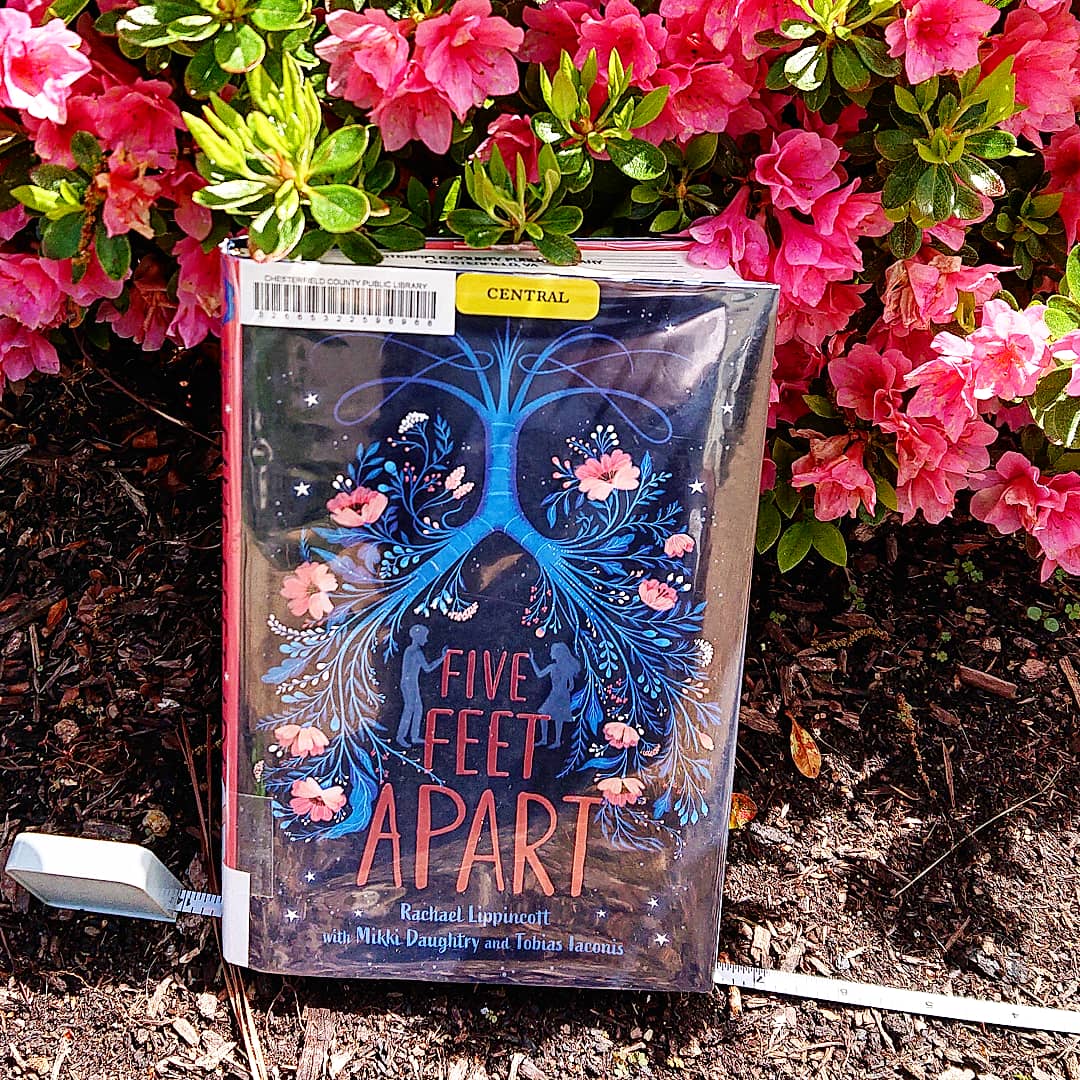
Review: Five Feet Apart by Rachael Lippincott

Alexis: Read 4/18/19

I was hesitant to read this. I put it on hold at the library so I would have time to think about it for a while, and a month later, I got an email that I could pick it up. And I decided, you know what? Why not!

For those of you who don’t know, last year, my lung spontaneously partially collapsed twice, a couple months apart. After the second one, I had surgery to adhere my lung to my chest wall so that it won’t ever happen again. But because of this, Five Feet Apart was super relatable for me. I found myself knowing how horrible it is not to be able to breathe, to literally feel your lung keep you from taking a deep breath as it fills your body with pain.

That being said, I do not have cystic fibrosis, and I can’t begin to know what it feels like to have a terminal illness. But this book brought back a lot of memories and feelings, and I identified with parts of Stella and Will’s ordeal.

Now, onto the review. I don’t have much to stay about the book other than well done. This is definitely this generation’s The Fault In Our Stars. The story is told from two different perspectives: Stella’s and Will’s. I love alternating POV’s and I found it worked really well for the story. And while I wasn’t a huge fan of Stella or Will’s characters at the beginning, I really enjoyed their journeys and their full character arcs by the end.

The writing style is very conversational. I enjoyed how the authors had the characters use so much modern technology because it felt very true to people/teenagers in real life. I will say that yes, parts of this book are cheesy, and yes, I guessed the ending halfway through. But Stella and Will’s relationship moves at an appropriate pace. I liked all of the characters’ backstories and motivations.

All in all, I think this is a solid YA read that achieves awareness of cystic fibrosis while telling a good story. I’m excited to watch the movie!

VERDICT: 4 ½ stars

Review: Lab Girl by Hope Jaren

Anna: Welcome to my April memoir review! This month my memoir of choice was Lab Girl by Hope Jahren. I thought this called for feet and green tea.

I’m really enjoying the challenge I’ve seemed to have given myself in 2019 of reading a memoir a month! I’m finding memoirs particularly enjoyable to listen to on audiobook, because I can easily listen to them at work. I listened to Lab Girl this way!

I found Hope’s life fascinating. Her love of science is so beautifully described—she thinks and writes so differently than I’m used too. There are breathtaking descriptions of trees and plants, which I found peaceful (although sometimes they made me a little sleepy!) I also liked how Jahren framed the narrative events of her life around chapters of release plant studies. My reading taste however, craves narrative, and I think what I enjoyed most were the scenes of Hope and Bill’s quirky friendship and the descriptions of her Scandinavian family.

Something that bothered me was Jahren’s use of dialogue tags that weren’t “said.” “Said” is, in my opinion, the only necessary dialogue tag 90 percent of the time, and I find other tags endlessly distracting, and this was especially the case in this book. All the “replies” “answered” “sighed” etc. in this really stuck out to me! This is quite the pet peeve, I know, but this is something I couldn’t avoid noticing on audio.

As a person who studied English and works in book publishing, the value of scientific research is something I take for granted. I read memoirs about writers all the time, something I never really realized until this book. Lab Girl reminded me of the importance of science in our world. Something Jahren repeatedly talks about is the fact that scientists don’t receive enough funding to carry out expensive and necessary research. This is something I knew but honestly never think about. Lab Girl helped me realize the importance of scientific funding and has even made me look at trees differently.

VERDICT: 3.5/5 trees


Review: Cruel Beauty by Rosamund Hodge

Alexis: Read 4/16/19

Why do I always really enjoy the first half of a book, only to really dislike the second half? That’s how I felt about Cruel Beauty.

Cruel Beauty is a Beauty and the Beast retelling. I’m a fan of fairytale retellings, and I actually took a seminar on Beauty and the Beast while I was in college. But what’s different about this retelling is that it blends the fairytale with Greek and Roman mythology and history.

The story is set sometime after the fall of Rome in Romana-Graecia, in a fictional land called Arcadia that was cut off from the rest of the world and held captive underground by the Gentle Lord. The Gentle Lord makes cruel bargains with the people of his land and sometimes sets his demons on them. The Greek and Roman influence was an interesting change of pace, as the original Beauty and the Beast story is from France. I love Greek mythology, and I loved the mix of Latin and Greek terms, history, and terminology. The stories told in the book took me back to my Latin classes.

In this book, the magic is called the Hermetic arts. The main character, Nyx, was trained by her father in this art, which is connected to the four elements. Nyx can use sigils to sort of control the “hearts” of each symbol. While this sounds interesting, not only was the magic never explained any deeper, but it was never useful in the story.

Here’s a basic outline of the plot: When Nyx’s parents couldn’t have children, Nyx’s father made a bad bargain with the Gentle Lord. Nyx’s mother bore twins but died in childbirth. The Gentle Lord required that Nyx be married to him, while Nyx’s sister could live free for the rest of her life. So the book opens up with Nyx marrying the Gentle Lord, who’s also called Ignifex.

I really did enjoy the first half of the book. All of the original aspects of Beauty and the Beast are there: the roses, the mirror, the enchanted castle, the question every night, and a beastly prince of sorts. Nyx’s mission is to kill Ignifex in order to save her land from his terrible reign. The first half focuses on her exploring the castle and trying to find its Hermetic hearts, which was my favorite part of the story.

I wasn’t a huge fan of Nyx, who mostly complained about her tragic fate and battled with her intense hate for her family and Ignifex. But I appreciated that she was a strong female character who made her own choices and expressed her strong emotions. Her relationship with her sister was weird, and as a twin myself, it didn’t feel like a true twin relationship, though some of it was intentional due to the characters’ circumstances. To be honest, I wasn’t a huge fan of any of the characters except for Shade.

As for the second half, there’s a really weird love triangle that didn’t work for the story. The plot starts to go downhill and then becomes convoluted. Nyx and Ignifex’s relationship is abusive, with Nyx hitting him basically every chapter and Ignifex being emotionally abusive. Nyx remembers an important plot-point only to forget about it until the very end, which was supremely annoying. There’s no clear antagonist. And the ending has a weird alternative time thing that’s even hard to describe.

I obviously have a lot of thoughts about this book. I was pleasantly surprised by the first half and disappointed in the second half. If the ending was different, this would’ve been a solid read!

VERDICT: First half: 4 stars

Second half: 2 stars

Total: 3 stars

Review: Idlewild by Nick Sagan

Alexis: Read 4/7/19

A teenager wakes up in the middle of a pumpkin patch with amnesia. He doesn’t know who he is, where he is, or what’s going on. He only knows that he was shocked so badly that he couldn’t move, causing his amnesia, and that he knows someone named Lazarus is dead, and someone just tried to kill him, as well.

Idlewind is like a mix between The Matrix and The Maze Runner. I don’t usually go for sc-fi, but I found myself enjoying the change of pace. I truly loved the beginning of the book. I found it really original and creative, and I enjoyed Sagan’s worldbuilding. I loved learning about Halloween’s character alongside him as his memory slowly started to resurface. I liked Sagan’s conversational writing style and I found Halloween’s gothic character interesting.

I also enjoyed the structure of the book. The majority of the book is in first person from Halloween’s POV, while excerpts in the beginning of each chapter focus on characters from the past. Sections called “Pace Transmission”s intersect the chapters. At first, these make no sense, but I found them helpful as the book progresses.

It’s hard to talk about this book without giving anything away. I feel like it’s best to go into it without knowing much. My overall consensus of the book is that I loved the first ¾ of it, including the plot twists and reveals, but thought the ending fell flat. I also wasn’t a fan of how the characters progressed, and I also didn’t like the characterizations of the female characters. In that regard, Idlewild feels very early 2000’s.

However, if you’re in the mood for a creative, apocalyptic sci-fi read with a large dash of virtual reality, I definitely recommend it. Most of the book was 4 stars for me, but the ending knocked it down ½ a star.

VERDICT: 3 ½ stars


SPOILERS BELOW:


My biggest issue with the ending was the reveal of Mercutio as Lazarus’ killer. I felt like there wasn’t any buildup or real evidence or motivations for this to make sense. I also didn’t feel like I knew the secondary characters well enough, especially since Halloween himself was still figuring everyone else out. Because of this, Simone and Mercutio’s deaths didn’t affect me, and I’m not really sure I want to continue reading the series. Halloween’s reaction to the ending felt a bit melodramatic, even for his already melodramatic character.

Review: King of Scars by Leigh Bardugo

Alexis: Read 3/24/19

I loved the first half of this book. I loved Nikolai’s internal (and sometimes external) battle within himself. I enjoyed learning more about Zoya: her past, her innermost feelings, her motivations. And at first, I rejoiced in Nina’s chapters, especially after her ending in Crooked Kingdom.

King of Scars is told in third person from various perspectives, including Nikolai, Zoya, Nina, and a man named Isaak. I’m glad Bardugo decided on third person, as I think it worked perfectly for the world in Six of Crows, and ultimately served a better purpose than the first person of the Shadow and Bone Trilogy.

I enjoyed the masterful worldbuilding and name dropping of characters from previous books. Bardugo has really cemented the Grishaverse. And I really enjoyed how the plot was building. However, the second half started to meander. Zoya ended up being the primary character, rather than Nikolai himself. The book’s title is literally Nikolai’s nickname, and yet he sometimes gets lost in the sea of other characters.

I honestly wanted to skip over Isaak’s chapters; I felt like his information could have been revealed later and it would have served the book better, even if the the reader wouldn’t get to know him as a character. But I really just didn’t care about him.

Nina’s chapters began to feel drawn out. As much as I enjoy her as a character, I found myself wanting to stay with Zoya and Nikolai’s storylines. I almost wanted Nina’s chapters to be separated from the rest of the story, maybe as its own short book.

My primary concern, besides Nikolai not being as center stage as I wanted him to be, was where the plot ended up. It was building up to such a great place, but then the ending ruined it for me. I’ll avoid spoilers here and go more into that below.

This book definitely felt like a follow-up to the Shadow of Bone trilogy, which I didn’t like nearly as much as the Six of Crows duology. I was hoping for more of a Six of Crows feel, with the masterfully crafted plot and characters. I just wish the book had only switched in POV from Nikolai to Zoya and that the plot was…different. Even with my mixed feelings, I still love the characters and Bardugo’s world, and I flew through this book.

The first half of the book: 5 stars. Second half: 3 stars

VERDICT: 4 stars

 
SPOILERS BELOW:

I felt like most of the plot reveals in the second half of the book were a little too coincidental. Hanne just happens to be the daughter of Brum? The Saints just happen to be alive with the answers to a greater power for Zoya? And the biggest of all: the Darkling’s comeback. It felt like a cop-out to me. I wanted something as equally as dark to be the main antagonist, but I wanted something different. The Darkling’s story was supposed to be over. With all the tumultuous politics going on, I just felt like the ending could’ve gone in a different and better direction.


Review: The Afterlives by Thomas Pierce

Alexis: Read 3/7/19

This book had an interesting premise, so why not check it out? After a cardiac arrest episode that leaves him legally dead, Jim Byrd lives with a device called the HeartNet. The HeartNet will continue to pump his heart if another cardiac arrest occurs. But now Jim is faced with his own mortality, and can’t help thinking about the afterlife. He and his new wife, Annie, try to figure out the afterlife by attending a new church called the Church of Search, by ghost hunting, and by tracking down a woman who claims she has a machine that will allow you to talk to the dead.

The story is in first person, told by Jim himself. But snippets of the past intersect his story. These snippets are in third person, following a cast of characters who lived in an old house, which is now a haunted restaurant. Jim and Annie aren’t sure why the house is haunted, though one of the house’s former owners, Clara, had a dog who died in a fire. I really liked these snippets into the past and thought it was an interesting choice to include them in the story.

I also really enjoyed Pierce’s writing style. His writing is conversational, and his sentences all have a pleasing cadence. Every character is a round character, with their own idiosyncrasies and passions and opinions on the afterlife.

The book has a small frame that mimics stage directions of a play. I found this fitting, as Annie is a playwright:

“Exit heartbeat. / Exit breath. / Exit every mood, every memory. / Exit you. / To where” (3)?

I enjoyed the sections about the ghost hunt, the machine, and Jim’s musings on life and death, which includes heart worries and panic attacks. There wasn’t much of a plot, and a lot of the middle section was spent on interactions with minor characters and minor plot points. Most of the book almost felt like a memoir or character study of Jim’s life. I enjoyed the beginning and the end, but I felt like 100 pages could’ve been cut out of this book and it would’ve made it more impactful.

The book also takes on a sci-fi edge, with the machine and the inclusion of holograms becoming a part of normal life. The book stretches over decades of Jim’s life, including decades into the future, but I found the holograms an odd choice for the book. Maybe they’re supposed to be symbols, like ghosts, in between life and death?

VERDICT: 3 out of 5 books

Review: Nevermoor by Jessica Townsend

Nevermoor is the first installment in a series about Morrigan Crow, who was born on Eventine, the unluckiest day. Morrigan is cursed to die on midnight of her eleventh birthday. Morrigan is blamed for every misfortune in the town, and she’s kept at arm’s length from everyone, including her family. Before the clock can strike midnight on Eventide, she’s swept away to a magical land called Nevermoor by an equally magical man, Jupiter North. Jupiter prepares Morrigan to compete in four trials that, if she’s successful, will grant her entrance into the legendary Wundrous Society.  

Before reading this, I’d heard Nevermoor compared to Harry Potter, and this is true in a lot of ways (although let’s be honest, nothing can ever truly compare). Nevermoor feels like a mix of The Sorcerer’s Stone and The Goblet of Fire, because of Morrigan’s introduction to magic at age 11, and the trials being like a less deadly Triwizard Tournament. The magic system is difficult to summarize. It feels more eclectic than The Wizarding World. I’ve also heard Nevermoor called a mix of Harry Potter and Alice in Wonderland, which I’d call accurate. We also know that there is going to be a special magic school down the line. Jupiter is also a very Dumbledore-y character, as her mentor, and someone who is obviously keeping secrets from Harry. I mean, Morrigan.

Moving on from Harry Potter!

Townsend is a great writer. Nevermoor is fantastically and colorfully written. It’s clever, hilarious, and by far the most creative fantasy I’ve read in a long time. It has great worldbuilding, but still leaves much more to be explored in later books.


I love Morrigan as a character, which is one of the reasons Nevermoor is so compulsively readable. Before Nevermoor, she has never known love. She has been shamed and ostracized by her family for her entire life. She just wants a place to belong. As I mentioned before, It did get a little annoying that Jupiter keeps her in the dark for so much of the book (ahem, Dumbledore) but I understand why that this needs to happen plot-wise. The villains are sufficiently creepy and well-developed, as are the quirky host of characters in the Hotel, and Morrigan’s two close friends, Hawthorne and Jack.

Despite the fact that it’s middle grade, Nevermoor tackles dark themes, such as abuse and death. There’s also a lot of commentary for adults that I never would have picked up on as a kid, such as the discussion of illegal immigration. There’s a scene on page 428 when the Wunderground is experiencing technical difficulties that mirror the MTA subway delay announcements so much that they had me cracking up.

Most importantly, Nevermoor is filled with memorable magic and a story that I can’t wait to keep reading! My one concern is that it’s going to be difficult for the following books in the series to live up to the standard of book number one!


VERDICT: 4.5 out of 5 books

Review: Caraval by Stephanie Garber

Alexis: Read 3/2/19

Unfortunately, I found Caraval so much worse than The Night Circus. I know a lot of comparisons have been drawn between the two books, so I thought I would give you my own.

The Night Circus is beautifully written, with lush and lyrical descriptions, but is very slow moving and has a sparse plot. I can’t say the same thing about Caraval’s writing. It felt middle-grade (and not in a creative way) and cliché. However, it is fast-paced and there is a layered plot. Both books have insta-love, though I have to say the relationship in Caraval actually felt more convincing.

So let’s delve more into Garber’s writing. Throughout the book, she relies on one particular, peculiar type of metaphor: the insert color was insert emotion. Here’s an example: “…a blaze of shimmery gold, the color of magic and wishes and promises of things to come” (14). Here’s another: “A ruby welt bloomed across his cheek. The color of rage and punishment” (45). Here’s a third: “…a rich cerise—the color of seduction and secrets” (660).

I usually love repetition, whether in motifs, anaphora, etc. But the repetition of these metaphors drove me crazy. They’re cliché and terrible and made me say “really??” out loud too many times. And none of them even made sense!

Another thing that drove me crazy was that half of the plot was predictable. You know from the beginning that Scarlett is going to get together with Julian. There was only one plot point towards the end that I didn’t see coming.

As for the characters, I only liked Julian, but only because he’s the only character with somewhat of an interesting personality. He’s your classic “dark and handsome but is he good or bad?” type of guy with Edward-Twilight caramel eyes: “light brown, the color of caramel and liquid amber lust” (172). The descriptions of him were super cringey.

I found Scarlett to be too whiny and annoying, and Donatella wasn’t much better. Even their names seemed to get in the way of the story; it was as if their names drew too much attention from it. It doesn’t help that Scarlett’s name is also a color, so her name is thrown around with all of the cringey color metaphors. One of the characters even says of Scarlett, “You’re so dramatic, you would’ve made a fantastic performer” (308). And god, was he right.

The dialogue doesn’t have any subtext. I absolutely hated that Governor Dragna is described as dragon-like. And I could’ve cared less about the plot of this book.

I think the one word that sums up this book is cringeworthy. I really wanted to like it, I enjoyed how the book opened up with letters, and I initially though Garber’s worldbuilding was good (in the first 10 pages). But this obviously wasn’t the book for me.

VERDICT: 1 and ½ out of 5 books

Review: Ruin and Rising by Leigh Bardugo

Alexis: Read 2/20/19

Ruin and Rising was certainly the best book of the Shadow and Bone Trilogy. I disliked Alina’s character in the first two books, and I felt like she became a more complex character in this one. Additionally, Mal had zero personality in the first two books, and he felt more real to me in Ruin and Rising, as well.

Everyone can agree with me here: Nikolai is still the most vibrant character. He has a sparkling personality and he knows what he wants. He echoes the beginning of Bardugo’s masterfully crafted characters in the Six of Crows series.

As for the plot, I feel like the first half of the book meanders. There’s a whole host of secondary characters that I didn’t really care about, except for Genya.

And time for an unpopular opinion: I don’t like the Darkling. He’s creepy, manipulative, and honestly rapey. His beauty doesn’t make up for that.

SPOILERS BELOW:

Okay, so I really enjoyed the plot twists in the second half of the book. Mal being the third amplifier? Nikolai getting turned into a monster? I didn’t see either of those coming, and it made the book more exciting!

The ending felt very Hunger Games to me: boy and girl get together and live a nice, normal life together, where they can grieve together forever. I honestly didn’t mind the ending, as I think it was the happiest ending for Alina and Mal. But Alina losing her power was anticlimactic and confusing. It felt unnecessary. Plus, she had such a good character arc by Ruin and Rising that I felt it was unfair for her to return to how she was in the beginning of the series.

Despite some of my issues with this book, I really enjoy the Grishaverse and I couldn’t put this book down. I enjoyed seeing Bardugo’s writing style evolve!

VERDICT: 4 out of 5 books

Review: My Absolute Darling by Gabriel Tallent

Anna: I’m finding this book very difficult to review. I love how detail-oriented the writing is and how Turtle’s internal dialogue dominates and drive the narrative. However, this book is hard to get through because of the horrific violence.

This is a survival/escape story. Strong warning for sexual, emotional, and physical abuse.

Tallent does a great job of building Turtle as a character, and we see her grow throughout the book. Turtles self-deprecating internal dialogue is really unique and shows the true impact of her dad’s abuse.

Turtle slowly realizes the extent of her father’s abuse. Part of what makes her realize she needs to leave is when she gets her period and therefore realizes she can get pregnant. She also helps realize that she needs to leave through her relationships with other characters, as she was isolated from other people for so long. Her romantic relationship with Jason is obviously a big part of this, too.

I like how Turtle ultimately defeated/escaped Martin with a skill that he taught her, i.e. shooting. It’s also her final revenge for so many things that he forced her to do, like making her shoot Cayenne. This showdown in also foreshadowed in the way that Turtle takes meticulous care of her gun and her knife, while Martin is so careless with his. It feels like Turtle finally takes ownership of herself. It feels full-circle.

I liked the ending. The fact that Turtle can’t even think about progressing in her relationship with Jason is realistic and I’m so glad Tallent ended it that way. I wouldn’t have believed it if they’d had a fairytale ending and if Turtle could automatically express her love for him. This also shows, like with the last scene with Anna and Turtle, that it’s going to take time for Turtle to recover from what’s happened to her, and that she never completely will.

Here’s what I had problems with:

There are lots of moments when it’s very apparent that the author is an adult male writing about prepubescent female anatomy, which honestly creeps me out. The way Turtle gets her first period IS NOT REALISTIC AT ALL. I thought she was having a miscarriage! There are so many scenes that are so cringy and obviously written by someone who does not possess female anatomy.

What in the world happened with the ocean, when Turtle and Jason got sucked out to sea? That scene is so abrupt and confusing that I had no idea what was happening, and I actually thought they were getting caught in a tsunami! Though I see the merit of stranding Turtle and Jason together on a cliff to grow their relationship, I still found this whole scene unnecessary and distracting (and not to mention so confusing). We know Turtle is tough and can survive in the wild and we don’t need to see it again here. I think a quieter bonding scene between Turtle and Jason would have been more effective.

I think there needed to be more Anna and Caroline. Both these women are presented as mother figures, yet they’re hardly developed. Anna’s character especially isn’t believable. As soon as she was introduced as the caring teacher I knew she would be the savior in the end. But then she’s hardly in the rest of the book, and she doesn’t even try to do anything when Turtle just disappears from school!

I wanted more about what happened to Turtle’s mom as well as more about the general past. For instance, Martin kept referring to another time when Turtle ran away, but we never get to see it as a reader. We’re told that Turtle’s mom killed herself to escape from Martin’s abuse, but that’s it. That’s also why I didn’t believe the bits about Caroline. If she was so close to Turtle’s mom, she had to have suspected something!

Mostly glaringly, there are bits of this book that feel violent for the sake of being violent. I think there’s a fine line between showing how something really is to bring light to an issue and exploiting it. Though Martin is clearly an awful person, this book sometime toed that line. Everything is shown to the reader, and it’s horrifying.

While I found I couldn’t put this down, there were aspects of this book that are so repelling and misguided that I can’t stand behind the book as a whole. I would love to hear other opinions from people who have read this!

VERDICT: 3 stars