Review: Honeysuckle Holiday by Kathleen M. Jacobs

Alexis: Read 3/11/19

*The author sent me a copy of her book in exchange for an honest review.*

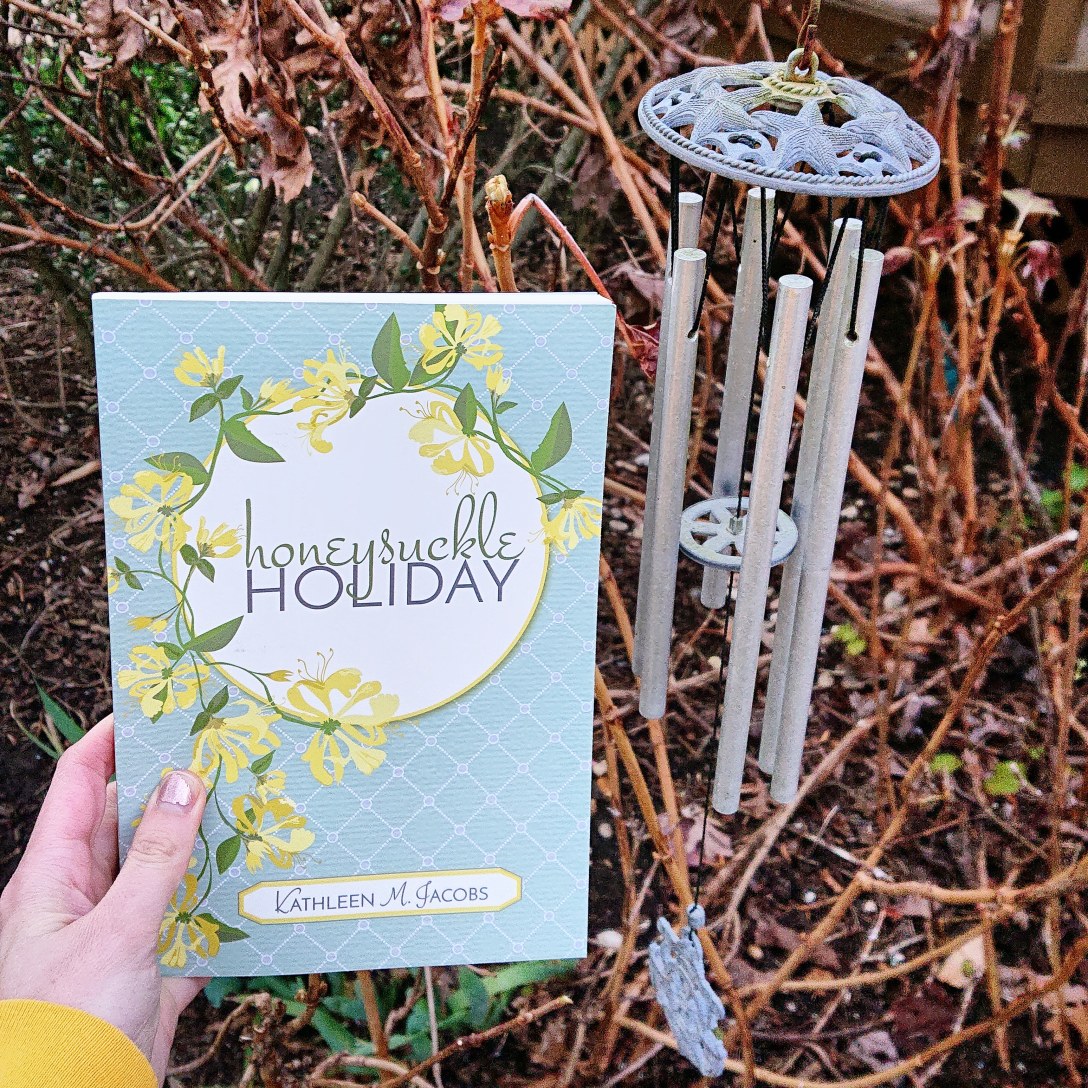
Honeysuckle Holiday was such a poignant read. Don’t let the cover fool you: this short book tackles childhood innocence and racism.

The story follows Lucy in two different time periods: 1965 and 1970, when she was twelve and sixteen-years-old. Though Honeysuckle Holiday is categorized as YA, I would describe it more as a bildungsroman/coming-of-age story. When Lucy’s father leaves, not looking back, on Christmas Day, she and her older sister, Caroline, try not to dwell on it too much. But she knows something has changed when her mother refuses to talk about him and when they have to move into a different house.

In her acknowledgements, Jacobs quotes a woman named Peggy Fox: ‘“You captured the voice of a twelve-year-old girl very well.’” And she’s right. Jacobs’ writing flows beautifully, but I was very aware that I was reading in the perspective of a twelve-year-old.

Lucy notices everything around her. She relates things to her Barbie dolls, which she admits she’s starting to outgrow. She is jealous of some of Caroline’s things but also wants to be like Caroline when she grows up. She partly knows why her dad left but is partly left in the dark. She’s curious about the world around her and asks lots of questions. Jacobs’ detailed descriptions mimic Lucy’s curious mind. I also like how she includes a lot of parenthetical phrases, as Lucy has a lot of afterthoughts.

I love all of the references Jacobs includes in her book. Lucy’s mother wears Chanel No. 5. Lucy uses a Velveeta box to hold her collection of found objects. The characters reference It’s A Wonderful Life, The Beatles, and TV shows of the time. These references cemented the story into its setting and time period, bringing it to life.

Lucy mentions To Kill a Mockingbird multiple times, and even relates herself to Scout. I found this fitting, as the story reminded me a lot of To Kill a Mockingbird. Both are told from a young perspective, but are really told for a more mature audience. Both deal with racial tensions and divides, as well as the horror of the KKK. I loved Jacobs’ inclusion of descriptions of food. The book is set in the South, and I enjoyed reading about Lila’s apple pies, okra, and Lucy’s love of steak.

While I liked how Lucy describes the honeysuckle vines ( as well as the smell) outside of her window, I don’t think the title of the story sums it up very well. Though the story itself was impactful, the title was not. To me, the honeysuckle symbolizes Lucy’s childhood innocence, and the book is about coming-of-age and losing that behind. I’m also not sure why the first couple of chapters are in Caroline’s POV.

Overall, if you’re looking for a quick read that’s packed with vivid details, that will draw you into the 60’s and 70’s, and whose message will stay with you, then I definitely recommend it.

VERDICT: 4 out of 5 books

Review: The Afterlives by Thomas Pierce

Alexis: Read 3/7/19

This book had an interesting premise, so why not check it out? After a cardiac arrest episode that leaves him legally dead, Jim Byrd lives with a device called the HeartNet. The HeartNet will continue to pump his heart if another cardiac arrest occurs. But now Jim is faced with his own mortality, and can’t help thinking about the afterlife. He and his new wife, Annie, try to figure out the afterlife by attending a new church called the Church of Search, by ghost hunting, and by tracking down a woman who claims she has a machine that will allow you to talk to the dead.

The story is in first person, told by Jim himself. But snippets of the past intersect his story. These snippets are in third person, following a cast of characters who lived in an old house, which is now a haunted restaurant. Jim and Annie aren’t sure why the house is haunted, though one of the house’s former owners, Clara, had a dog who died in a fire. I really liked these snippets into the past and thought it was an interesting choice to include them in the story.

I also really enjoyed Pierce’s writing style. His writing is conversational, and his sentences all have a pleasing cadence. Every character is a round character, with their own idiosyncrasies and passions and opinions on the afterlife.

The book has a small frame that mimics stage directions of a play. I found this fitting, as Annie is a playwright:

“Exit heartbeat. / Exit breath. / Exit every mood, every memory. / Exit you. / To where” (3)?

I enjoyed the sections about the ghost hunt, the machine, and Jim’s musings on life and death, which includes heart worries and panic attacks. There wasn’t much of a plot, and a lot of the middle section was spent on interactions with minor characters and minor plot points. Most of the book almost felt like a memoir or character study of Jim’s life. I enjoyed the beginning and the end, but I felt like 100 pages could’ve been cut out of this book and it would’ve made it more impactful.

The book also takes on a sci-fi edge, with the machine and the inclusion of holograms becoming a part of normal life. The book stretches over decades of Jim’s life, including decades into the future, but I found the holograms an odd choice for the book. Maybe they’re supposed to be symbols, like ghosts, in between life and death?

VERDICT: 3 out of 5 books

Review: Nevermoor by Jessica Townsend

Nevermoor is the first installment in a series about Morrigan Crow, who was born on Eventine, the unluckiest day. Morrigan is cursed to die on midnight of her eleventh birthday. Morrigan is blamed for every misfortune in the town, and she’s kept at arm’s length from everyone, including her family. Before the clock can strike midnight on Eventide, she’s swept away to a magical land called Nevermoor by an equally magical man, Jupiter North. Jupiter prepares Morrigan to compete in four trials that, if she’s successful, will grant her entrance into the legendary Wundrous Society.  

Before reading this, I’d heard Nevermoor compared to Harry Potter, and this is true in a lot of ways (although let’s be honest, nothing can ever truly compare). Nevermoor feels like a mix of The Sorcerer’s Stone and The Goblet of Fire, because of Morrigan’s introduction to magic at age 11, and the trials being like a less deadly Triwizard Tournament. The magic system is difficult to summarize. It feels more eclectic than The Wizarding World. I’ve also heard Nevermoor called a mix of Harry Potter and Alice in Wonderland, which I’d call accurate. We also know that there is going to be a special magic school down the line. Jupiter is also a very Dumbledore-y character, as her mentor, and someone who is obviously keeping secrets from Harry. I mean, Morrigan.

Moving on from Harry Potter!

Townsend is a great writer. Nevermoor is fantastically and colorfully written. It’s clever, hilarious, and by far the most creative fantasy I’ve read in a long time. It has great worldbuilding, but still leaves much more to be explored in later books.


I love Morrigan as a character, which is one of the reasons Nevermoor is so compulsively readable. Before Nevermoor, she has never known love. She has been shamed and ostracized by her family for her entire life. She just wants a place to belong. As I mentioned before, It did get a little annoying that Jupiter keeps her in the dark for so much of the book (ahem, Dumbledore) but I understand why that this needs to happen plot-wise. The villains are sufficiently creepy and well-developed, as are the quirky host of characters in the Hotel, and Morrigan’s two close friends, Hawthorne and Jack.

Despite the fact that it’s middle grade, Nevermoor tackles dark themes, such as abuse and death. There’s also a lot of commentary for adults that I never would have picked up on as a kid, such as the discussion of illegal immigration. There’s a scene on page 428 when the Wunderground is experiencing technical difficulties that mirror the MTA subway delay announcements so much that they had me cracking up.

Most importantly, Nevermoor is filled with memorable magic and a story that I can’t wait to keep reading! My one concern is that it’s going to be difficult for the following books in the series to live up to the standard of book number one!


VERDICT: 4.5 out of 5 books

Review: Caraval by Stephanie Garber

Alexis: Read 3/2/19

Unfortunately, I found Caraval so much worse than The Night Circus. I know a lot of comparisons have been drawn between the two books, so I thought I would give you my own.

The Night Circus is beautifully written, with lush and lyrical descriptions, but is very slow moving and has a sparse plot. I can’t say the same thing about Caraval’s writing. It felt middle-grade (and not in a creative way) and cliché. However, it is fast-paced and there is a layered plot. Both books have insta-love, though I have to say the relationship in Caraval actually felt more convincing.

So let’s delve more into Garber’s writing. Throughout the book, she relies on one particular, peculiar type of metaphor: the insert color was insert emotion. Here’s an example: “…a blaze of shimmery gold, the color of magic and wishes and promises of things to come” (14). Here’s another: “A ruby welt bloomed across his cheek. The color of rage and punishment” (45). Here’s a third: “…a rich cerise—the color of seduction and secrets” (660).

I usually love repetition, whether in motifs, anaphora, etc. But the repetition of these metaphors drove me crazy. They’re cliché and terrible and made me say “really??” out loud too many times. And none of them even made sense!

Another thing that drove me crazy was that half of the plot was predictable. You know from the beginning that Scarlett is going to get together with Julian. There was only one plot point towards the end that I didn’t see coming.

As for the characters, I only liked Julian, but only because he’s the only character with somewhat of an interesting personality. He’s your classic “dark and handsome but is he good or bad?” type of guy with Edward-Twilight caramel eyes: “light brown, the color of caramel and liquid amber lust” (172). The descriptions of him were super cringey.

I found Scarlett to be too whiny and annoying, and Donatella wasn’t much better. Even their names seemed to get in the way of the story; it was as if their names drew too much attention from it. It doesn’t help that Scarlett’s name is also a color, so her name is thrown around with all of the cringey color metaphors. One of the characters even says of Scarlett, “You’re so dramatic, you would’ve made a fantastic performer” (308). And god, was he right.

The dialogue doesn’t have any subtext. I absolutely hated that Governor Dragna is described as dragon-like. And I could’ve cared less about the plot of this book.

I think the one word that sums up this book is cringeworthy. I really wanted to like it, I enjoyed how the book opened up with letters, and I initially though Garber’s worldbuilding was good (in the first 10 pages). But this obviously wasn’t the book for me.

VERDICT: 1 and ½ out of 5 books

Review: The Night Tiger by Yangsze Choo

Alexis: Read 2/27/19

The Night Tiger is a fascinating blend of magical realism, historical fiction, romance, and murder mystery. It follows two main characters: Ji Lin and Ren. Ji Lin is the apprentice of a dressmaker who is also secretly a dance-hall girl. Ren is an eleven-year-old houseboy who recently switched masters due to his old master’s death. Their lives come together when Ji Lin finds a severed finger and tries to figure out where to return it.

I love that the book is set in 1930’s colonial Malay, now modern Malaysia. This makes for a rich and cultural setting, and I loved reading about the different languages spoken and the foods eaten. I loved Choo’s descriptions of clothing from Ji Lin’s point of view, and how she showed England’s rule and influence over the culture of Malay.

Throughout the book, Choo focuses on the superstitions based on chinese numbers, as well the folklore of weretigers. She even includes a section explaining these at the end of the book, which I wish were placed before the book as pretext, but I still appreciated her including them at all.

The first 30 pages were a little slow, and I had to get used to Choo’s writing style and tone. But then I was hooked. This isn’t a fast-paced book, and the mystery is revealed slowly. Though the main plot is fairly slow, there were enough subplots to hold my attention.

I loved Ji Lin as a character. She’s a classic modern day heroine in 1930’s Malaysia, yet she also fits in perfectly in the time period. She’s intelligent and clever and isn’t afraid to speak her mind. Yet, unlike where a lot of strong female characters seem to fail, she is still feminine and caring. I also really enjoyed Shin, her step brother’s, character. I found he and Ji Lin to have a lot of chemistry, and I found their relationship moved in a natural direction.

What I didn’t like about the book: the switching POVs. Ji Lin’s chapters were first person, past tense, while Ren’s chapters were in third person, present tense. And every once in a while, I was thrown into William Acton’s POV (Ren’s new master). It would have served the book better if both Ji Lin and Ren’s chapters were in first person, or, honestly, if the whole book was in Ji Lin’s perspective. Sometimes Ren felt like an afterthought.

I really enjoyed The Night Tiger’s setting, atmosphere, and characters. I wish the ending had tied up some of the loose ends, but overall, this was an interesting and unique read. Just don’t read it if you get queasy at the mention of severed fingers!

VERDICT: 4 out of 5 books


SPOILERS BELOW:

I’m not really even sure how to address the twin issue. Why do authors always feel like one of the twins has to be dead? I enjoyed Ren’s “cat whiskers” sense, but Yi’s role in the story was kind of “eh” for me.

I actually really liked the fact that Ji Lin and Shin fell in love. Their relationship, and the progression of their relationship, felt very real to me, and I loved the dynamic. I didn’t find it weird because they were so close and important to each other and not actually related.

However, I wasn’t a fan of how Shin’s character progressed. He professed his love for Ji Lin, only to beg her to have sex with him…? It felt completely out of character, as Shin was nothing but respectful towards Ji Lin, and even though he was portrayed as a womanizer, I knew from the beginning that it was obviously just a front. I felt like their almost-bedroom scene could have gone very differently. But, in the end, I was glad Ji Lin stood up for herself and decided to wait on marriage and pursue a career. It felt true to her character.


Review: Bluebird, Bluebird by Attica

Anna: This month, my fiancé and I read Bluebird, Bluebird by Attica Locke. This is the first in a new noir series about Darren Matthews, a black Texas Ranger in East Texas. Darren’s job is on the line when he is sent to the rural town of Lark to investigate the murder of two people, a black lawyer and Chicago-resident Michael Wright, and a local white woman named Missy Dale. The people of Lark are frustratingly secretive. To further complicate things for Darren, Michael’s wife, Randie, is already trying to find out what happened to her husband.

Bluebird, Bluebird is about race, family, and justice. While I found all the topics important and the plot okay, I wasn’t thrilled by the writing style, which is why I ultimately gave the book three stars. Most of the characters felt glaringly one dimensional, especially the women.

The weakest character is Lisa. Not only is she extremely one dimensional and mostly nonexistent, but she’s the stereotypical “wife”. She’s mad at Darren because he just wants to ”roam” and live his life and she just wants him to come home and be safe. Um, no. I know this takes place in the south, but still. You’d think a man wrote this.


This use of recall and memory also made it hard to care about some of the secondary characters like Joe and Joe Junior. The reader never sees them, and their stories are told in such an indirect way that I found it hard to care.

The writing in general is super tell-y. I felt I was being alternately spoon fed and smacked over the head while being told, “this is what this means!” I would have liked to draw these conclusions myself.

One of my huge pet peeves in books is when a twin dies and the other twin is dating the dead twin’s former lover. Ahem, J.K. Rowling, I’m looking at you. As a twin, this is super annoying because TWINS AREN’T INTERCHANGEABLE. In this book, Darren’s twin uncles, William and Clayton, raised him. His Uncle William is dead, and William’s wife Naomi is dating Clayton now. I hate this.

Here are some things I did like:

The discussion of race relationships and how the justice system treats black people unfairly.

The fact that Randie and Darren didn’t fall in love. I would have just stopped reading then and there if that happened.

That Darren had noticed the tree in his yard where Mack had buried the gun, but left it alone. I think that was a great twist and a clever way to end the book and say that justice is complicated.

VERDICT: 3 out of 5 books

Review: Ruin and Rising by Leigh Bardugo

Alexis: Read 2/20/19

Ruin and Rising was certainly the best book of the Shadow and Bone Trilogy. I disliked Alina’s character in the first two books, and I felt like she became a more complex character in this one. Additionally, Mal had zero personality in the first two books, and he felt more real to me in Ruin and Rising, as well.

Everyone can agree with me here: Nikolai is still the most vibrant character. He has a sparkling personality and he knows what he wants. He echoes the beginning of Bardugo’s masterfully crafted characters in the Six of Crows series.

As for the plot, I feel like the first half of the book meanders. There’s a whole host of secondary characters that I didn’t really care about, except for Genya.

And time for an unpopular opinion: I don’t like the Darkling. He’s creepy, manipulative, and honestly rapey. His beauty doesn’t make up for that.

SPOILERS BELOW:

Okay, so I really enjoyed the plot twists in the second half of the book. Mal being the third amplifier? Nikolai getting turned into a monster? I didn’t see either of those coming, and it made the book more exciting!

The ending felt very Hunger Games to me: boy and girl get together and live a nice, normal life together, where they can grieve together forever. I honestly didn’t mind the ending, as I think it was the happiest ending for Alina and Mal. But Alina losing her power was anticlimactic and confusing. It felt unnecessary. Plus, she had such a good character arc by Ruin and Rising that I felt it was unfair for her to return to how she was in the beginning of the series.

Despite some of my issues with this book, I really enjoy the Grishaverse and I couldn’t put this book down. I enjoyed seeing Bardugo’s writing style evolve!

VERDICT: 4 out of 5 books

Review: My Absolute Darling by Gabriel Tallent

Anna: I’m finding this book very difficult to review. I love how detail-oriented the writing is and how Turtle’s internal dialogue dominates and drive the narrative. However, this book is hard to get through because of the horrific violence.

This is a survival/escape story. Strong warning for sexual, emotional, and physical abuse.

Tallent does a great job of building Turtle as a character, and we see her grow throughout the book. Turtles self-deprecating internal dialogue is really unique and shows the true impact of her dad’s abuse.

Turtle slowly realizes the extent of her father’s abuse. Part of what makes her realize she needs to leave is when she gets her period and therefore realizes she can get pregnant. She also helps realize that she needs to leave through her relationships with other characters, as she was isolated from other people for so long. Her romantic relationship with Jason is obviously a big part of this, too.

I like how Turtle ultimately defeated/escaped Martin with a skill that he taught her, i.e. shooting. It’s also her final revenge for so many things that he forced her to do, like making her shoot Cayenne. This showdown in also foreshadowed in the way that Turtle takes meticulous care of her gun and her knife, while Martin is so careless with his. It feels like Turtle finally takes ownership of herself. It feels full-circle.

I liked the ending. The fact that Turtle can’t even think about progressing in her relationship with Jason is realistic and I’m so glad Tallent ended it that way. I wouldn’t have believed it if they’d had a fairytale ending and if Turtle could automatically express her love for him. This also shows, like with the last scene with Anna and Turtle, that it’s going to take time for Turtle to recover from what’s happened to her, and that she never completely will.

Here’s what I had problems with:

There are lots of moments when it’s very apparent that the author is an adult male writing about prepubescent female anatomy, which honestly creeps me out. The way Turtle gets her first period IS NOT REALISTIC AT ALL. I thought she was having a miscarriage! There are so many scenes that are so cringy and obviously written by someone who does not possess female anatomy.

What in the world happened with the ocean, when Turtle and Jason got sucked out to sea? That scene is so abrupt and confusing that I had no idea what was happening, and I actually thought they were getting caught in a tsunami! Though I see the merit of stranding Turtle and Jason together on a cliff to grow their relationship, I still found this whole scene unnecessary and distracting (and not to mention so confusing). We know Turtle is tough and can survive in the wild and we don’t need to see it again here. I think a quieter bonding scene between Turtle and Jason would have been more effective.

I think there needed to be more Anna and Caroline. Both these women are presented as mother figures, yet they’re hardly developed. Anna’s character especially isn’t believable. As soon as she was introduced as the caring teacher I knew she would be the savior in the end. But then she’s hardly in the rest of the book, and she doesn’t even try to do anything when Turtle just disappears from school!

I wanted more about what happened to Turtle’s mom as well as more about the general past. For instance, Martin kept referring to another time when Turtle ran away, but we never get to see it as a reader. We’re told that Turtle’s mom killed herself to escape from Martin’s abuse, but that’s it. That’s also why I didn’t believe the bits about Caroline. If she was so close to Turtle’s mom, she had to have suspected something!

Mostly glaringly, there are bits of this book that feel violent for the sake of being violent. I think there’s a fine line between showing how something really is to bring light to an issue and exploiting it. Though Martin is clearly an awful person, this book sometime toed that line. Everything is shown to the reader, and it’s horrifying.

While I found I couldn’t put this down, there were aspects of this book that are so repelling and misguided that I can’t stand behind the book as a whole. I would love to hear other opinions from people who have read this!

VERDICT: 3 stars

Review: Shadow and Bone; Siege and Storm by Leigh Bardugo

Alexis:

I’ve dedicated this past week to reading the first two books in the Shadow and Bone Trilogy, and hopefully I can get the last book from the library next week!

I read the Six of Crows Duology last year and I absolutely loved it, so I was looking forward to reading the first books in Bardugo’s Grishaverse.

I seem to agree with everyone else (at least on Goodreads) that the second book in the trilogy is better than the first. I was surprised to find that the first book relied on some tropes, the most prevalent of which is the love triangle. However, I thought that Shadow and Bone did a great job when it came to worldbuilding and introducing the Grisha’s powers. 

The second book’s plot is much more intricate than the first. It honestly reminds me of The Hunger Games. Politics come into play, and Alina starts to become a powerful symbol of hope. I enjoyed the new characters that were introduced, but I felt like Mal’s character wasn’t as strong as he was in the first book. However, Bardugo’s keen sense of humor comes out more in the second book.

Minor spoilers below:

One of the biggest issues I have with the two books is the way that male characters interact with Alina, which, unfortunately, only gets worse in Siege and Storm. Multiple male characters touch and kiss Alina without her consent, and the way the Darkling interacts with her makes me sick. In Siege and Storm, no one respects that Alina and Mal are in a relationship, and she gets kissed and even gets marriage proposals. I understood all of this happens for plot reasons, but here Alina is, in a different love triangle than in the first book, and she even enjoys the attention from Nikolai.

I feel like I say this in every review, but despite my issues with the books, I did enjoy reading them. I love the Grishaverse and I’m interested to see where the third book goes. I just can’t help comparing this series to the Six of Crows Duology. It’s interesting to see how much Bardugo’s writing has evolved.

Shadow and Bone: 3 out of 5 books

Siege and Storm: 4 out of 5 stars

Review: Sugar Run by Mesha Maren

This review is spoiler-free and from both of us!

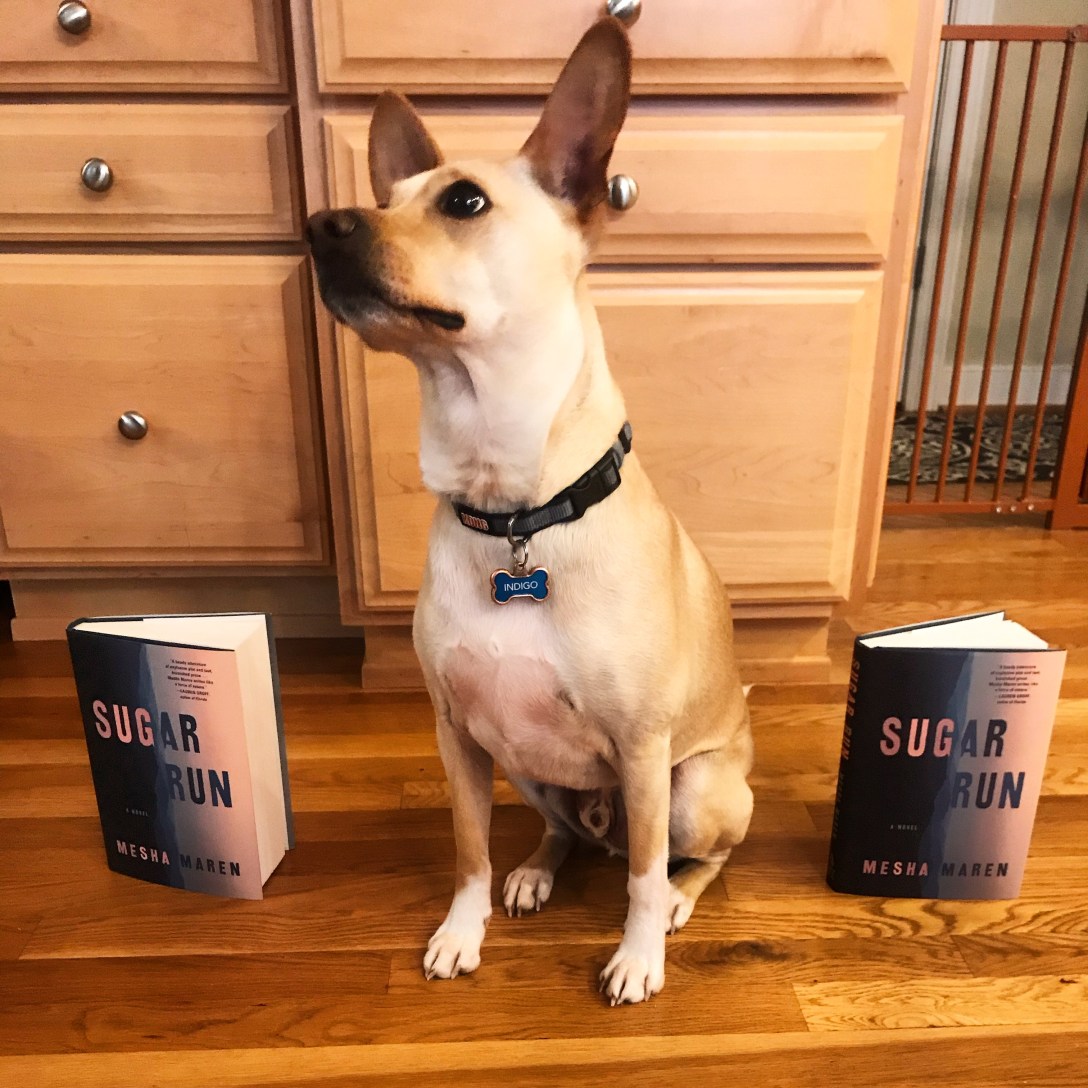
There is a dog in this book, so that’s our excuse for featuring a very confused Indy in this.

Alexis:

I’m thankful I had the opportunity to hear Mesha Maren discuss her book, because I feel like I really understood her vision. In Sugar Run, Jodi, the main character, is just released from prison, where she served eighteen years. She enters into a relationship with a young mother named Miranda, and their lives become tangled together. It’s a story of hope and hopelessness.

I love Maren’s lyrical writing style. Her writing has such a hard realness to it. She writes lush descriptions as she paints life in West Virginia. As Maren discussed in her talk, her book is hard to categorize. It’s a noir, crime, Southern Literature, and LGBTQ novel. But this is one of the great things about it: it’s a collage of genres, and it works.

This is a dark book that deals with vices to the max. It deals with crime, murder, sex, and lots of drugs. All of the characters are flawed, and make really bad decisions, yet I cared about them. The first half of the book is more character driven, while the second half is more plot heavy. The chapters alternate between the present (written in past tense) and the past (written in present tense) which I thought worked really well.

VERDICT: 4 out of 5 books


Anna:

Like Alexis, I’m so happy we had the opportunity to meet Maren at the Fountain Bookstore here in Richmond. Hearing an author discuss her book and writing process always enriches my understanding of it as a reader. The way Maren described her characters before I’d read about them made me more invested as a reader.

Maren’s writing is exactly what I love about literary fiction, even though, as Alexis said, this is a blend of genres. It is so dark and violent, but it is beautifully and breathtakingly written and full of nature imagery. The characters are well drawn out and real.

The violence in the lives of all the characters contrast so starkly with Jodi’s obsession with the rural landscape of her homeland. Her love of West Virginia mirrors themes of stability and nostalgia in Jodi’s life. It also offers commentary on the ways humans inflict violence on the earth, as the horrors of fracking is something frequently discussed.

The ending of books is something I’m constantly disappointed by, and, happily, this was not the case with Sugar Run! I thought the conclusion of both the interwoven timelines is so well done, and, most importantly, believable. Maren’s pacing is perfection.

During her talk, Maren touched a bit on the book she’s writing next, and you can bet I’ll be picking that up when that comes out!

VERDICT: 4 out of 5 books