Anna’s January Wrap Up

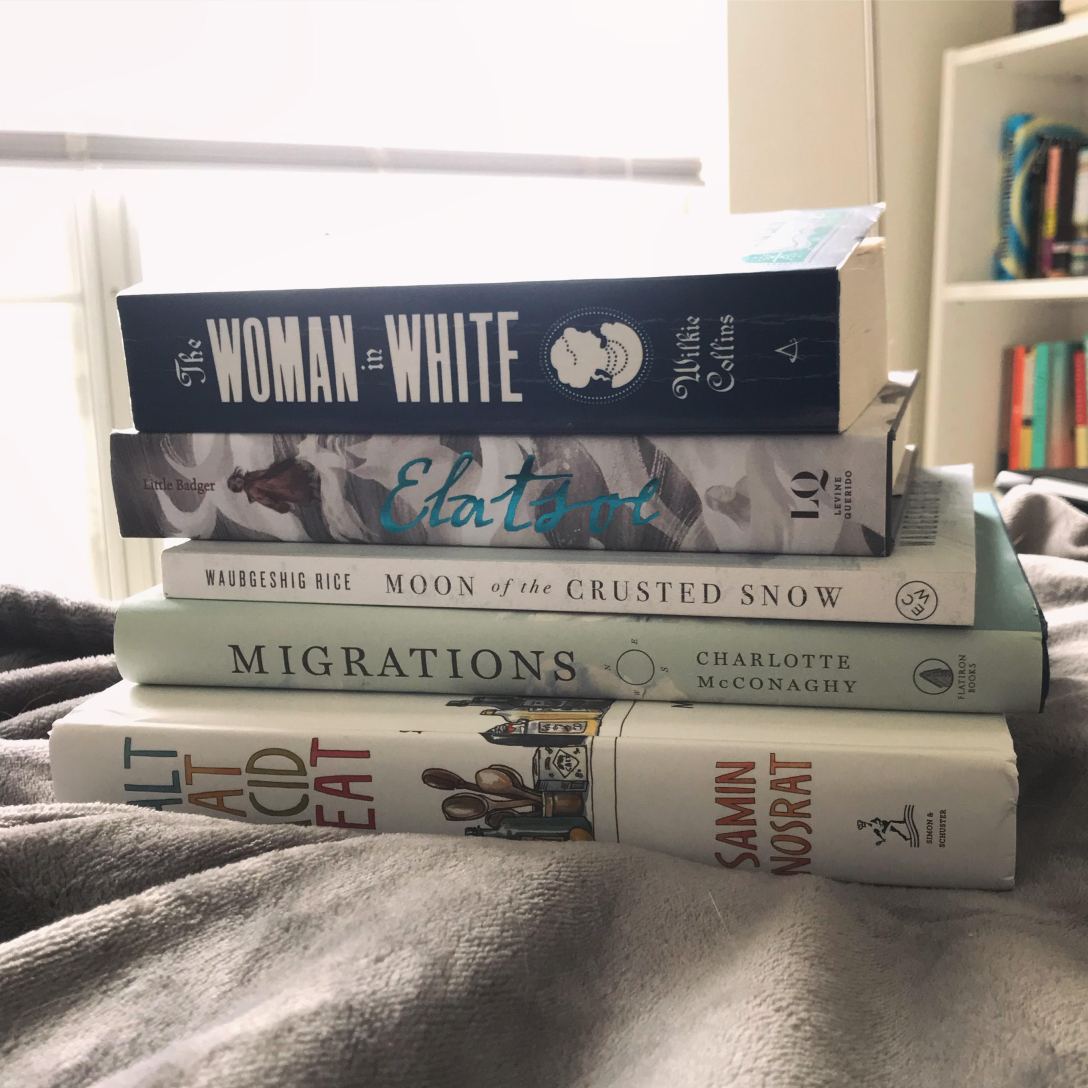
Between continuing to distance from others and the wintery weather, my reading was a major comfort and escape this month. I’m also happy with the diverse genres and authors I was able to read this month. I read two nonfiction books (one memoir and one cookbook), and two books by Indigenous authors, both of which work in favor of my 2021 reading goals. Here’s what I read: 

The Woman in White: Started off the year with an atmospheric, satisfying classic mystery. 

Elatsoe: Spooky magical YA by an Indigenious author. My only criticism is that this read VERY young to me. 

Moon of the Crusted Snow: actually a literary dystopian as promised (unlike Migrations) Written by an Indigenous author.

Migrations: The low point of my reading month. Do not recommend this one. Read my review.

Salt Fat Acid Heat: Mastering the Elements of Good Cooking: This made-to-be-read cookbook changes the food game! Check out my review.   

After the Eclipse: A Mother’s Murder, a Daughter’s Search (audiobook; not pictured); A heartbreaking memoir about the author’s mother’s murder. Also a criticism of the explorative nature of true crime as a genre. 

Review: Migrations by Charlotte McConaghy

book with river behind it

VERDICT: 2 stars

Trigger warnings: Suicide, Sexual Assault

I’ve wanted to read Migrations since before its release. It has great ratings on Goodreads, which proves that you need to take ratings with a grain of salt. I did, however, see a 1 star review from a trusted reviewer. Because of the dystopian aspect, I wanted to read this for myself.

I was disappointed. 

The actual style of the writing is the only thing I liked about this book. It’s lyrical yet concise. But there are glaring holes in the world building and the plot. Then there’s the biggest problem-Franny.

Migrations alternates between two timelines: the past and present. In the present, almost all animals have gone extinct in the world. There aren’t many fish left, and people who still fish are hated. Franny worms her way onto a fishing ship to follow the last migration of Arctic Terns. She tells the captain she is an orithinogist, and that she thinks the Arctic terns will lead them to fish. She is right, for the most part, so she stays on the boat.

We are introduced to Franny’s tumultuous childhood in Ireland. Her mom disappeared when she was young, and she lived with her father’s mother in Australia. Back in Ireland, Franny sits in on at University and meets the love of her life- Insta love style. She and Niall marry immediately, but very quickly it’s a struggle for Franny to stay. 

Franny is the most unlikable narrator I have ever encountered. There is nothing redeeming about her. She is so chaotic that she’s not even a believable character. And the author’s excuse for her behavior? She’s a “wanderer”. She’s unable to stay in one place. Why? It’s in her blood.

SPOILERS: Franny’s defining character trait is violence. She sleepwalks and attempts to strangle Niall in her sleep. She’s in jail for  murder, and it’s unclear if it was on purposeful or not. She also managed to kill two more people over the course of the present narrative. And yet. Franny is a wonderful swimmer and saves multiple people from drowning over the course of the story as well. Her character is completely unpredictable but predisposed to destroy and leave. 

In the past, we know that Franny served time in prison. It’s eventually revealed why. She (accidently?) rammed headfirst into another car, killing Niall and the woman in the other car. Franny claims she did it on purpose. Then she reveals that she saw an owl, which distracted her from the road. Franny is an unreliable narrator, so we don’t really know. Which brings me to my next point. 

Niall, Franny’s husband, is seemingly okay with the fact that Franny will just leave him when she feels she has to. By the end, we are made to understand their relationship is like this-Franny is a wild thing, possibly a bird, possibly something else. She is untamed. Niall is a scientist and by trapping Franny, he’s able to study her closely. But Franny, being a wild thing, kills him in the end.

Franny succeeds(?) in following the birds to their last migration. destroying everything else around her in the process. She plans to spread Niall’s ashes into the sea there. She also plans on killing herself. She spreads the ashes, and then submerges herself, fully intending to end it. But she doesn’t. The book ends with her being released from prison for the second time of her life. Her dad, who has never been part of her life and who is a convicted killer herself, is waiting to pick her up. They drive off together.

Then there’s the complete and utter lack of worldbuilding. This is apparently set in the not-so-far future in which climate change and human behavior has made most animals in the world extinct. For some reason, fishermen have received the bulk of the blame for this act (maybe because there are still some fish in the ocean? It’s not very well explained). This could have been such a rich world and the extinction of the animals could have added another layer to Franny’s story. Instead, the state of the world is barely acknowledged throughout the story. 

Overall: With more developed worldbuilding, maybe I could have forgiven some of Franny’s erratic behavior in this book. Or maybe not. Either way, I don’t recommend reading this. Migration’s book description first reminded me of one of my favorite books, The Lightkeepers by Abby Geni. After reading Migrations, they can’t be compared. Save yourself the pain and read the Lightkeepers instead. 
Review: The Overstory by Richard Powers

book: the overstory

Anna: Verdict: 3.5/5 books

The Overstory follows the lives of several characters who eventually come together. I found myself wondering how in the world these characters and their stories would connect, which is what motivated me to keep reading. There’s one thing all the characters have in common: their love of trees. 

Perhaps like the growth of trees, this is a dense, slow book that’s overwritten at points. It could have been cut by a good 200 pages or so. There’s a lot going on in a forest, and Powers attempts to comment on all of it. 

The beginning- which reads like short stories- is a study and introduction of each character. I like this part of the book best, because I generally enjoy character studies and not a lot of plot. One of the most impressive parts of this book is that all the characters and their stories do become. 

The way that Powers writes about trees is beautiful. I try not to read a lot of reviews before writing my own, but I did peek at some for The Overstory. One Goodreads reviewer called this “tree porn.” Tree porn this certainly is, and I’m blown away by the understanding and research Powers displays on biology and earth science, tree species, and the complexities of environmental activism. I’ve never thought much about terrorism as activism, which is one of the environmental avenues explored in this book. The question of why plant lives are less important than human lives is one of the most interesting themes here, but there’s so much else going on that I think it gets a little lost.

I also didn’t love the ending. I think Powers killed off characters for the sake of not knowing what else to do. Much like the long stories in the beginning, a drawn out ending followed the interlocking narratives in the middle.

Overall, The Overstory, is a massive, detailed, and flashy experiment on trees. I wanted to spend more time in the activism part of the story, which instead fell short (literally) in comparison to the rest. I’m happy I read this, but truthfully I probably won’t read any Richard Powers again.

Review: Cemetery Boys by Aiden Thomas

Alexis:

Cemetery Boys follows Yadriel, a trans teenager trying to gain acceptance from his family. His family are brujos, a group of magical Latinos who can summon ghosts and help them pass on to the afterlife. When Yadriel’s cousin, Miguel, dies, Yadriel tries to prove he’s a real brujo by summoning his ghost, but he accidentally summons Julian, a fellow schoolmate, instead.

I really enjoyed reading this book. The characters and dialogue are Thomas’ greatest writing strength. I loved getting to know Yadriel and his family, and the energetic characters of Maritza (Yadriel’s cousin) and Julian were so much fun to read. It’s hard to find stories with fully fleshed out characters, but I loved Cemetery Boys’ main characters.

The overall story gives me Coco and Gods of Jade and Shadow vibes. I enjoyed reading about the history, magic, and culture of the brujos, as well as the Día de Muertos. The themes of family, acceptance, and love shine on the page.

That being said, the pacing was a little slow, and the climax felt rushed in comparison; most of the plot was thrown into the last couple of chapters, and the action scenes aren’t quite punchy enough. Since I prefer character-driven stories, this didn’t affect my overall rating. However, it’s something to keep in mind if you prefer plot-driven stories over slow-burn and character-driven stories.

It’s also worth noting that while Maritza plays an important role in the book, the women are literally told in the beginning to stay home and cook. Yadriel makes it clear that he does not approve of this; however, the healing and cooking role of the women characters does not change throughout the book. So while the story focuses on breaking gender roles/stereotypes, I found it a little odd that Yadriel breaks stereotypes, but Maritza and the other women are still forced to be stuck in their traditional roles.

But bottom line, this was a fun, lively, and heartwarming read. If you’re looking for snarky characters, trans and LGBTQ representation, with a heavy dash of magic and ghosts, then I recommend picking this up!

VERDICT: 👻👻👻👻.5

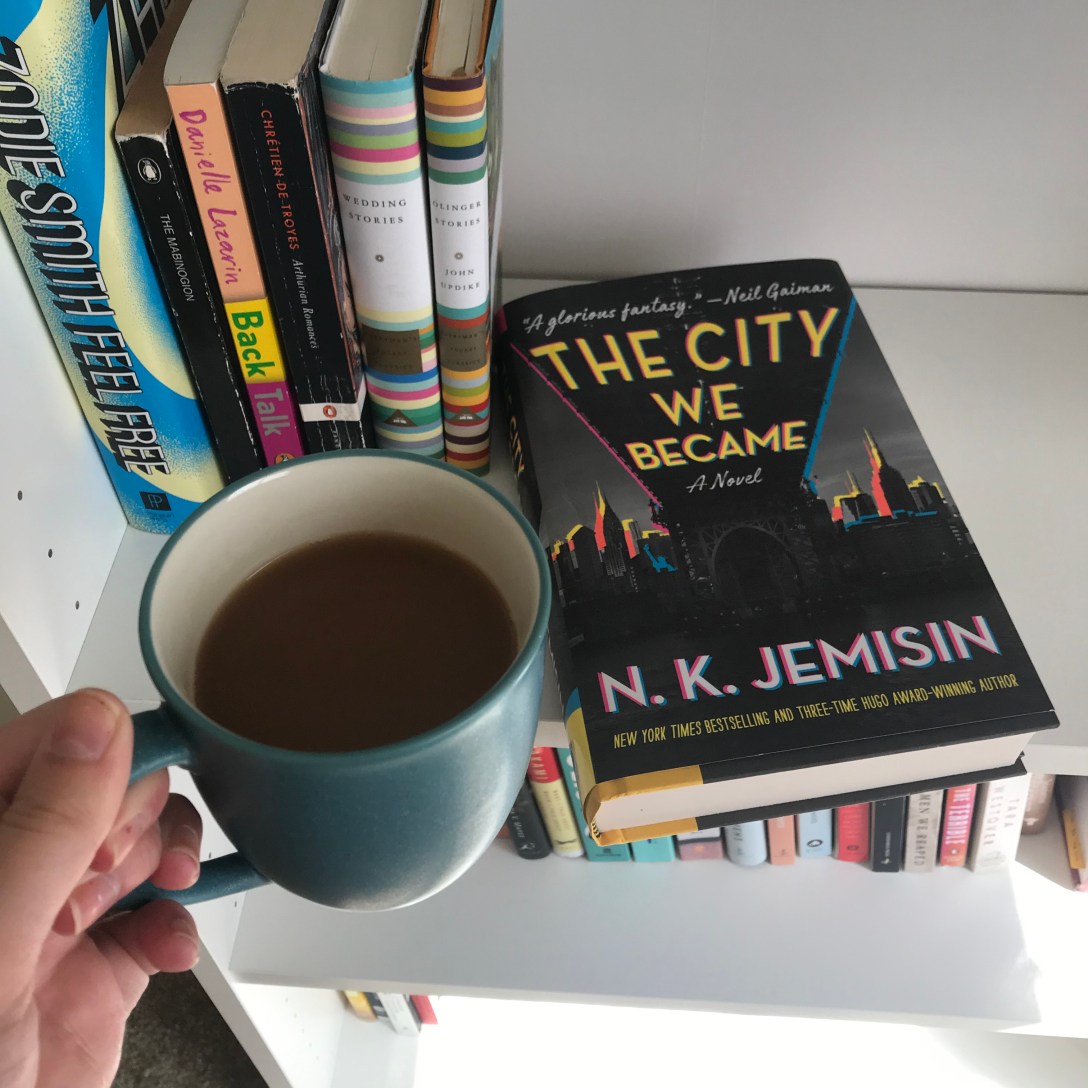
Review: The City We Became by N.K. Jemisin

Anna: I so badly wanted to love this! I love New York City and I lived there for a year, so I want to make a disclaimer that this wasn’t an issue of me not understanding NYC. I also think N.K. Jemisin is a talented author and I enjoyed The Fifth Season

What I liked:

  • Great themes of equality, identity and belonging; fighting hate: racism, sexism, homophobia; and what it means to belong somewhere
  • Wonderfully diverse group of characters of varied races, sexualities, and identities
  • The setting and the complex characterization of New York City

What I didn’t like:

  • Too on the nose
  • Confusing world building
  • Lots of telling and not showing (We are told exactly what something is and what it means throughout)

This is a unique and creative fantasy novel, but not without some thoroughly confusing world building. While I enjoyed the setting and the diverse cast of characters, I couldn’t shake the feeling of being hit over the head with thinly-veiled symbolism throughout. With little room for interpretation and imagination, I’m not sure if I’ll pick up the next book in this series. 

VERDICT: 3 out of 5 books

Anna’s September Reading Wrap up

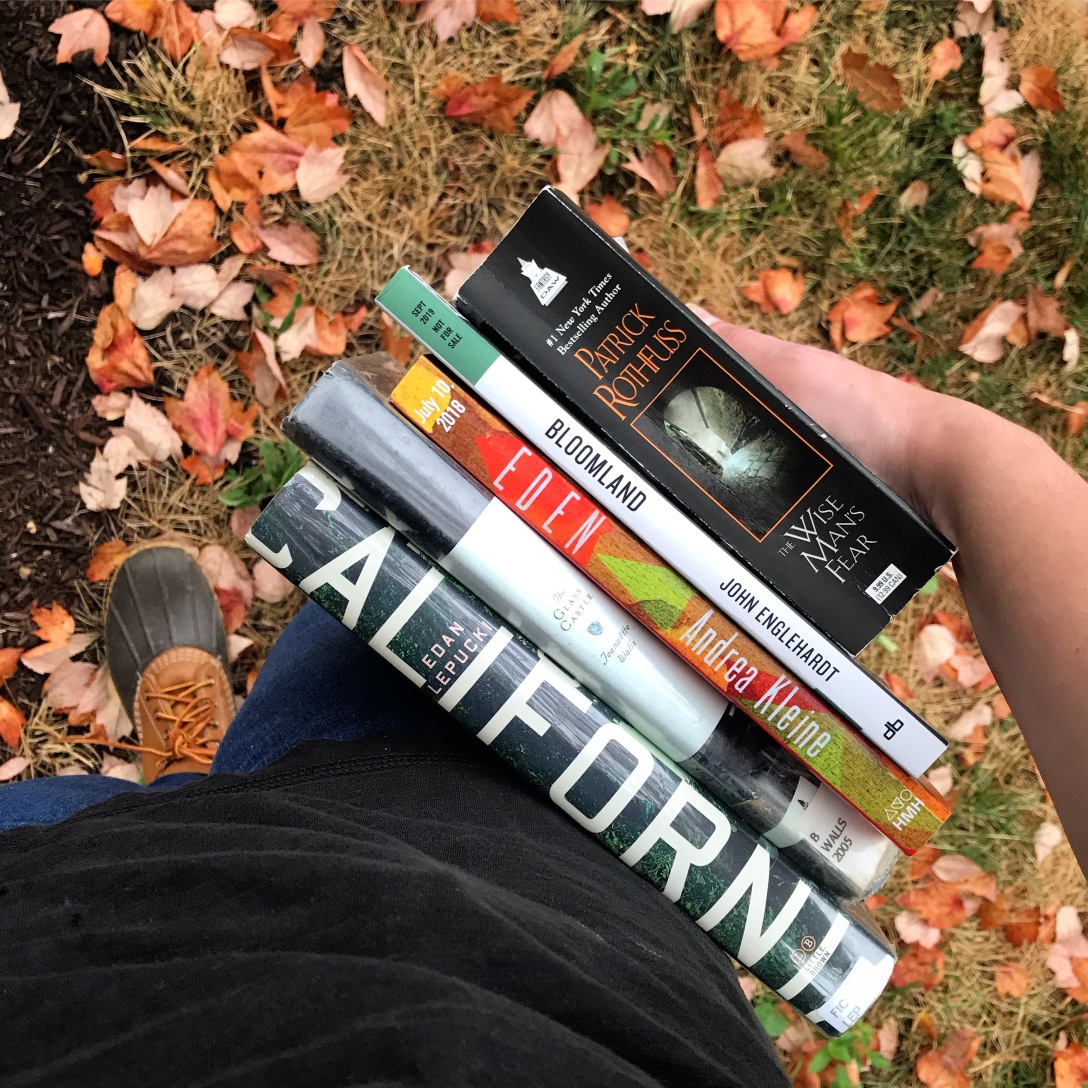
Anna: It’s the end of September! The leaves are officially starting to change, and it was cool enough today to break out my boots! It’s supposed to be 90 degrees on Wednesday, but I’m still embracing fall to its fullest! Here’s what I read this month:

5 stars:

The Glass Castle by Jeannette Walls

Support Independent Bookstores - Visit IndieBound.org
4 stars:

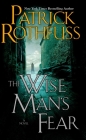
The Wise Man’s Fear by Patrick Rothfuss

Support Independent Bookstores - Visit IndieBound.org

Bloomland by John Enlehardt

Support Independent Bookstores - Visit IndieBound.org

3.5 stars

California by Edan Lepucki 

Support Independent Bookstores - Visit IndieBound.org

3 stars:

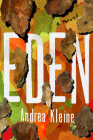
Eden by Andrea Kleine

Support Independent Bookstores - Visit IndieBound.org

The take away from this month’s wrap up is that if you haven’t read The Glass Castle, you need to. There will be a review coming soon! What did you read this month?

Review: Good Omens by Neil Gaiman and Terry Pratchett

Alexis:

Good Omens is a satirical book about the Apocalypse. When a demon named Crowley realizes he’s misplaced the Antichrist, an eleven-year-old boy named Adam, he teams up with his old enemy turned friend, an angel named Aziraphale. Together, they try to find Adam so that they can save Earth before the Apocalypse starts.

While I really enjoyed this book, I didn’t love it. I did love the beginning. The writing is brilliant and satirical, and it makes fun of everything. The book is full of religious scripture and religious references. Every line is witty, out there, and full of British humor.

I really enjoyed reading about Crowley and Aziraphale, and I wish that the majority of the book was from their point of view. I did like reading about the Four Horsemen, but some of the other characters were tedious to read about. My biggest complaint with the book is that there is a huge cast of characters, and the book jumps around a lot. It’s also a little too slow-paced.

If you like Supernatural, the two share a lot of names and qualities. I’m excited to watch the Good Omens show on Amazon Prime, however; I think it will come across really well on screen!

VERDICT: 3.5 stars

Review: Gods of Jade and Shadow by Silvia Moreno-Garcia

Alexis:

I read Gods of Jade and Shadow while I was on the beach yesterday. It’s currently storming, so I’m inside writing this review!

In Gods of Jade and Shadow, eighteen-year-old Casiopea Tun lives in Mexico in the 1920’s. But her town is small and traditional, and she lives in her grandfather’s house, where she is forced to serve him and his grandson, Martín. But one day, she opens a locked box in her grandfather’s room and unleashes the Mayan god of death: Hun-Kamé. Together, Casiopea and Hun-Kamé go on a journey to reclaim Hun-Kamé’s throne from his brother in Xibalba: The Underworld. 

In a lot of ways, this book defies genres. It’s a mix of Mayan mythology, magical realism, and historical fiction. I love all of the different elements thrown together; it makes for such a rich and interesting culture and setting. Moreno-Garcia crafts a dark and mythic world.

I love Casiopea’s character, and I enjoyed following her journey. She’s such a strong character who, even though she’s a little lost in the world, knows who she wants to be. She’s determined and strong-willed but caring and righteous, and I enjoyed getting to know her. 

I also enjoyed reading about the character of Hun-Kamé. I loved how the author described him and wrote him as a complex god who tried his best to figure out Casiopea as well as his brother. 

This is one of those books that’s full of memorable lines. 

“Dreams are for mortals.”

“Why?”
“Because they must die.” (121).

“Is that why you stare at stars?” he asked. “Are you searching for beauty or dreaming with your eyes wide open?” (122). 

“Words are seeds, Casiopea. With words you embroider narratives, and the narratives breed myths, and there’s power in the myth. Yes, the things you name have power.”

I loved the author’s descriptions, and I loved reading about Casiopea and Hun-Kamé’s journey.

VERDICT: 5 stars 

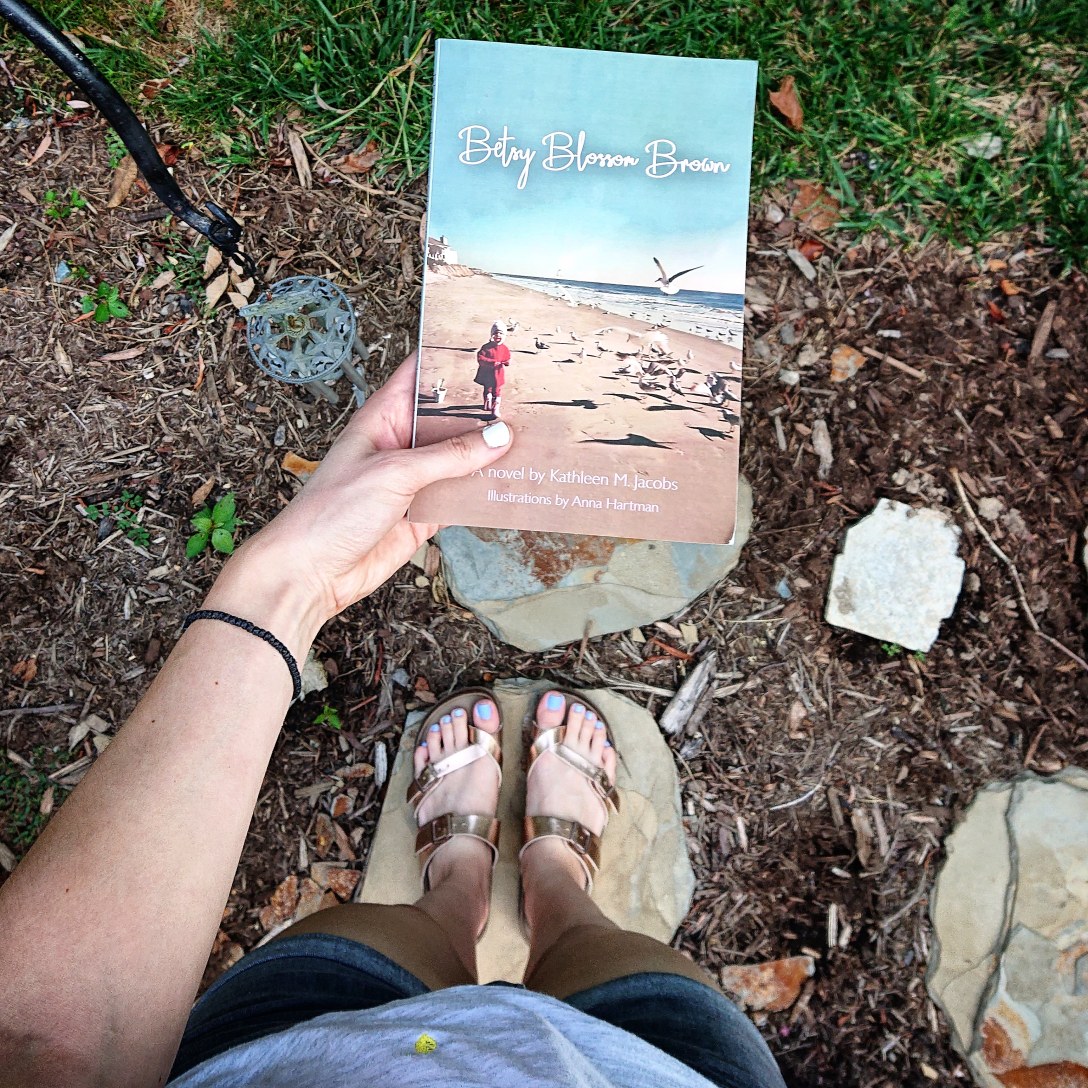
Review: Betsy Blossom Brown by Kathleen M. Jacobs

Alexis:

Thanks so much to Kathleen M. Jacobs for sending me her book! Jacobs has a gift for writing details, and vividly describing colors and clothes that create a vintage atmosphere and a Southern setting.

However, there are two big issues that kept me from being fully absorbed in the story: the POV randomly switches between first person and third person, and the name “Betsy Blossom Brown” was thrown around a little too often. 

To address the first issue, it happens so often in Betsy Blossom Brown that it made me confused. Even in the first couple of pages, one paragraph says, “‘But I don’t understand,’ Betsy winced.” And five paragraphs later begins with, “I turned each side of my hair behind my ears…” At first, I thought this was a characterization of Besty, that maybe she sometimes referred to herself in third person. But then I remembered that this was a minor problem in Honeysuckle Holiday.

As for Betsy’s name, it is a great Southern name, and makes for a great book title. However, I think the amount of times the repetition of her full name was repeated throughout the story lessened the magic of her name. 

That being said, I thought Jacobs did a great job of talking about and depicting Betsy’s Aspberger’s. Not many works of fiction deal with Aspberger’s, so I found this to be refreshing and enlightening. The story was character-driven, and I found Betsy’s character to be quirky and interesting. 

The writing in Betsy Blossom Brown is full of beautiful imagery, including vivid colors and clothing, that set up a coming-of-age story in a beautiful and nostalgic Southern setting. Jacobs writes in a conversational style that works well for her characters. However, I preferred the storyline in Honeysuckle Holiday, which I also found to be more cohesive. 

VERDICT: 3 stars

Review: Hello, Sunshine by Laura Dave

Alexis:

This is a book with an unlikeable main character. In fact, most of the characters are unlikeable, except for Sunshine’s cute niece. This makes for an interesting book. As a reader, I kept wondering, “Why is Sunshine like this? Why has she made all these terrible decisions?”

Lying, and what happens when your lies are exposed, is the center of the book. In Hello, Sunshine, Dave exposes how living a lie makes Sunshine confront her past and her future. Sunshine is a successful culinary star, but the kicker? She can’t cook. When she gets hacked and her secret is exposed, her life immediately falls apart.

It was a fast and interesting read, but it wasn’t super impactful.

VERDICT: 3 stars