I absolutely loved parts of this book, but other parts bored me.
The first fifty pages didn’t rope me in, but once Essie leaves the cold planet of Thanda, the story becomes much more interesting.
Essie’s character is by far the most interesting part of the story. She’s a strong but well-rounded character, and it’s rare to find a heroine who loves math, coding, puzzles, and mechanical engineering, not to mention cage fighting, in a book. Once we begin to know her character better, her motivations are clear, and her past is interesting. And I absolutely loved her misfit drones, especially Dimwit, a shining character on the page (despite being a drone!).
I enjoyed how this was a retelling of Snow White. It was fun piecing together all of the sci-fi versions of the fairytale, but the fairytale pieces didn’t distract from the story, only added interesting twists.
However, I wish the worldbuilding and imagery were more drawn-out. I initially liked Dane’s character, but it was like I could only glimpse him on the page. Even though he was basically in every scene, he started to feel like a background character. Lewis did a great job describing Essie’s “stitching,” or coding, but when it came to images of the characters or the world, sometimes it fell flat.
That being said, I still enjoyed it overall!
VERDICT: 🍎🍎🍎.5/5
TW: Kidnapping, child abuse, rape, murder/death, war
Here’s the thing: This was a highly entertaining read. It’s basically The Bachelor but in a dystopian America: drama, drama, drama. Once I reached page 140, I was a little more invested, because that’s when the worldbuilding actually started.
The world itself is interesting, and I wish there was even more of it! I think the overall themes and commentary on the current American society are great, including purity culture, self worth based on class, and the US’ relationship with China, despite the main character’s name being too on the nose.
BUT
The writing is…not great. Too much telling. And if felt too unpolished, too unedited.
The dialogue is stiff and too direct. Aspen’s character is such an asshole; Maxon comes off as a little, well, off; America is basically, “Oh, poor me. Everyone thinks I’m beautiful enough to win this contest, but I don’t think I’m good enough and want to go home to my asshole boyfriend.”
I also couldn’t help but compare this to The Hunger Games the entire time I was reading. That might be my own fault, but I think there were just too many similarities (though watered down similarities, to be fair).
This had the potential to be a great commentary on American society, but what can you do!
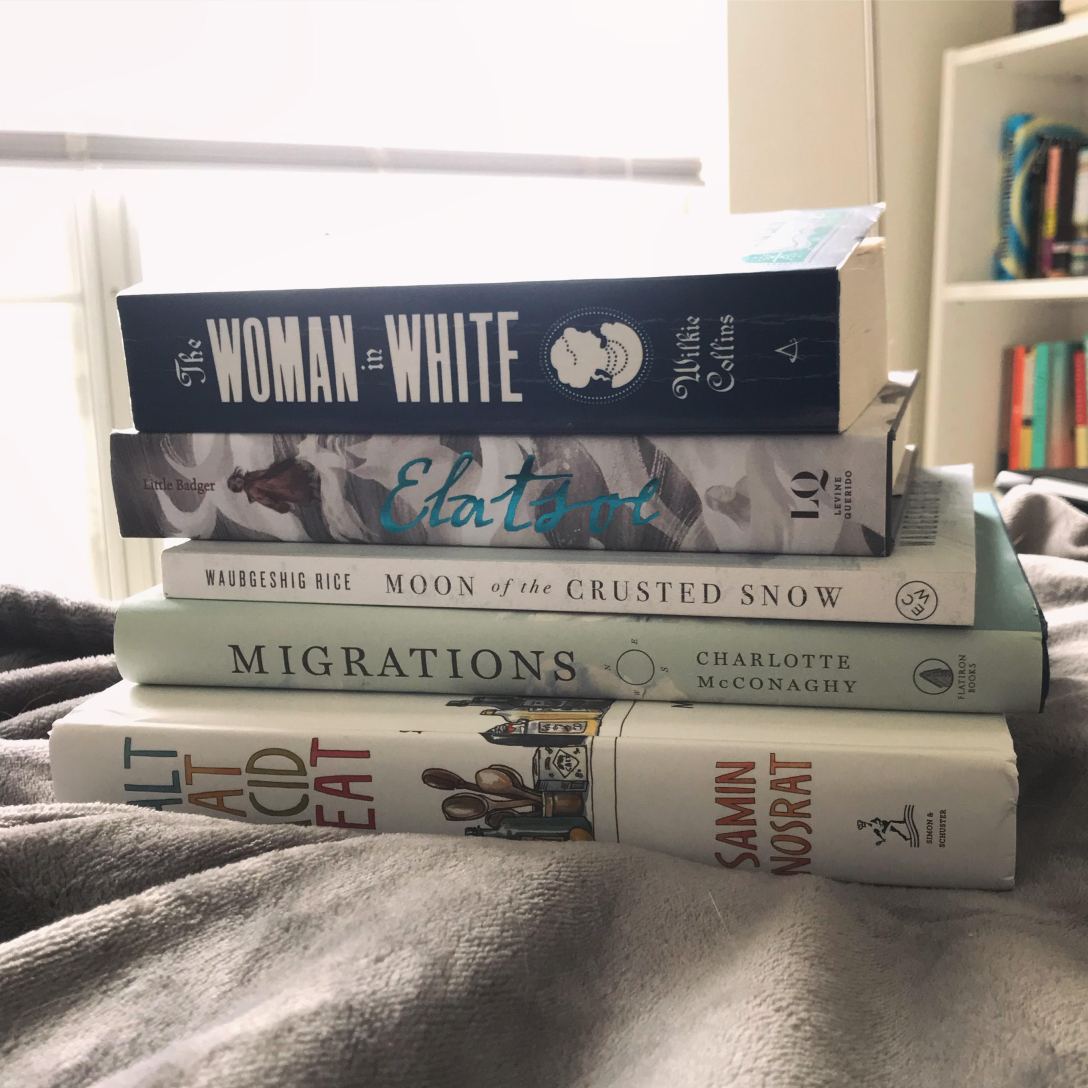
Between continuing to distance from others and the wintery weather, my reading was a major comfort and escape this month. I’m also happy with the diverse genres and authors I was able to read this month. I read two nonfiction books (one memoir and one cookbook), and two books by Indigenous authors, both of which work in favor of my 2021 reading goals. Here’s what I read:
The Woman in White: Started off the year with an atmospheric, satisfying classic mystery.
Elatsoe: Spooky magical YA by an Indigenious author. My only criticism is that this read VERY young to me.
Moon of the Crusted Snow: actually a literary dystopian as promised (unlike Migrations) Written by an Indigenous author.
Migrations: The low point of my reading month. Do not recommend this one. Read my review.
Salt Fat Acid Heat: Mastering the Elements of Good Cooking: This made-to-be-read cookbook changes the food game! Check out my review.
After the Eclipse: A Mother’s Murder, a Daughter’s Search (audiobook; not pictured); A heartbreaking memoir about the author’s mother’s murder. Also a criticism of the explorative nature of true crime as a genre.
Salt Fat Acid Heat is a cookbook that is meant to be read. It first teaches you the science behind the four basic elements of cooking- salt, fast, acid, heat. There are then recipes in the back to put your skills to practice.
This book teaches you how to season from within with salt, how to properly use fat as a cooking medium or as a seasoning, how to balance meals with acid, and, finally, how to transform food with heat.
My husband and I both love to cook, and we read this back to back, cover to cover. Samin inspired us to make immediate changes to our kitchen by investing in some new staples, reorganizing, and immediately putting her recipes and tips to the test.
Some tips of hers that I’ve been putting into practice are: to salt ahead of time and for as long as possible, to let meat come to room temperature before cooking, and to always heat my pan before adding anything. I’ve always been a fan of roasting veggies, but her simple tip of briefly boiling vegetables instead has been revolutionary!
My only complaint with this cookbook is that it is very meat-heavy. There are dozens of chicken recipes, specifically, which seems to be a favorite of Samin’s. To each his or her own, but as someone who favors vegetarianism, I’m a little disappointed with the overwhelming emphasis on meat.
Even so, I highly recommend you pick this up if you want to spice up your cooking!
I’ve wanted to read Migrations since before its release. It has great ratings on Goodreads, which proves that you need to take ratings with a grain of salt. I did, however, see a 1 star review from a trusted reviewer. Because of the dystopian aspect, I wanted to read this for myself.
I was disappointed.
The actual style of the writing is the only thing I liked about this book. It’s lyrical yet concise. But there are glaring holes in the world building and the plot. Then there’s the biggest problem-Franny.
Migrations alternates between two timelines: the past and present. In the present, almost all animals have gone extinct in the world. There aren’t many fish left, and people who still fish are hated. Franny worms her way onto a fishing ship to follow the last migration of Arctic Terns. She tells the captain she is an orithinogist, and that she thinks the Arctic terns will lead them to fish. She is right, for the most part, so she stays on the boat.
We are introduced to Franny’s tumultuous childhood in Ireland. Her mom disappeared when she was young, and she lived with her father’s mother in Australia. Back in Ireland, Franny sits in on at University and meets the love of her life- Insta love style. She and Niall marry immediately, but very quickly it’s a struggle for Franny to stay.
Franny is the most unlikable narrator I have ever encountered. There is nothing redeeming about her. She is so chaotic that she’s not even a believable character. And the author’s excuse for her behavior? She’s a “wanderer”. She’s unable to stay in one place. Why? It’s in her blood.
SPOILERS: Franny’s defining character trait is violence. She sleepwalks and attempts to strangle Niall in her sleep. She’s in jail for murder, and it’s unclear if it was on purposeful or not. She also managed to kill two more people over the course of the present narrative. And yet. Franny is a wonderful swimmer and saves multiple people from drowning over the course of the story as well. Her character is completely unpredictable but predisposed to destroy and leave.
In the past, we know that Franny served time in prison. It’s eventually revealed why. She (accidently?) rammed headfirst into another car, killing Niall and the woman in the other car. Franny claims she did it on purpose. Then she reveals that she saw an owl, which distracted her from the road. Franny is an unreliable narrator, so we don’t really know. Which brings me to my next point.
Niall, Franny’s husband, is seemingly okay with the fact that Franny will just leave him when she feels she has to. By the end, we are made to understand their relationship is like this-Franny is a wild thing, possibly a bird, possibly something else. She is untamed. Niall is a scientist and by trapping Franny, he’s able to study her closely. But Franny, being a wild thing, kills him in the end.
Franny succeeds(?) in following the birds to their last migration. destroying everything else around her in the process. She plans to spread Niall’s ashes into the sea there. She also plans on killing herself. She spreads the ashes, and then submerges herself, fully intending to end it. But she doesn’t. The book ends with her being released from prison for the second time of her life. Her dad, who has never been part of her life and who is a convicted killer herself, is waiting to pick her up. They drive off together.
Then there’s the complete and utter lack of worldbuilding. This is apparently set in the not-so-far future in which climate change and human behavior has made most animals in the world extinct. For some reason, fishermen have received the bulk of the blame for this act (maybe because there are still some fish in the ocean? It’s not very well explained). This could have been such a rich world and the extinction of the animals could have added another layer to Franny’s story. Instead, the state of the world is barely acknowledged throughout the story.
Overall: With more developed worldbuilding, maybe I could have forgiven some of Franny’s erratic behavior in this book. Or maybe not. Either way, I don’t recommend reading this. Migration’s book description first reminded me of one of my favorite books, The Lightkeepers by Abby Geni. After reading Migrations, they can’t be compared. Save yourself the pain and read the Lightkeepers instead.
So, to no one’s surprise, I read this book in one night. I’m living for the dark, witchy aesthetic of this book! It’s set in 1800s Sicily, Italy. Historical fantasy is one of my favorite subgenres of fantasy, so I was pumped to read this one.
Kingdom of the Wicked follows Emilia, a witch who grew up hearing horror stories from her grandmother about the princes of Hell and dark magic alike. When her twin sister, Vittoria, dies a gruesome death, Emilia teams together with Wrath, one of the princes of Hell, in order to avenge her sister’s death.
Emilia’s family works in a restaurant, and I loved reading about the food that she and her family cooks. It’s a great way to ground the story, since it’s otherwise heavy on fantasy elements, and it made me hungry!
The beginning was a little bit slow, but I liked how it built up the story. I think Maniscalco did a great job with the setting, and I really enjoyed following Emilia as she runs around the city trying to figure everything out. I also enjoyed the chemistry and bickering between Emilia and Wrath, as well as their tumultuous enemies to lovers kind of relationship.
As for the genre, I felt like Kingdom of the Wicked bounced back and forth between YA and NA. Emilia, the main character, is 18. Sometimes, I really liked her character, and I felt like she was a good balance between a strong female character and a realistic, grieving character. Other times, however, she was very naive and made some dumb decisions, so if you’re not into naive characters, this might not be the book for you. However, I liked learning how the princes of Hell worked alongside Emilia as she tried to figure out what she’s been thrown into.
Besides that, while I enjoyed the plot overall, there were some confusing bits. I found myself re-reading the ending because it was fairly vague, which might be the point, considering its leading into the next book. Either way, I’m looking forward to the sequel!
Overall, if you’re into witchy vibes, historical fantasy, and morally gray characters, then give this one a try!
The Overstory follows the lives of several characters who eventually come together. I found myself wondering how in the world these characters and their stories would connect, which is what motivated me to keep reading. There’s one thing all the characters have in common: their love of trees.
Perhaps like the growth of trees, this is a dense, slow book that’s overwritten at points. It could have been cut by a good 200 pages or so. There’s a lot going on in a forest, and Powers attempts to comment on all of it.
The beginning- which reads like short stories- is a study and introduction of each character. I like this part of the book best, because I generally enjoy character studies and not a lot of plot. One of the most impressive parts of this book is that all the characters and their stories do become.
The way that Powers writes about trees is beautiful. I try not to read a lot of reviews before writing my own, but I did peek at some for The Overstory. One Goodreads reviewer called this “tree porn.” Tree porn this certainly is, and I’m blown away by the understanding and research Powers displays on biology and earth science, tree species, and the complexities of environmental activism. I’ve never thought much about terrorism as activism, which is one of the environmental avenues explored in this book. The question of why plant lives are less important than human lives is one of the most interesting themes here, but there’s so much else going on that I think it gets a little lost.
I also didn’t love the ending. I think Powers killed off characters for the sake of not knowing what else to do. Much like the long stories in the beginning, a drawn out ending followed the interlocking narratives in the middle.
Overall, The Overstory, is a massive, detailed, and flashy experiment on trees. I wanted to spend more time in the activism part of the story, which instead fell short (literally) in comparison to the rest. I’m happy I read this, but truthfully I probably won’t read any Richard Powers again.
I hate giving a book 2 stars, but this one just wasn’t doing it for me.
I liked the overall idea, and I enjoyed the descriptions of the food.
However, the writing style was stiff and didn’t have any variety to it; it felt like every sentence was the same length. It was very much so “She said this. They did this.”
I found the dialogue and characters to be the same. The dialogue sounded very unnatural, and it didn’t help that all of the characters talked the same way. There was no subtext to the dialogue; it was all, “I’m sorry Auntie. I didn’t mean it.” “That’s okay. I still love you, Vanessa.”
Besides that, there was a lot of name dropping. There’s a scene in the Louvre where Vanessa and her love interest dissect every piece of art. Vanessa constantly talks about how fancy her aunt is, and name drops designers left and right. At times, it felt overly elitist.
The romance in the book was also pretty weird, including insta-love that just didn’t feel genuine to me.
And finally, whenever the background characters heard one of Vanessa’s predictions, they always accepted them as truth. I found this odd. I’d be very weirded out if I heard a prediction about my life come out of a stranger’s mouth, and I expected there to be more conflict from this.
I was hoping this book would be a nice, easy change of pace, but I just found it a little disappointing.
I reached my goal of reading 50 books in 2020, and then I actually surpassed it by reading 51.
My top 10 books won’t be a surprise; I’ve reviewed most of them here already. However, I will include a short blurb about each one as a refresher.
Without further ado, here are my top 10 books of 2020, in no particular order!
Crescent City by Sarah J. Maas
Maas is a guilty pleasure of mine. Her books have a way of wholly drawing you into her worlds, and this one was no different. Crescent City is a new adult, brash urban fantasy that follows Bryce, a half-fae. She teams together with Hunt, a fallen angel, to solve the mystery of her best friend’s murder. Craziness and romance ensue.
Deeplight by Frances Hardinge
Hardinge is one of my favorite writers; she always kills it! Deeplight is a slowburn YA fantasy with deaf representation that centers around toxic friendships. It has a large dose of monstrous sea gods. It’s an imaginative, dark, and wonderfully written book.
Raybearer by Jordan Ifueko
While categorized as YA, I found that this West-African inspired fantasy book leaned more towards adult. I loved the writing, the intricate worldbuilding, and the plot. The plot itself is hard to explain; you’ll have to pick it up!
The Ten Thousand Doors of January by Alix E. Harrow
While this historical fantasy starts out slow and a bit confusing, it morphs into a lyrical story about family and belonging. It’s full of other dimensions, and, you guessed it, doors.
House of Salt and Sorrows by Erin A. Craig
This retelling of “The Twelve Dancing Princesses” is dark and gothic. The story focuses on sisterhood and death/murder, with a fun dose of dancing at balls to balance it all out.
The Song of Achilles by Madeline Miller
This is a coming-of-age story and a retelling of the Greek myth of Achilles and Patroclus. It follows the romantic relationship of the two characters up until the Trojan War. Miller’s writing is fantastic, and she’s a Greek mythology genius.
Race the Sands by Sarah Beth Durst
Race the Sands follows two women in the desert world of Becar, where you can ride monstrous creatures called kehoks, who are reincarnated from the worst of the worst people in a past life. The story focuses on reincarnation, determination, and carving your own path in the world, and I found it to be a refreshing fantasy read.
The House in the Cerulean Sea by T.J. Klune
This is whimsical and heartwarming, a great change of pace for adult fantasy. It follows Linus, a Case Worker at the Department in Charge Of Magical Youth, who is given an assignment to inspect an island full of magical children classified as dangerous.
The Bone Houses by Emily Lloyd-Jones
This YA, Welsh inspired historical fantasy follows Ryn, a gravedigger who begins to notice that the dead are rising, and teams together with a boy named Ellis. It’s a classic journey story with great characters and an enjoyable plot. I loved the fresh take on zombies, or “bone houses.”
The Happy Ever After Playlist by Abby Jimenez
Finally, a contemporary romance book somehow made it onto my list! I enjoyed this book far more than I anticipated. I loved the funny, snappy dialogue, the characters, and the romance. The focus on music, and the inclusion of the playlist, only added to the story.
Honorary re-read favorites: The Six of Crows duology by Leigh Bardugo
I read Six of Crows and Crooked Kingdom in 2018, and though I immediately classified them as some of my favorite books, I had forgotten a lot of the plot. I absolutely loved re-reading them in 2020! They’re Bardugo’s best works, in my opinion, with an intricate world and plot, and very well-drawn characters that you’ll be rooting for from the beginning (even the morally grey ones).
My 2021 reading goal is to branch out a little more outside of YA fantasy. My classes will help with this, of course (I can’t believe I’ll finish my last semester in 2021!) I also currently have Kindle Unlimited, and I’m excited to dive into some thrillers and historical fiction!
2020 was a year for the books (ha). This year, I read a total of 84 books. I’ve heard many other readers say that living through a pandemic has helped one thing-their reading life. I read the same amount of books annually that I normally do, but being forced to stay home for the majority of the year helped me focus on reading a little more slowly and perhaps a little more intentionally.
A year in reading: Like usual, the majority of the books that I read were literary fiction by women authors. Like in 2019, I read a mixture of audiobooks and physical books. I’ve significantly trimmed down my physical TBR, and I’ve gotten in the habit of selling or donating all books I rate under 4 stars. I didn’t read nearly as much fantasy as I normally do, and I liked even less of what I read in the genre. I re-read some old favorites, like Princess Academy (still amazing) and the Harry Potter books (I re-read the entire series before J.K. Rowling and her Trans-bashing). I was lucky enough to land on Algonquin’s mailing list, and I reviewed their most popular book of the year, His Only Wife. I also rediscovered a love for middle grade fiction. I continued fostering my love for contemporary Irish literary fiction in Exciting Times, Marlena, and Tana French’s newest, The Searchers. Perhaps most surprisingly, a thriller even made it onto my favorites list for the year, something I never thought possible!
Writers & Lovers by Lily King
A classic tale of a struggling writer trying to make it big. Complete with a love triangle, commentary on the love/hate relationship with an artist and their craft, and the overall theme of reaching for your dreams no matter what, I loved everything about this book. And it has a happy ending! Great for writers and dreamers.
2. Long Bright River by Liz Moore
I’m not a huge reader of thrillers, but this book broke my heart. Fast-paced yet character-driven, this is a book about duty and sisterly love. Tigger warnings for sexual violence and drug abuse.
3. Rules of Civility by Amor Towles
A modern Great Gatsby. If you’re looking a richly written and seductive book about the extravagance and of the New York upper class, told by an outsider, this is the book for you.
4. Small Spaces by Katherine Arden
My favorite middle grade book of the year. This spooky first in a series is all about friendship, grief, and finding your way. It’s a lot scarier than I expected, too! Its sequel, Dead Voices, is just as good, and I can’t wait for book three to come out later this year!
5. Ninth House by Leigh Bardugo
Ninth House is one of the few fantasy novels I read this year. Watch out fans of Bardugo’s Six of Crows duology: this is not YA! Besides the unique and bloody magic system, the coolest thing about this world is that it reimagines Yale’s secret societies as deadly magic groups who are up to no good.
6. The Miseducation of Cameron Post by Emily M. Danforth
I’m years late to this party. The Miseducation of Cameron Post is just as good as everyone promised. This is the ultimate coming out book that paved the way for LGBTQ+ YA fiction as we know it now (stories about queer teens, not stories centered purely around coming out).
7. Just Mercy by Bryan Stevenson
Another book that I should have read years ago. Just Mercy brings to light mainstream systems of abuse and oppression in the American prison system, specifically in regards to the amount of African Americans wrongly convicted of the death penalty in the South. If you haven’t read this yet, you need to.
8. Wolf Hollow by Lauren Wolf
This is a wonderful coming-of-age novel about a young girl who stands up to the town bully, starting a chain reaction of sinister events in her small, rural town. Trigger warnings for death and physical abuse. This was dark!
9. In the Dream House by Carmen Maria Marchad
My favorite memoir of the year. Machado chronicles her abusive relationship with her girlfriend. In the Dream House is told through lyrical and imaginative fragments, and Machado also includes commentary on the lack of research available on abuse in same sex relationships.
10. The Pull of the Stars by Emma Donaghue
I love Emma Donoghue’s writing, and this new 2020 release didn’t disappoint. A deadly flu breaks out in Ireland during World War 2. I love dystopian literature, and a global pandemic didn’t stop me from reading The Pull of The Stars. The book follows a few devastating days in the life of a labor and delivery nurse who battles to save the lives of sick mothers and their babies. Don’t read this is you’re squeamish about birth!
My 2021 reading goals are to:
Read more books from diverse perspectives. As I mentioned, I read a lot of women authors. Some of my favorite reads from this year featured LGBTQ+ authors. This coming year, I’d love to read books by more people of color as well as more translated works.
Read more nonfiction besides memoir. Will I ever read as much nonfiction as I read fiction? Probably not. But I want to make an effort to reach nonfiction that expands my worldview and knowledge in valuable ways as Just Mercy did this year for me.
Read more classics that I actually enjoy. For me, this means Victorian novels. I’m still making my way through the only one I started this year, The Woman in White by Wilkie Collins. There are books in this category that, embarrassingly, I’ve never read, including Wuthering Heights or any Dickens.
Here’s to a year of healing, another great year of reading!