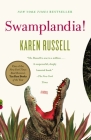
Review: Swamplandia by Karen Russell

This book was on my TBR for a while, and it was one of the many that I picked up in the $1 section of The Strand when I lived in New York. Unfortunately, Swamplandia and I didn’t get along.

While I was intrigued by the Swamplandia theme park as a character, I felt like the whole thing was a big metaphor for mental health that I didn’t understand. There are some parts I did like, like the quirky and flawed Bigtree family and its members, who are all very different from each other. Kiwi’s perspective was my favorite, and by far the most interesting.

I also didn’t like the way Russel handled some aspects of this book…Native American appropriation, anyone? I found much of the plot confusing but also kind of pointless, particularly what happened to Ava in the woods. And can someone please tell me what the red seth represented? Womanhood?!

Ultimately, I felt this is something I feel I didn’t understand and didn’t care to figure out.

 Support Independent Bookstores - Visit IndieBound.org
 
VERDICT: 3 out of 5 books

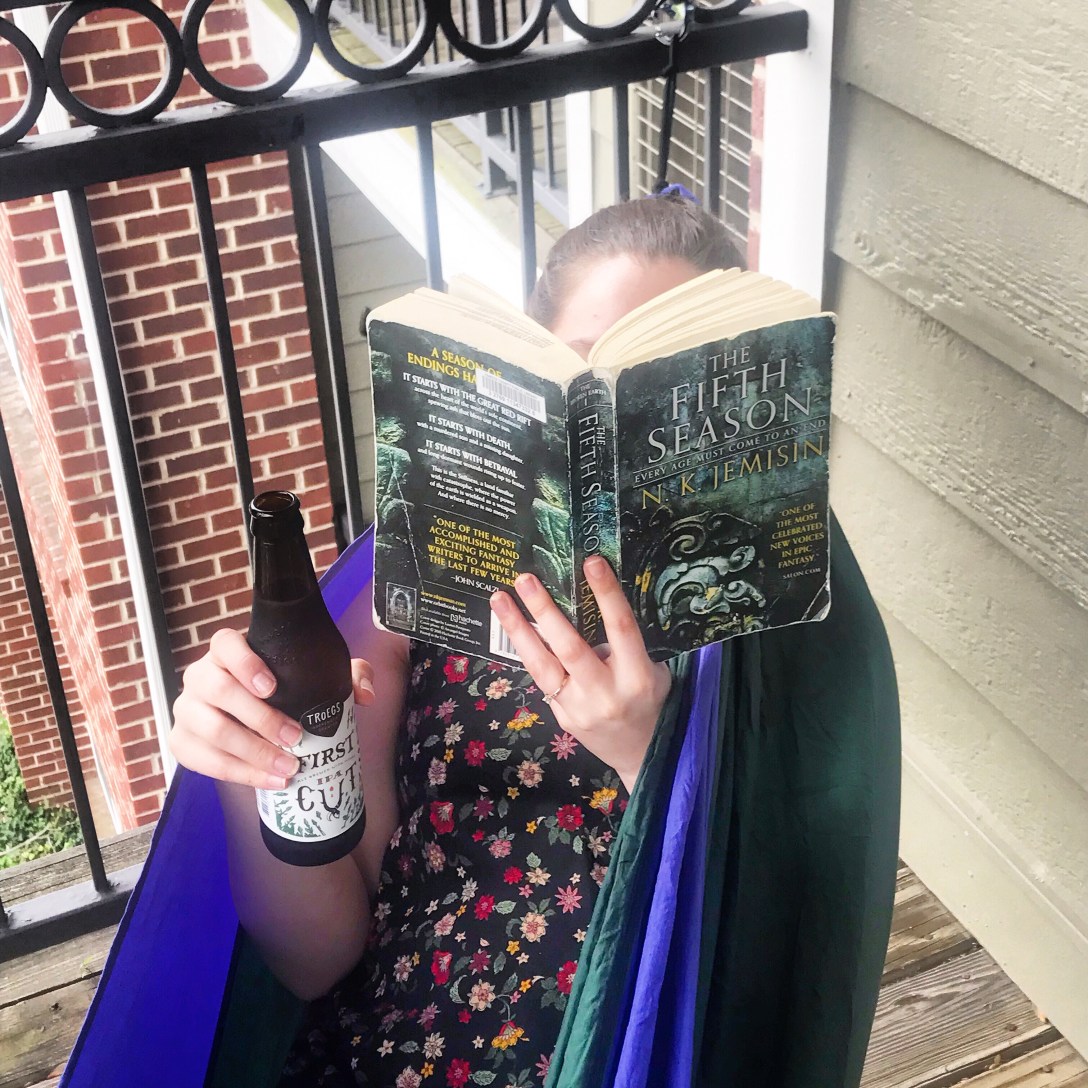
Review: The fifth Season by N. K. Jemisin

Recently I was in the mood for some fantasy, and this did the trick! I loved this atmospheric book!

Warning: this book is really confusing at first. It’s hard to explain even after reading it. It plops you right into this strange world and runs with it, and it took me a couple hundred pages to really feel like I had any sort of grasp of what was going on. You don’t know how the different perspectives relate. Enough people warned me of this that I knew I had to keep going, and it was Jemisin’s power of characterization–specifically the fact that I both empathized with and was so frustrated with Essun–that hooked me from the start.

The Fifth Season has a little bit of everything–badass women, love triangles that don’t suck, violence, great worldbuilding, and a prevailing theme of overcoming otherness. This is a book that flips typical elements of epic fantasy on its head–namely its general lack of black, female, and queer characters–all of which have ample representation in The Fifth Season. Specifically, in The Stillness, the people with the power have dark skin and Essun repeatedly feels self-conscious about her lighter, silky hair. The Fifth Season also successful utilizes multiple perspective and different points of view, including the second person, something I never would have thought possible.

This book is fantastically unique and I’d highly recommend it. I’m looking forward to reading the second book in The Broken Earth Series!

Support Independent Bookstores - Visit IndieBound.org

VERDICT: 4 out of 5 books


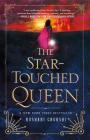
Review: The Star-Touched Queen by Roshani Chokshi

Alexis:

I was a little hesitant to read The Star-Touched Queen. I had high hopes for Roshani Chokshi’s newest book, The Gilded Wolves, which came out earlier this year. And unfortunately, that book fell short for me.

The Star-Touched Queen takes place in two fantasy kingdoms called Bharata and Akaran. When main character Maya turns seventeen, her father, the Raja of Bharata, seeks to marry her off in her order to bring peace to his kingdom. The land of Bharata believes in horoscopes, and Maya’s horoscope speaks of death and a doomed marriage. When Maya is forced to choose a husband, she chooses a cloaked king named Amar who takes her to his strange and empty kingdom of Akaran.

The story that follows is a blend of Hades and Persephone and Beauty and the Beast.

This book claims to be YA fantasy, and despite the almost-insta-love, I found it to be so much more than that. Chokshi’s writing borders on magical realism. She blends reality with mythology in a way that might annoy or confuse some readers. But it is Neil Gaiman-esque in a way that I love. Chokshi’s writing shines in her worldbuilding, magical descriptions, and in her dialogue. Her writing is otherworldly and atmospheric.

This book is full of Indian mythology and folklore, including strange creatures and reincarnation. Chokshi weaves kingdoms together and writes dark, death-like imagery, with large sprinklings of magic throughout.

I want to give this book 5 stars, but it’s not quite there. While I was completely absorbed by the story and the world, Maya and Amar’s characters are lacking. Maya’s main characteristic is that she no longers wants to be shunned, and she wants freedom. While I like this about her, I never felt like I had a full grasp of her personality, not to mention what she wants or doesn’t want in life. While Amar is an interesting character, again, I feel like Chokshi never gives him enough of a personality.

However, this is the first book in a series, so I hope later books give Maya and Amar a chance to build into rounder characters. However, I noticed that the next books in the series don’t even focus on Maya and Amar.

I loved this book, I just wish Chokshi’s character development was better!

Support Independent Bookstores - Visit IndieBound.org

VERDICT: 4 stars

Review: We are the Ants by Shaun David Hutchinson

“What if I don’t give a shit about the world?”

“I’d say that’s pretty fucking sad.”

“Why?”

“Because the world is so beautiful.”  

We are the Ants is a difficult book to explain and to “place”. This is technically “science fiction”, and I say technically because it blends reality and fantasy. I love that it defies genres! The reader is left to wonder what is real and what is not. I’d warn potential readers not to the read the book jacket copy, because I want them to enjoy the mystery and surprise.

Trigger warnings for self harm, sexual assault, and suicide. This is a BIG part of the book so please don’t read this if that’s something too close to home.

I felt such a connection to the characters, particularly the narrator and protagonist, Henry, a teenage boy who is faced with a big decision: should he save the world or allow it to be destroyed? When we meet him, he’s overcome with grief over losing his boyfriend.  I was so invested in his story as he comes to terms with his grief and mental instability and battles many forms of bullying and harassment. Henry’s grief and mental health manifests itself in a totally original way that I thought worked so well.

This is also just “angsty” enough to be believable but not shallow or stereotypical in any way, a problem I sometimes have “drama” in YA. We are the Ants depicts horrific reality of mental health. This book doesn’t shy away from critically examining the demands our society has on teenagers. The amazing part is that Hutchinson explores all these themes through the unique lens of alien abduction and the impending apocalypse.

We are the Ants is one of the best YA novels I’ve read in awhile! I highly recommend it!

VERDICT: 5 books!


Review: We Never Asked for Wings by Vanessa Diffenbaugh

Alexis:

Anna and I both read The Language of Flowers by Vanessa Diffenbaugh years ago and we loved it. We Never Asked for Wings has some similar themes: pregnancy, motherhood, family, and honesty.

The book opens when Letty, a young and troubled mother of two, leaves her children alone to go to Mexico to find her parents. Her parents were living with her and taking care of her children, and she doesn’t know how to be a mother.

The story mostly alternates between Letty and her young teenage son, Alex. While Letty navigates motherhood, Alex navigates school and a budding relationship with a girl named Yesenia, all while caring for his six-year-old sister Luna and searching for the father he’s never known.

I mostly connected with Alex as a character, as his dreams and motivations felt real and true to character. He was a good and innocent character who happened to be in a bad situation. However, because the story did focus on him so much, the book tended to lean towards a more YA vibe.

I think Diffenbaugh did a good job with certain struggles of the Espinosa family, such as poverty and citizenship.

However, I struggled to connect with Letty. She was almost overly flawed, so much so that I disliked reading about her character. I was annoyed with all of her actions. She neglected her family and continued to make a string of bad decisions, including getting her son drunk. She had some almost-redeemable moments towards the end, but it wasn’t enough of a character arc for me.

My biggest problem with the book is that you can tell Diffenbaugh struggled to write the story. In the acknowledgments, Diffenbaugh says, “They say book two is hard. Whether or not this is true I don’t know, but I believed it to be true, and so this book was hard for me. Really hard.”

While I enjoyed the overall core of the story, as well as the motif of bird and feathers, parts of this book felt off. When Wes, Alex’s father, is finally introduced, he never feels like a round character. He, and his personality and motivations, just sort of hover in the story.

The events in the latter part of the book feel too melodramatic. While somewhat believable, Alex’s actions are a little too out of character. And after all the dramatic events at the end, it wraps up just a little too nicely.

VERDICT: 3 stars


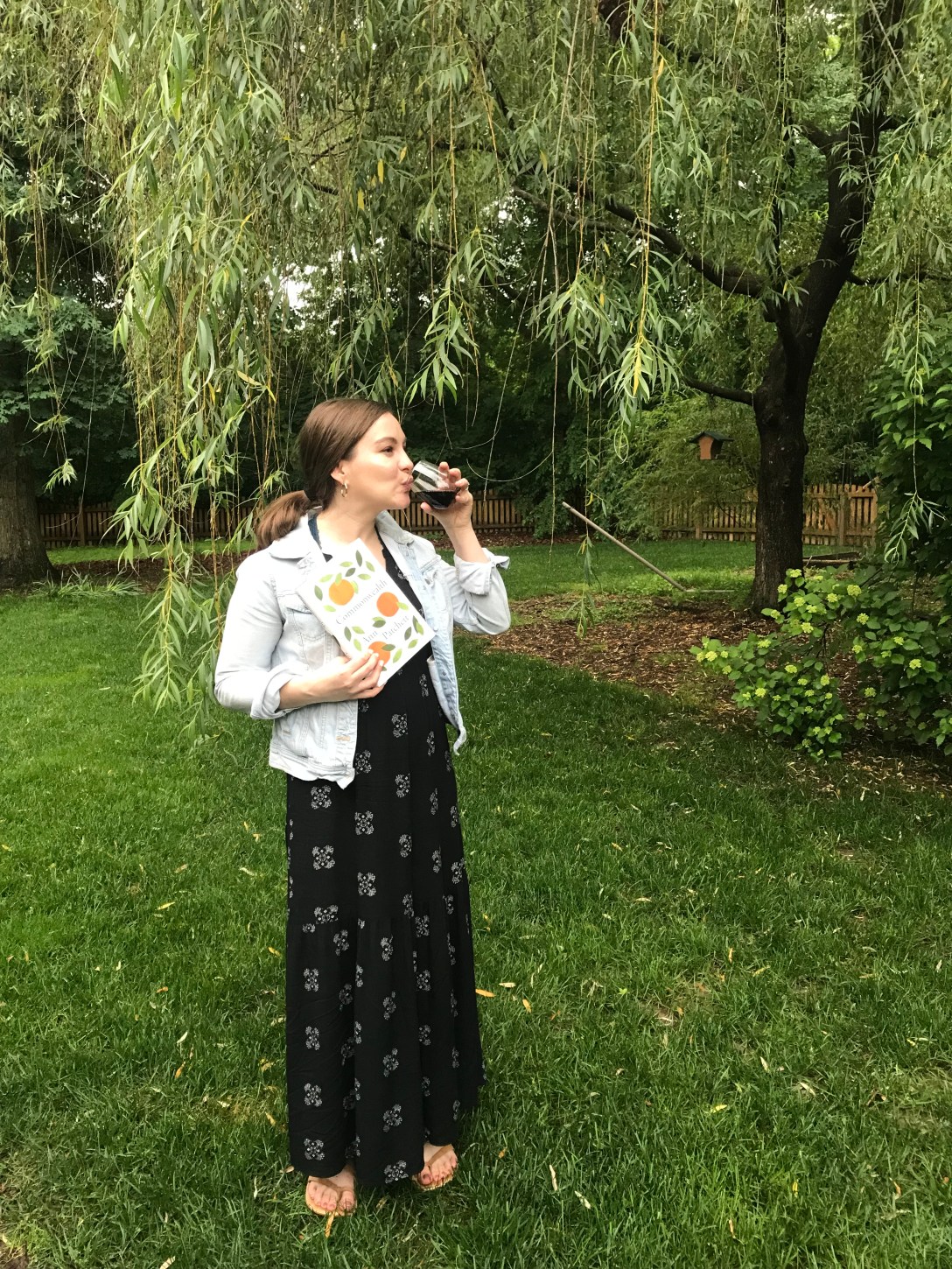
Review: Commonwealth by Ann Patchett

Anna:

It’s official. Ann Patchett is a literary genius.

Commonwealth is hard to explain, and it took me so long to pick up because besides being a multigenerational family tale, the description is pretty vague. I’m so glad I finally read it! This is a book that kept me reading late into the night, and only regretted a little bit the next day at work, which I haven’t done in a while.

The book is extremely character-driven, which is one of the reasons I liked it so much. Despite the depth of characterization, I wouldn’t describe the plot as slow-moving at all–there’s a family tragedy at the center of it all that ties the characters together and keeps the reader guessing.

This book has many different characters and perspectives, which is something I love in a book but is often difficult to do well. Ann Patchett does this beautifully. All the characters are fully fleshed out with real motivations and lives, even the ones that only have a few pages in their perspective. At the end thought about who I would identify as the central character. It’s probabably, Franny–the baby at the baptism responsible for mixing all their lives together in the first place–bringing the book full circle! Yet every other character feels just as vital.

Commonwealth is about guilt, forgiveness, and the complexities of familial love. It’s also set partially in Virginia, where I live and where everything bad in the book happens! I cracked up at all the descriptions of the summer heat and mosquitoes.

VERDICT: 4 books

Which Ann Patchett book should I pick up next? The only other one I’ve read is State of Wonder.

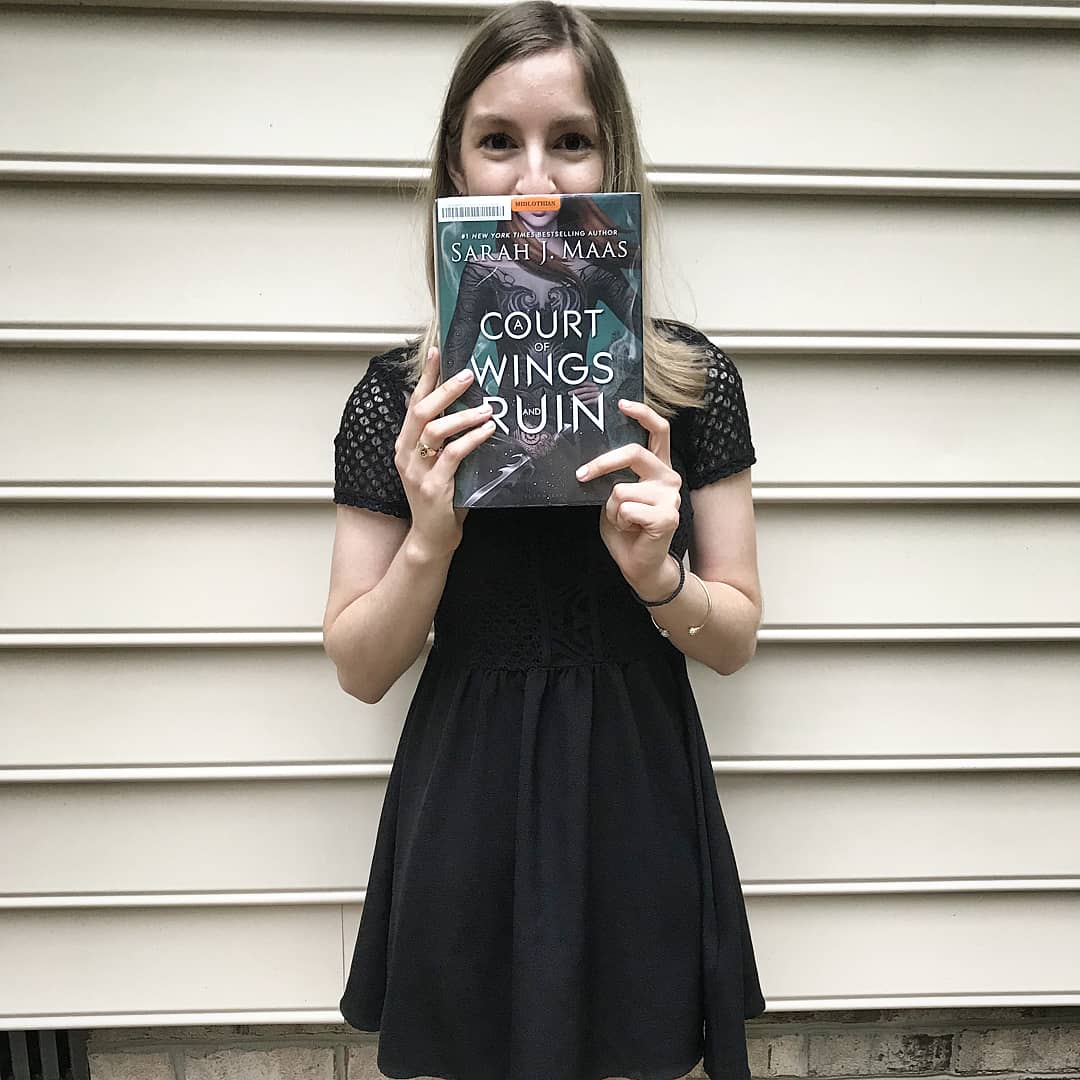
Review: A Court of Wings and Ruin by Sarah J. Maas

Alexis:

Spoilers Below!

Overall, A Court of Wings and Ruin, the third book in the A Court of Thorns and Roses trilogy, was a 4 star read. It was more along the lines of the first book than it was the second book. However, I did have a list of issues with it that I will explain below!

I’ll start with what I liked. Maas’ writing shines when she writes action scenes. I loved reading the war scenes. I thought she did a great job with their pacing and descriptions.

I also loved that Rhysand fully transformed in the final battle. I was like, “Heck, yes!”

I also enjoyed having all the High Fae in the same scenes. Their histories and abilities were very interesting all pooled together.

As for what I didn’t like as much, for some reason, Maas’ writing is just a little bit worse in this book. She has a tendency to lean towards the occasional cheesy line, but this book seemed to bring her cheesiness out just a little more.

This book felt like Maas had been rushed, that she had a deadline that her publisher wanted her to keep, so she wrote this book quickly. And then it wasn’t edited enough. The pacing felt slow. This book is about war, and war does drag on, but the plot doesn’t flow as nicely as it did in A Court of Mist and Fury. Everything just felt slowed down.

And…the sex scenes did not fit as well in this book as they did in A Court of Mist and Fury. They felt cringey and all of them were basically a carbon copy of each other. There’s also a scene where Rhys tells Feyre, “You smell like blood,” after they fought in a battle. And then they have sex. Hmm. I don’t know about that.

And, my biggest issue. I am all for diversity, but not just for the sake of diversity. Mor’s reveal as bisexual was a complete cop-out from Maas. Mor’s been hiding that she’s bi…for 500 years?? Just so she won’t hurt Azriel’s feelings?? Her hiding this from her family for that long did not feel true to character.

As for the plot, I had issues with the fact that Feyre is insanely powerful and yet she HARDLY FOUGHT. Obviously, Rhysand has significantly more war experience, but Feyre is his equal, so they should’ve fought together. Her mention of, “You know, I don’t really like war,” was not a good enough reason for her not to fight.

As for the whole new cast of characters at the end, this also felt like a cop-out from Maas. When Rhysand asked why they couldn’t find them, their answer was, “Oh, I guess we hid too well, so even our friends couldn’t find us.”

If they had been such good friends/allies during the last war, they definitely would’ve found a way to keep in contact with Rhysand and his crew.

As for my last complaint, Armen should’ve died. Rhysand coming back from the dead made sense, but there’s no way Armen could’ve come back after all that.

Despite my issues, I enjoyed the book overall! I definitely think the trilogy is worth a read, just be aware that it isn’t perfect.

VERDICT: 4 stars


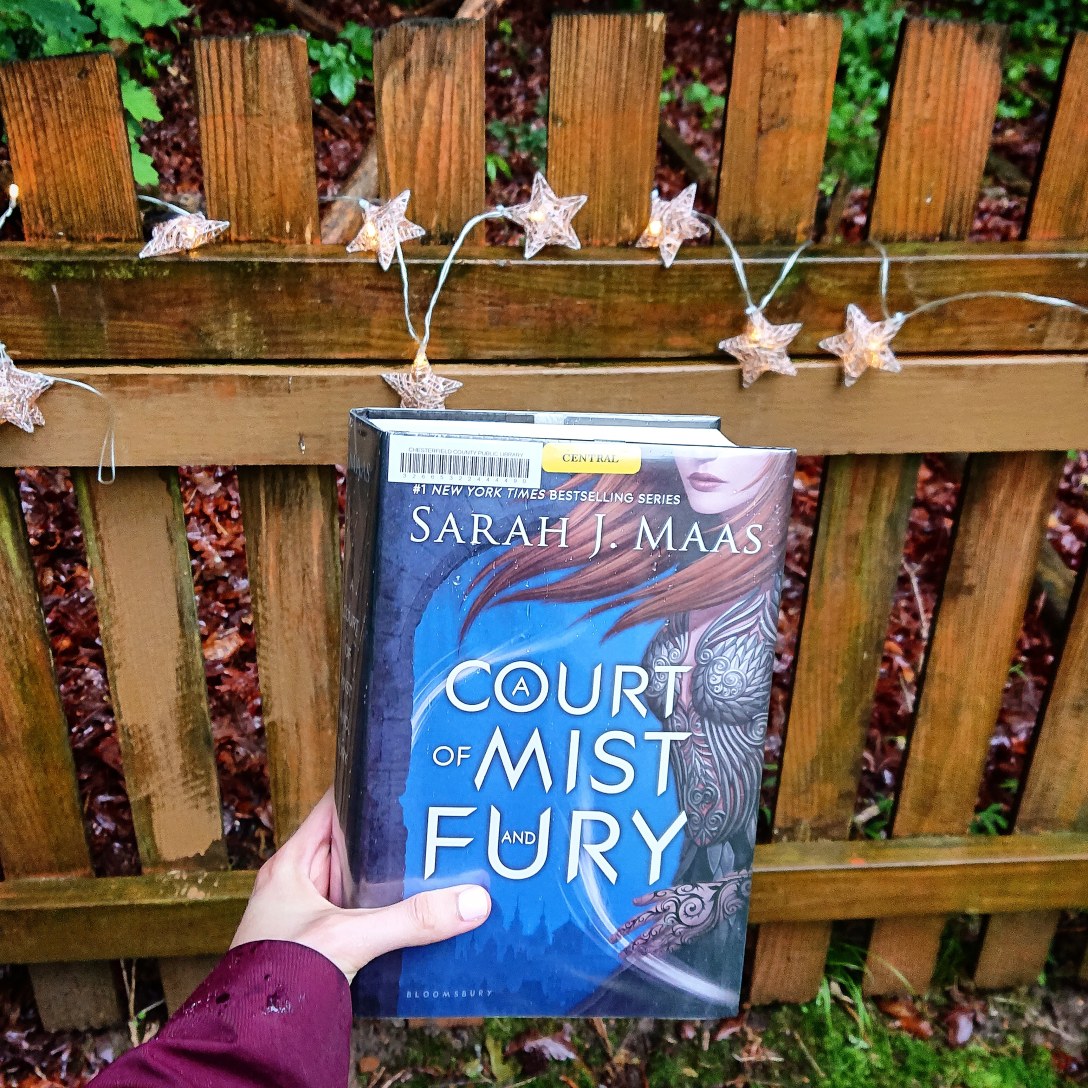
Review: A Court of Mist and Fury by Sarah J. Maas

Alexis:

Okay, let me start off by saying I have a lot of feelings about this book, which is awesome, because if I book can dig down in me and make me feel all sorts of things, then I am here for it!

A Court of Mist and Fury builds off of A Court of Thorns and Roses but makes the world 10 times better. Plot? There’s lot of plot. Characterization? Tons of it. Tragic backstories and permeating feelings of guilt? There’s a lot of that, too. I love character driven stories, and this book dove deep into the characters of Feyre and Rhysand.

It’s hard to talk about this book without spoiling anything, but I’ll write my non-spoiler review first.

First of all, it’s important to address the fact that this book is a monster, as it weighs in at 626 pages. When I first got it from the library, I thought, “What can she possibly go on about for that many pages?”

I will admit, it took me a good 50 pages to get into it. The sex scene towards the beginning was cringey. The beginning was a little slow, but necessarily so, as Feyre dealt with the trauma from the end of the first book. But it quickly becomes interesting once Feyre enters the Night Court. I loved meeting a whole new cast of characters. Sometimes secondary characters feel too bare for me as a reader, but Rhysand’s crew felt very fleshed out.

Maas did a much better job of explaining the magic system, and I enjoyed learning about the world’s complicated history. I loved the whole atmosphere of the Night Court.

I enjoyed Feyre’s character development, and I really enjoyed learning about Rhysand. He’s such a complex character, and I loved learning about his motivations and his backstory. I’m also a sucker for the tall, dark, and handsome type.

Without spoiling anything, let me just say that this is the best relationship/romance I’ve read in a while. I wasn’t all for it in the first book; it was okay, but it was lacking a real depth. But Maas didn’t hold anything back in the sequel.

That being said, there were some small things in this book that I take issue with. While I enjoy Maas’ writing style overall, sometimes she throws out a line that makes me cringe. She writes “snarled” way too many times, and things like “said baldly.” She writes “he purred” more often than I ever want to read; I’m a firm believer in “said” is best. I know the characters are supposed to have a predatory side, but ugh. It was a little too cringey for me.

This book also negated the first book in a lot of ways, which I’ll go into in the spoiler-filled section of my review below.

If you’re debating reading the series, get through the first book so that you can get to this one! I loved the worldbuilding and I especially loved the character growth. I don’t give 5 stars lightly, but I was wholly engrossed in reading this. I stayed up past my bedtime reading this (whoops) and finished it the next day.

I’m excited to read the next one.

VERDICT: 5 stars

SPOILERY REVIEW BELOW:


Feyre + Rhysand—OH THANK GOD. Tamlin had no personality, and I was interested to see how Maas would further their relationship. But she hit it out of the park with Rhysand. He just oozes personality, and he and Feyre actually have chemistry! Yay! I’m very picky when it comes to relationships in books; often it feels too rushed or too out of nowhere. But Maas took the idea of a slow burn and stretched it, so that Feyre and Rhysand actually knew each other inside out and trusted each other with their lives.

I’m also down for anything with flying, and I loved how Maas described Rhysand and the other characters’ wings.

Like I said above, this book did negate some aspects of the first one. After everything Feyre went through to save Tamlin in the first book, she jumps awfully fast to Rhysand. I’m not complaining about it, because it honestly felt true to character, but it was a bit jarring at first. I know some other readers had issues with Tamlin’s actions in the beginning of A Court of Mist and Fury, and felt betrayed by his character and actions. But I wasn’t too fond of him as a character to begin with so…I didn’t mind!

And while Lucien was my favorite character in the first book, he acts like a shell of his former self in this one. But considering how his story arc ended, I’m sure I’ll see much more of him in the 3rd book!
Review: The Book of Dreams by Nina George

Alexis:

The Book of Dreams is a thought-provoking and profound read. It follows four different characters from three different perspectives; Henri, a man who feels he is undeserving of love, who saves a girl from drowning but gets hit by a car and slips into a coma; Sam, his teenage son, who he’s unwillingly never met; Eddie, Henri’s ex-girlfriend and the love of his life; and Madelyn, a twelve-year-old coma patient who we see through the eyes of the other characters.

Though this isn’t classified as magical realism, aspects of it feel very magical realism. The book blurs the line between dream and reality. I won’t explain it any further than that, because I feel it’s best to read this book with fresh eyes.

George explores the cyclicality of life and death, and what it means to straddle the not-so-straight line between the two. She explores love, grief, and regret. Sometimes translations don’t do a book justice, but I found that Simon Pare did a beautiful job. The writing flows really well and George’s descriptions are beautiful and unique. 

This is a very character-driven story. It focuses on the experiences, relationships, and emotions of its three main characters as they navigate life around Henri’s coma. I loved all of the characters and was interested in all of their lives.

Another aspect I love about this book is Sam’s synesthesia: he sees color for numbers, emotions, etc. I loved his character and found his synesthesia added a lot of color (ha) to the story, though I felt like it could’ve been cranked up a notch because I found it so fascinating!

I think the ending of this book is polarizing, but I thought the ending worked well for the book as a whole; George even mentions in her afterword that this book was not intended to be “market friendly.” But I found this book deep, moving, and true to itself.

If you’re looking for a beautifully written book that intensely focuses on its characters and explores the boundaries between life and death, then I highly recommend it.

VERDICT: 5 stars

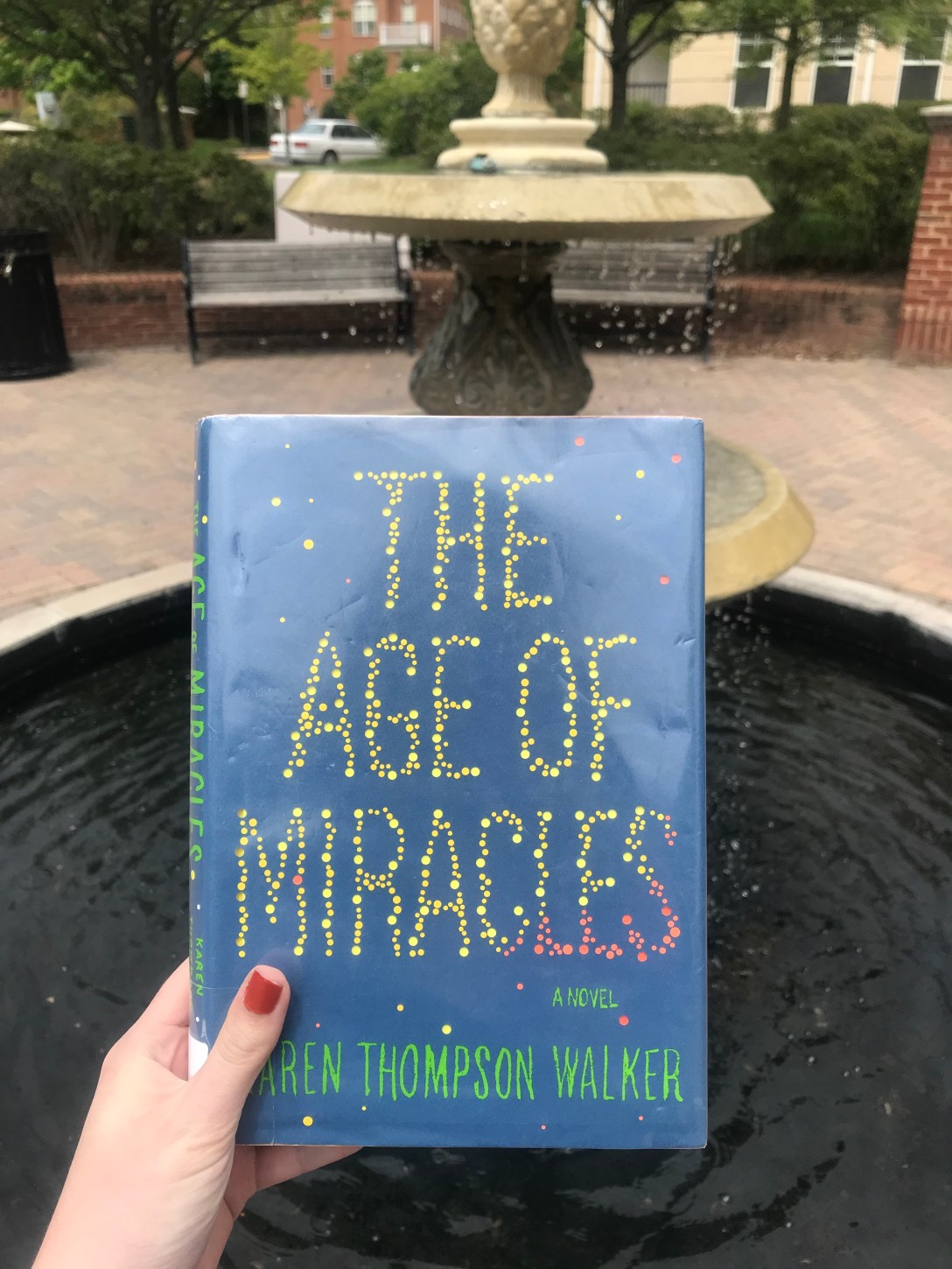
Review: The Age of Miracles by Karen Thompson Walker

Anna: I love apocalyptic fiction, but I heard so many conflicting opinions about this author’s recent release, The Dreamers, that I decided to start with her previous novel.

The Age of Miracles has a lot of potential. At surface level, this book sounds like something I should love. It’s a character drive coming-of-age apocalyptic novel with a young and likable female protagonist, Julia. When earth’s days begin to slow and lengthen, society is split into people who follow the new system of “clock time” and people who abide by the sun and follow “real time”. Those who chose to follow real time are alienated, and the mainstream clock timers begin to exhibit symptoms of a gravity-driven disease.

This book scratches at the surface of something, and then fails to focus on the right things. When something interesting involving the end of the world happened I kept thinking, “we’ll get to that soon” but over and over again, we don’t. The societal division between clock time and real time is such an interesting idea, for example, but it is hardly explored. So much of this book feels like it’s on the surface of something but instead of diving deeper turns away and continues to explore the mundane and expected.

Another big problem I had is that many of the characters just don’t feel believable, besides Julia, who is about only thing about this book that feels real. Julia’s parents are poor stereotypes of a heterosexual marriage. Julia’s mom is always worried, anxious, and nagging her father, while her father is factual and completely robotic. I found it absolutely ridiculous and unbelievable that Julia’s father is completely unworried by the end of the world. HELLO, who wouldn’t be freaking out if Earth’s gravity shifted, people began to get sick, and the days unexplainably lengthened. The fact that he isn’t concerned at all about any of these things drove me insane. The author continually makes Julia’s mom out to be crazy for her anxieties, but since she’s the only character who seems scared by the impending doom, she’s one of the only characters I feel I can trust.

Don’t get me started on Seth. Walker just couldn’t decide what kind of character she wanted him to be. For such a character-driven novel, I expected more dynamic and complicated characters, and this isn’t the case. Both the plot and the characterization fall short.

VERDICT: 3 out of 5 books