Alexis’ September Wrap Up

An orange basket full of books sits on the forest floor.

Alexis: September wrap up time!

Once again, I had a great reading month. And I actually managed to read 3 5-star books!

⭐⭐⭐⭐⭐

For the Wolf by Hannah Whitten

Forestborn by Elayne Audrey Becker

Defy the Night by Brigid Kemmerer

I loved all of these! For the Wolf is a slow-moving, atmospheric new adult fantasy read with plenty of creepy woods, earthy magic, and romance.

Forestborn is about a shifter named Rora, who goes on a quest with her brother and her best friend, Finley’s, brother in order to cure Finley from a magical illness. Rora is a fantastic main character, and Becker’s writing is lovely. I loved the worldbuilding and the quest storyline.

Defy the Night has dual POVs: Tessa, an apothecary who is illegally distributing medicine to cure the poor from a ravaging sickness, and Corrick, the crowned prince and King’s Justice. It’s a classic fantasy with great pacing, well-rounded characters you want to root for, and a well-written romance.

⭐⭐⭐⭐

Lakesedge by Lyndall Clipstone

ACOWAR (re-read) by Sarah J. Maas 

As I’ve mentioned in a previous post, Lakesedge is a lyrical, atmospheric fantasy with dark magic, a run-down estate, and creepy, atmospheric vibes.

A Court of Wings and Ruin is the third book in the A Court of Thorns and Roses series. I already own the other two, and figured I was due for a re-read (plus it was nice to have 700 pages to read to distract me from the fact that I was in the hospital).

⭐⭐⭐.5

Small Favors by Erin A. Craig

Small Favors is a hodgepodge of YA fantasy, historical fantasy, and thriller. When monsters are rumored to have returned to the woods outside of Amity Falls, Ellerie struggles to help her family survive. This is a well-written, chaotic thriller, but ultimately the story is too drawn-out to be a 4-star read.

⭐⭐:

Much Ado About You by Samantha Young

What We Devour by Linsey Miller

Much Ado About You is a rom-com that follows Evie, a thirty-something who spontaneously decides to work in a bookshop in England. While I liked all of the Shakespeare references, the writing was just way too cheesy for me.

What We Devour is a unique book with a grim, bloody magic system in a corrupt world. While I loved the beginning, I had a hard time connecting with the characters, and I often had no clue what was going on with the repetitive plot. There is some great ace rep, as Lorena, the main character, is asexual. But unfortunately, I couldn’t connect with this book as much as I wanted to. 

I’m looking forward to some great fall and Halloween themed reads in October!

Review: For the Wolf by Hannah Whitten

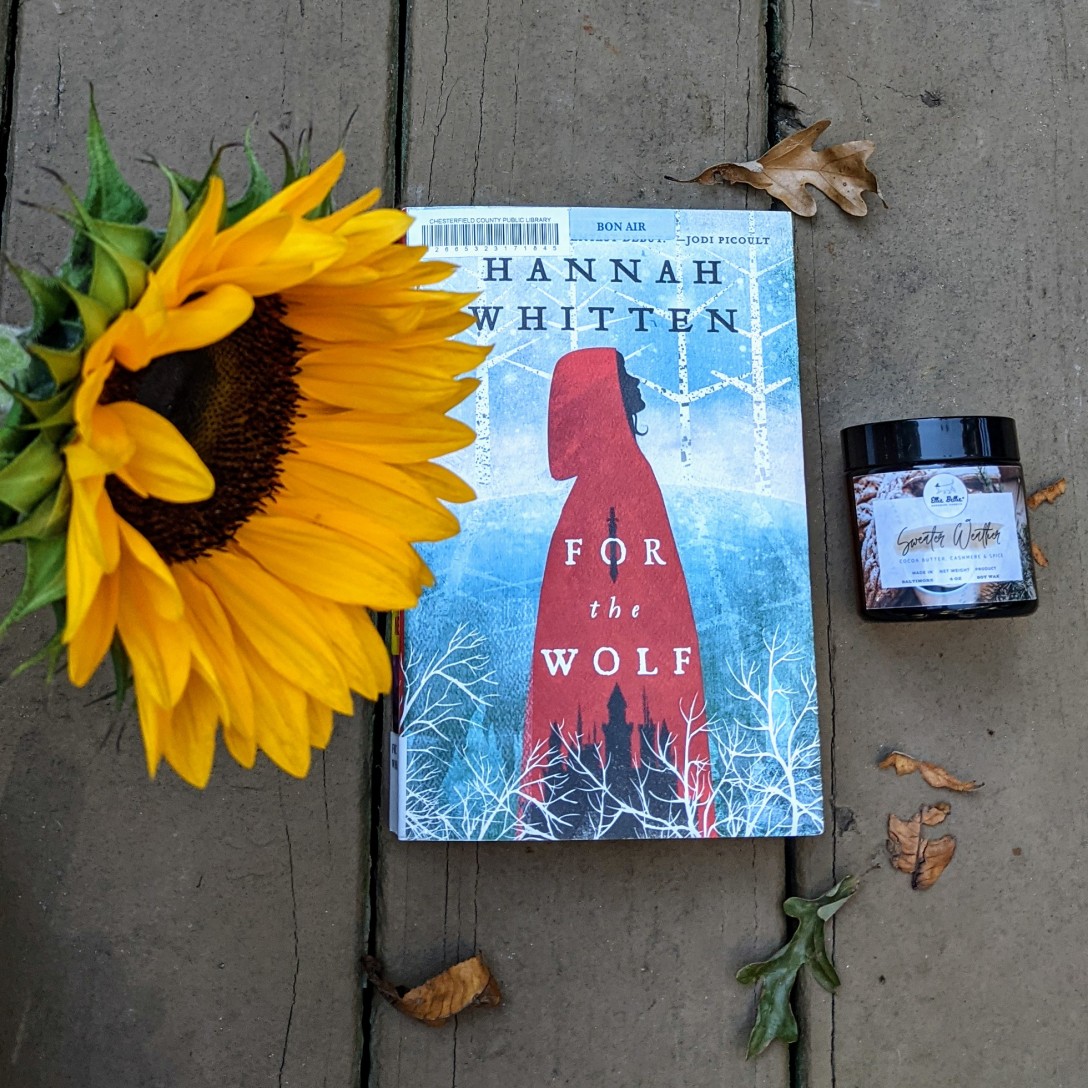
A library copy of For the Wolf sits on a deck flanked by a sunflower and a Sweater Weather candle, along with some fall leaves.

Alexis:

For the Wolf has a lot in common with Lakesedge:

✔️A self-sacrificing man who is seen as a monster to the outside world, but who is only trying to control the environment around him—the environment that is also a part of him

✔️ A run-down estate/castle surrounded by dark, creepy woods

✔️ A slow-paced story of a strong woman attempting to learn how to control her magic

Which of course means that I loved it! I’m always, always a sucker for an atmospheric read with lyrical writing and creepy woods. And this book has so many depictions of dark woods come alive with earthy magic.

Although For the Wolf is being marketed as YA fantasy for some reason, I would describe it as a new adult, romantic fantasy, as Red, the main character, and her twin sister, Neve, are twenty-years-old. 

Red is the Second Daughter of the Queen of Valleydan, which means that she must be sacrificed to the Wolf of the Wilderwood. She’s been told all her life that the Wolf is a monster who is keeping the world’s captured gods from returning. But when she finally meets the Wolf, a man named Eammon, she realizes that what she’s been told is a lie. Meanwhile, stuck as the Princess, Neve, the First Daughter, is doing everything in her power to get Red back from the Wolf, even if it means upending her own world.

As much as I loved this book, I will admit some flaws I noticed while I was reading. While Lakesedge’s magic and worldbuilding is clear, For the Wolf’s worldbuilding is a little hazy. I enjoy slow-paced books, but a lot of answers about the magic system came a little late. We also get short chapters, called Interludes, from Neve’s perspective. And I’ll be honest: I wasn’t really interested in her chapters. However, based on the ending, I think her POV will work well in the sequel. 

While the romance is very similar to that in Lakesedge, I do think it was more fleshed-out and better written in For the Wolf. 

All in all, if you liked similar books, such as Uprooted and The Wolf and the Woodsman, then you might enjoy this one, too!

VERDICT: ⭐⭐⭐⭐⭐

TW: Self harm for magic use (cutting), blood and mild gore, parental death, religious abuse 

Anna’s August Wrap Up

I didn’t read as much as I normally do this month, but that’s okay! I was busy going to the beach and filling my weekends with other end of summer experiences. 

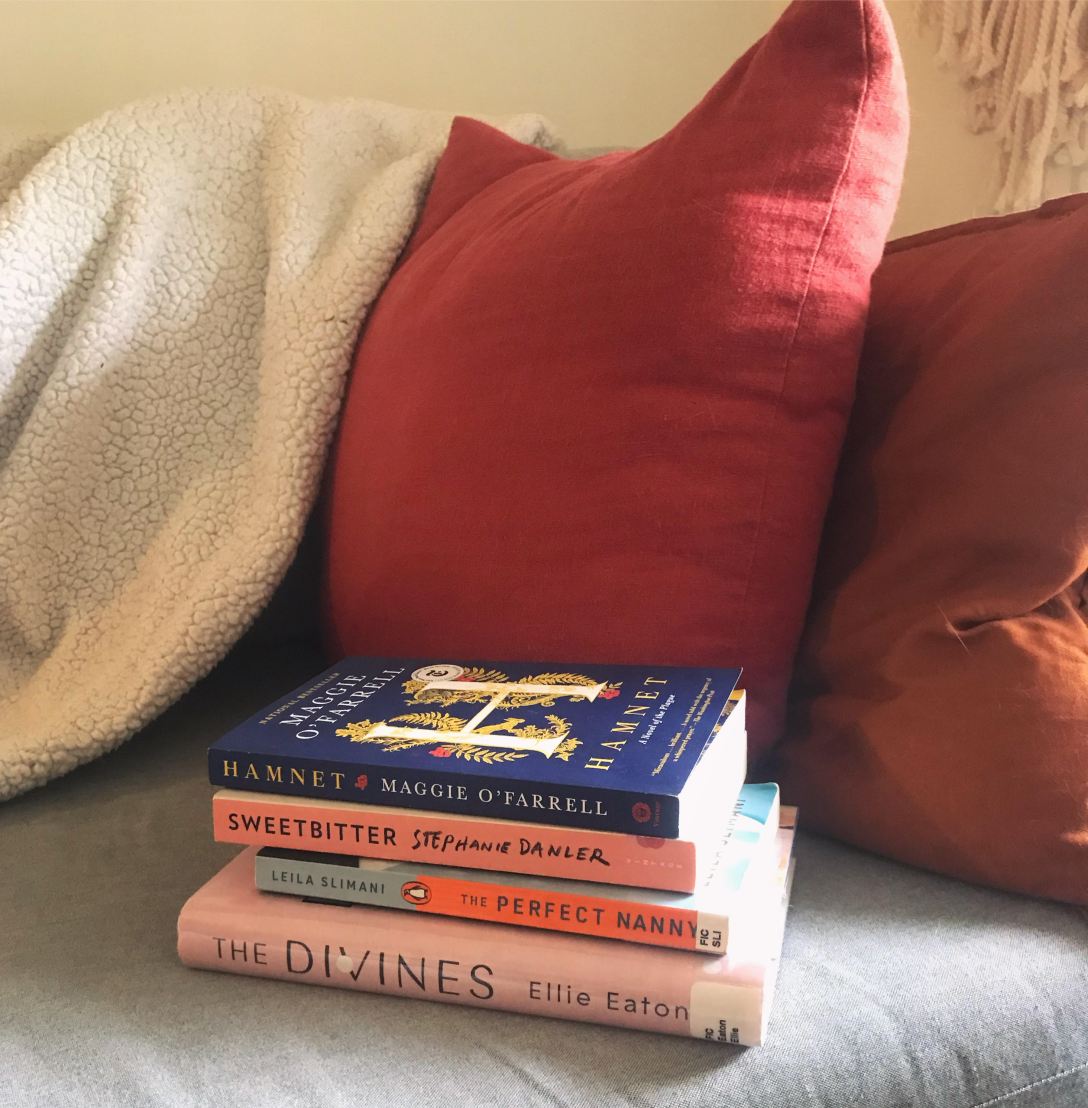
I finally read Hamnet this month, and loved it as much as everyone else did! It’s a lyrical written story about grief and Shakespeare’s (fictionalized) family. This is exactly what I’m looking for in literary fiction- beautiful writing and expertly written characters. Maggie O’Farrell clearly did her research on the Shakespeare family, but she also tells an original story that stands on its own. Hamnet is also the first book that made me cry in years.  

I liked the descriptions of food and NYC in Sweetbitter, but overall it was too slow & way overwritten. My favorite thing about this book is what I learned about working in the restaurant/food industry, specifically fine dining. If you can get through Tess’s overly naive and heady descriptions of her life after randomly moving to New York City, you’ll learn about the inner-workings  and politics of running a famous restaurant. Seriously, this girl doesn’t know anything about New York City (or life) when she gets there. Yet somehow she’s likable, sexy, and a protegee at her job? What saved this book for me, as someone who lived there for a year and worked in two unforgiving industries (publishing & retail), is the love/hate descriptions of working your butt off living in New York City. 

The Perfect Nanny was the most underwhelming thriller I’ve read all year. Translated from French, this book has a lot of half-baked ideas and proclamations about motherhood, race, and class. All these ideas and themes were underdeveloped. 

But the biggest problem I had with The Perfect Nanny is that it’s a thriller, and yet there was no surprise or twist. At the very beginning of the book, we learn that a French couple’s nanny, Louise, has killed their two children. Spoiler alert, she did. And there’s no nuance to why she did it. I also didn’t find Louise’s character very believable. There’s not nearly enough to justify her mental breakdown at the end.

I love a good campus novel with a mystery and vapid teenage girls, and The Divines didn’t disappoint. This one has surprisingly low/poor reviews on Goodreads. Maybe people don’t like it because it’s slow-paced and the characters are extremely dislikable. Although that description also fits the much-loved The Secret History by Donna Tartt French, and I thought The Divines was better. What I really liked about this book was how the reader learns about Joe’s experiences and trauma at boarding school affected her adult life. This book also takes an interesting look at how memories can change over years and how people remember the same events differently. 

I also read Moonflower Murders (not pictured), the second book in the Susan Ryeland series by Anthony Horowitz, which was just as good as the first! I don’t want to spoil anything from book one, Magpie Murders, but these books have some of the most masterful plotting I’ve ever read. They’re also both murder mysteries within a muder mystery. I really hope there will be a book three! 

With August ending, I can’t wait to officially kick off my fall reading in September!

Review: Wild Beauty by Anna-Marie McLemore

Alexis holds a hardcover copy of Wild Beauty in one hand while standing in front of a fence and a forest.

Alexis:

Happy Friday, everyone! This week felt like it flew by.

I’ve just been consuming books lately, so I’m a little backed up on book reviews. But it’s time to talk about Wild Beauty.

I’ve been meaning to read McLemore’s books for a while now; she’s known for her magical realism books and her lyrical writing. And one of the best aspects of this book is her lush, lyrical writing. I love the way she describes the flowers and the gardens of La Pradera. I love magical realism, and reading this book often felt like reading a dream.

The plot: The Nomeolvides women are not like other women. They can create flowers with only their hands—but they’re also cursed. They can’t leave their magical garden estate of La Pradera without getting sick. And on top of that, if they fall in love too deeply, their loves disappear into thin air. But then a boy named Fel appears at La Pradera one day. And Estrella, one of the Nomeolvides girls, tries to help him figure out who he is and where he came from. 

I liked the bixeual representation, and the collection of girls was fun to read about, even if they tended to blend together. I do wish I got to know Estrella’s character even more; Fel was definitely the standout character to me, and the only one who felt like he had a real backstory and motivation. 

As much as I enjoyed McLemore’s writing and imagery, this book was very, very slow moving. And I don’t mind slow-moving, character-driven books. However, oftentimes, this book didn’t read like a book. I’m not sure what it felt like most of the time; maybe a long-form narrative poem? 

Besides the chapters from Fel’s POV, this book has no plot until the last quarter or so. And what surprised me was that the plot was amazing. It was so interesting, and made so much sense in the context of the book, that I found myself a little annoyed. Why didn’t McLemore weave this plot in earlier instead of describing flowers or the girls dancing and conversing for the hundredth time? The ending was powerful, and the way the plot unraveled was wonderful. I just wish it was present in more of the book. 

VERDICT: ⭐⭐⭐/5

Pub day spotlight: The Temple House Vanishing by Rachel Donohue

Anna: Happy publication day to The Temple House Vanishing by Rachel Donahue! Thank you @algonquinbooks for sending me an arc of this book in exchange for an honest review.

Set in a boarding school in an old Victorian house in Ireland, scholarship student Louisa quickly becomes enamored by classmate Victoria and their charismatic art teacher, Mr. Lavelle. Louisa struggles to fit in with her rich classmates, but as she becomes closer to Victoria and Mr. Lavelle, something even darker is underfoot. 

25 years later, an unnamed journalist investigates Louisa’s disappearance. It’s widely accepted that Louisa willingly ran away with Mr. Lavelle, but as the journalist becomes more entangled with the case, it’s clear something much worse happened.


The Temple House Vanishing evokes major My Dark Vanessa and The Likeness vibes. This is a quick, smart, and atmospheric read that explores love, friendship, obsession, race, class, and the ways in which men in positions of power take advantage of young women. I did find the perspective from the journalist a little lacking and would have liked more character development there. We learn little about her own life, besides that she grew up on Louisa’s street and Louisa once babysat her. The only thing we know is that she is a workaholic. I thought something might happen with her intern, who gets a lot of dialogue, but that turns out to be a dead-end in the plot. Then there is also an artistic choice in the epilogue involving a ghost that I found a little strange and a bit cheesy.

But overall, I can’t say no to a spooky boarding school mystery, and this is another one of those.

Review: Betty by Tiffany McDaniel

Anna: If you’re looking for an emotional coming-of-age story I highly recommend Betty. Set in Appalachian Ohio, Betty and her five siblings live with their mother and Cherokee father in a dilapidated house surrounded by racism, poverty, and family secrets. This is also fiercely feminist novel, which I love. 

Betty is about sisterly love, nature, and cycles of trauma and abuse in families. When she is eleven, Betty discovers a deadly family secret that shapes the course of her life. Despite the difficult themes, this book is beautifully and lyrically written. Betty’s dad, Landon, and his storytelling the love of nature he encourages in his children are a driving force of the novel. Her mom, on the other hand, is violent and unpredictable, a product of years of being the victim of violence herself.

This is also an own-voices story, as Tiffany McDaniel is the descendants of Cherokee ancestors, and the characters in Betty are fictional accounts of real family members

Major trigger warning for sexual violence 

VERDICT: 4.5 stars

Review: Disability Visibility: First-Person Stories from the Twenty-First Century edited by Alice Wong

Anna: Why do we read? For entertainment, yes, but part of that enjoyment comes from the thrill of briefly living in and therefore learning about an experience that’s not your own. My favorite books as a kid featured fantasy worlds like Hogwarts and Narnia. As a mature reader, I still find myself reaching for different worlds, but I’m less interested in fantasy. I’m more interesting in learning about the every day lives of other people around the world.

That being said, when I kept hearing about Disability Visibility I realized there was a huge gap in my reading experience.

Disability Visibility is an essay collection edited by the activist Alice Wong. I do not identify as a disabled person, so please take my words with a grain of salt. But this book came highly rated and recommended by disabled people in the bookish community.

This book gives space to an amazing amount of different voices. The essays are about prejudice, misrepresentation in the media, accessibility, advocacy, and perhaps most importantly, just being a disabled person.

This collection also got me thinking about just how many “first person” narratives I’ve really read about disability, both fiction and nonfiction. It’s no new thing that disability has long been misrepresented in the media, especially in the issue of own voices representation. As a teenager I, unfortunately, consumed what I now call “trauma porn”, which romanticized illness and disability and killed off characters, promoting the harmful ideas that disabled bodies are better off dead. This included The Fault in our Stars and Me Before You, the movie adaptation of which casted an able-bodied actor for the role of a quadriplegic.

Now, I try to research authors before reading books, to make sure I read own voices stories. We also like to think that we’re slowly moving toward a more accepting and accessible society. I know that being an ally is more than slapping closed captions on my Instagram stories and reading just one book about disability. But I hope this is just the beginning of my disability reading and learning journey.

Review: Lost in the Never Woods by Aiden Thomas

Alexis:

Well, my laptop stopped charging, and I had to wait to get a new charging port. It’s hard updating a blog without my laptop! Thankfully, it’s all fixed now, so time for another book review!

Lost in the Never Woods is a modern day Peter Pan retelling that takes places when Wendy turns eighteen years old. A string of child disappearances all keep coming back to her, only reminding her of when her own two little brothers disappeared years ago without a trace. And then Peter Pan shows up in Wendy’s town.

I enjoyed Thomas’ writing style in Cemetery Boys, and I likewise enjoyed it in this one. It was spookier and less lighthearted than Cemetery Boys, while keeping the heartwarming magic of Peter Pan. 

The basic plot reminded me of the middle grade series Peter and the Starcatchers, which I read when I was younger, so I think if you enjoyed that series, you’ll like this book. I liked the themes of childhood and trauma that Thomas explores; this book focuses a lot more on Wendy’s trauma and emotions than plot. I’m also always a sucker for a book featuring spooky woods.

My one main critique is that the final plot reveal at the end wasn’t my favorite. Also, the characters weren’t as well-rounded as I would have liked. There’s a smaller spoilery critique that I’ll include down below. But overall, I enjoyed this one. 

VERDICT: ⭐⭐⭐⭐/5

SPOILERS BELOW:

Okay, so Peter Pan romance, right? I don’t have a problem with that except, well, Peter is a child. He goes through a weird growth spurt in this book and ends up being physically around Wendy’s age by the end, but mentally, I believe he was still around 13? I don’t know, it was a little weird having them have a romance at the end when Peter just ends up going back to being a child. As much as I love romance, I almost wish this book had focused more on friendship rather than a really slow burn romance.

Real Talk & a Half-Review: The Once and Future Witches by Alix E. Harrow

Alexis:

Do you think DNFing is talked about enough in the book/literary world? Or do you think it’s perceived as being too negative a topic?

I don’t DNF books often. I only do if I A) really can’t stand the writing style/topic or B) if I lose interest in the story. But I always strive to be as honest as I can when it comes to my reviews. When I read a book, I can’t ignore the fact that I have a creative writing background, so things that some readers can get over/don’t think are a big deal, I often can’t ignore.

All that being said, since I really enjoyed The Ten Thousand Doors of January, I was looking forward to reading Harrow’s new book.

Unfortunately, finishing this book just feels like a chore. I got halfway through, and I found myself not caring about what happens to the main characters.

The Once and Future Witches follows three estranged sisters in the 1890s in a city called New Salem, the City Without Sin, after the original Salem burned down. The sisters join the suffragette movement and attempt to bring back the lost magic of witches. 

While I admire that this book focuses on sisterhood, magic and fairy tales, and the advancement of women, I was never sucked into the story. Despite all three sisters having interesting backstories, they don’t feel well-rounded on the page, and for some reason, I only found myself caring a little about Beatrice/Bella’s character, but not enough about the others to continue reading. 

I don’t mind a slower pace in books; in fact, The Ten Thousand Doors of January has a fairly slow pace. But The Once and Future Witches feels insufferably slow to me. While I love Harrow’s imagery, the writing in this book feels repetitive. The plot seems to move in circles rather than in a line. And important information was revealed later rather than earlier. 

This is a historical fantasy book, set in the 1890’s, as I mentioned previously. But the book is in present tense, despite the beginning being in past tense…? The present tense just doesn’t fit, and I think it was a strange choice. 

And finally, there are some uncomfortable moments for me when it comes to race. Obviously, in 1890’s America, race was a huge issue. I know that “colored” was the term used back then, so why do I feel uncomfortable reading it every time? Maybe because this is a historical fantasy book, which automatically means it’s set in an alternative timeline/alternate history (like New Salem).

Juniper, one of the sisters, curses like a sailor, which again, doesn’t seem to fit in the story. But I’m sure women cursed in the past, right? Oh, definitely. But I know for a fact that “hot damn” was not around during that time period. Most of the curses she spews sound extremely modern, and it takes me out of the story. So if Juniper can swear in a modern way, why couldn’t “colored women” simply be changed to black women? And the fact that Harrow described a Sioux woman as a “clay-colored woman” only made me feel even more uncomfortable. One of the sisters, Beatrice, is heavily involved with a character named Cleo, a black woman, and clearly she is all for equality, but it still doesn’t erase the smaller, uncomfortable details. 

Have you read this one? Do you agree or disagree with me? Maybe other readers will have a different experience; books are up for interpretation, after all.

Review: Stitching Snow by R.C. Lewis

Alexis:

I absolutely loved parts of this book, but other parts bored me.

The first fifty pages didn’t rope me in, but once Essie leaves the cold planet of Thanda, the story becomes much more interesting.

Essie’s character is by far the most interesting part of the story. She’s a strong but well-rounded character, and it’s rare to find a heroine who loves math, coding, puzzles, and mechanical engineering, not to mention cage fighting, in a book. Once we begin to know her character better, her motivations are clear, and her past is interesting. And I absolutely loved her misfit drones, especially Dimwit, a shining character on the page (despite being a drone!). 

I enjoyed how this was a retelling of Snow White. It was fun piecing together all of the sci-fi versions of the fairytale, but the fairytale pieces didn’t distract from the story, only added interesting twists. 

However, I wish the worldbuilding and imagery were more drawn-out. I initially liked Dane’s character, but it was like I could only glimpse him on the page. Even though he was basically in every scene, he started to feel like a background character.  Lewis did a great job describing Essie’s “stitching,” or coding, but when it came to images of the characters or the world, sometimes it fell flat.

That being said, I still enjoyed it overall! 

VERDICT: 🍎🍎🍎.5/5

TW: Kidnapping, child abuse, rape, murder/death, war