Anna’s January Wrap Up

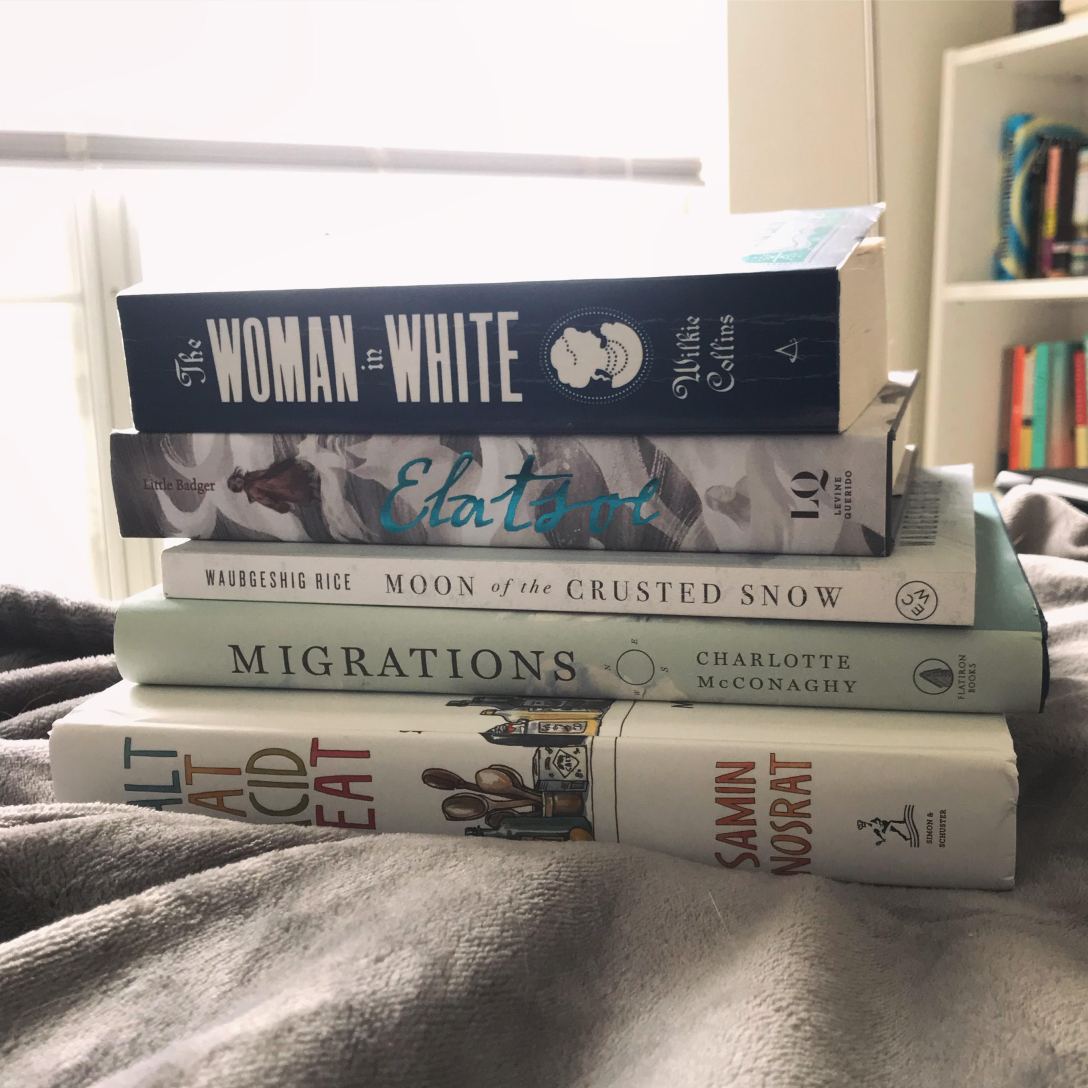
Between continuing to distance from others and the wintery weather, my reading was a major comfort and escape this month. I’m also happy with the diverse genres and authors I was able to read this month. I read two nonfiction books (one memoir and one cookbook), and two books by Indigenous authors, both of which work in favor of my 2021 reading goals. Here’s what I read: 

The Woman in White: Started off the year with an atmospheric, satisfying classic mystery. 

Elatsoe: Spooky magical YA by an Indigenious author. My only criticism is that this read VERY young to me. 

Moon of the Crusted Snow: actually a literary dystopian as promised (unlike Migrations) Written by an Indigenous author.

Migrations: The low point of my reading month. Do not recommend this one. Read my review.

Salt Fat Acid Heat: Mastering the Elements of Good Cooking: This made-to-be-read cookbook changes the food game! Check out my review.   

After the Eclipse: A Mother’s Murder, a Daughter’s Search (audiobook; not pictured); A heartbreaking memoir about the author’s mother’s murder. Also a criticism of the explorative nature of true crime as a genre. 

Review: Migrations by Charlotte McConaghy

book with river behind it

VERDICT: 2 stars

Trigger warnings: Suicide, Sexual Assault

I’ve wanted to read Migrations since before its release. It has great ratings on Goodreads, which proves that you need to take ratings with a grain of salt. I did, however, see a 1 star review from a trusted reviewer. Because of the dystopian aspect, I wanted to read this for myself.

I was disappointed. 

The actual style of the writing is the only thing I liked about this book. It’s lyrical yet concise. But there are glaring holes in the world building and the plot. Then there’s the biggest problem-Franny.

Migrations alternates between two timelines: the past and present. In the present, almost all animals have gone extinct in the world. There aren’t many fish left, and people who still fish are hated. Franny worms her way onto a fishing ship to follow the last migration of Arctic Terns. She tells the captain she is an orithinogist, and that she thinks the Arctic terns will lead them to fish. She is right, for the most part, so she stays on the boat.

We are introduced to Franny’s tumultuous childhood in Ireland. Her mom disappeared when she was young, and she lived with her father’s mother in Australia. Back in Ireland, Franny sits in on at University and meets the love of her life- Insta love style. She and Niall marry immediately, but very quickly it’s a struggle for Franny to stay. 

Franny is the most unlikable narrator I have ever encountered. There is nothing redeeming about her. She is so chaotic that she’s not even a believable character. And the author’s excuse for her behavior? She’s a “wanderer”. She’s unable to stay in one place. Why? It’s in her blood.

SPOILERS: Franny’s defining character trait is violence. She sleepwalks and attempts to strangle Niall in her sleep. She’s in jail for  murder, and it’s unclear if it was on purposeful or not. She also managed to kill two more people over the course of the present narrative. And yet. Franny is a wonderful swimmer and saves multiple people from drowning over the course of the story as well. Her character is completely unpredictable but predisposed to destroy and leave. 

In the past, we know that Franny served time in prison. It’s eventually revealed why. She (accidently?) rammed headfirst into another car, killing Niall and the woman in the other car. Franny claims she did it on purpose. Then she reveals that she saw an owl, which distracted her from the road. Franny is an unreliable narrator, so we don’t really know. Which brings me to my next point. 

Niall, Franny’s husband, is seemingly okay with the fact that Franny will just leave him when she feels she has to. By the end, we are made to understand their relationship is like this-Franny is a wild thing, possibly a bird, possibly something else. She is untamed. Niall is a scientist and by trapping Franny, he’s able to study her closely. But Franny, being a wild thing, kills him in the end.

Franny succeeds(?) in following the birds to their last migration. destroying everything else around her in the process. She plans to spread Niall’s ashes into the sea there. She also plans on killing herself. She spreads the ashes, and then submerges herself, fully intending to end it. But she doesn’t. The book ends with her being released from prison for the second time of her life. Her dad, who has never been part of her life and who is a convicted killer herself, is waiting to pick her up. They drive off together.

Then there’s the complete and utter lack of worldbuilding. This is apparently set in the not-so-far future in which climate change and human behavior has made most animals in the world extinct. For some reason, fishermen have received the bulk of the blame for this act (maybe because there are still some fish in the ocean? It’s not very well explained). This could have been such a rich world and the extinction of the animals could have added another layer to Franny’s story. Instead, the state of the world is barely acknowledged throughout the story. 

Overall: With more developed worldbuilding, maybe I could have forgiven some of Franny’s erratic behavior in this book. Or maybe not. Either way, I don’t recommend reading this. Migration’s book description first reminded me of one of my favorite books, The Lightkeepers by Abby Geni. After reading Migrations, they can’t be compared. Save yourself the pain and read the Lightkeepers instead. 
Review: The Overstory by Richard Powers

book: the overstory

Anna: Verdict: 3.5/5 books

The Overstory follows the lives of several characters who eventually come together. I found myself wondering how in the world these characters and their stories would connect, which is what motivated me to keep reading. There’s one thing all the characters have in common: their love of trees. 

Perhaps like the growth of trees, this is a dense, slow book that’s overwritten at points. It could have been cut by a good 200 pages or so. There’s a lot going on in a forest, and Powers attempts to comment on all of it. 

The beginning- which reads like short stories- is a study and introduction of each character. I like this part of the book best, because I generally enjoy character studies and not a lot of plot. One of the most impressive parts of this book is that all the characters and their stories do become. 

The way that Powers writes about trees is beautiful. I try not to read a lot of reviews before writing my own, but I did peek at some for The Overstory. One Goodreads reviewer called this “tree porn.” Tree porn this certainly is, and I’m blown away by the understanding and research Powers displays on biology and earth science, tree species, and the complexities of environmental activism. I’ve never thought much about terrorism as activism, which is one of the environmental avenues explored in this book. The question of why plant lives are less important than human lives is one of the most interesting themes here, but there’s so much else going on that I think it gets a little lost.

I also didn’t love the ending. I think Powers killed off characters for the sake of not knowing what else to do. Much like the long stories in the beginning, a drawn out ending followed the interlocking narratives in the middle.

Overall, The Overstory, is a massive, detailed, and flashy experiment on trees. I wanted to spend more time in the activism part of the story, which instead fell short (literally) in comparison to the rest. I’m happy I read this, but truthfully I probably won’t read any Richard Powers again.

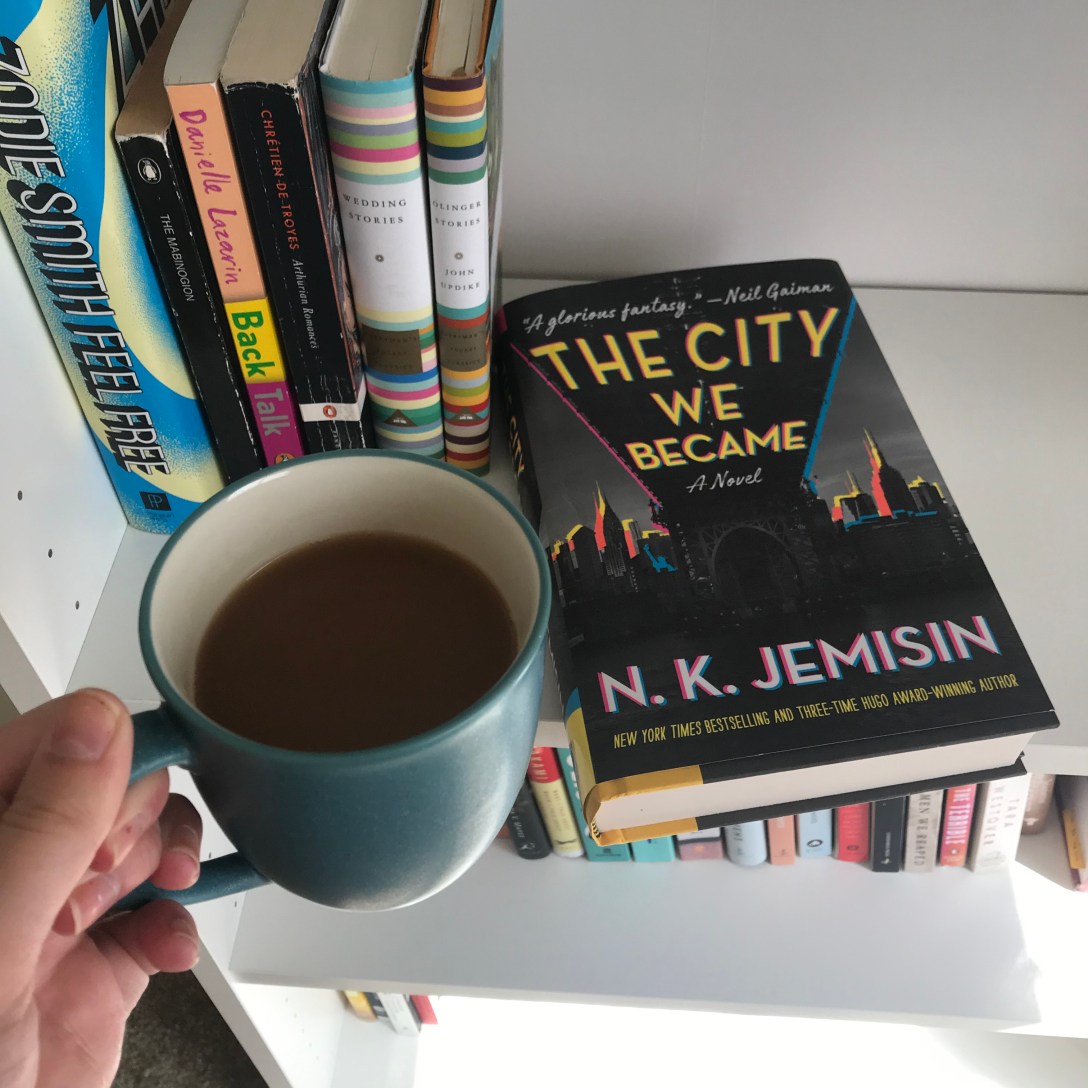
Review: The City We Became by N.K. Jemisin

Anna: I so badly wanted to love this! I love New York City and I lived there for a year, so I want to make a disclaimer that this wasn’t an issue of me not understanding NYC. I also think N.K. Jemisin is a talented author and I enjoyed The Fifth Season

What I liked:

  • Great themes of equality, identity and belonging; fighting hate: racism, sexism, homophobia; and what it means to belong somewhere
  • Wonderfully diverse group of characters of varied races, sexualities, and identities
  • The setting and the complex characterization of New York City

What I didn’t like:

  • Too on the nose
  • Confusing world building
  • Lots of telling and not showing (We are told exactly what something is and what it means throughout)

This is a unique and creative fantasy novel, but not without some thoroughly confusing world building. While I enjoyed the setting and the diverse cast of characters, I couldn’t shake the feeling of being hit over the head with thinly-veiled symbolism throughout. With little room for interpretation and imagination, I’m not sure if I’ll pick up the next book in this series. 

VERDICT: 3 out of 5 books

Review: Bone Crier’s Moon by Kathryn Purdie

Alexis:

I’ll be honest: this book wasn’t my favorite.

Synopsis: In the Lands of South Galle, Bone Criers are a myth, except to Bastien, whose father was killed by a beautiful woman in white when he was a kid. Bone Criers are young women who must lure their soulmates to them, only to kill them as a sacrifice. This rite of passage allows Bone Criers (or Leuress, as they call themselves) to become Ferriers. Ferriers ferry dead souls to the afterlife. 

Bastien vows to take revenge on the Bone Criers, only for him to end up as the soulmate to the same Bone Crier he’s trying to kill. Ailesse is trying to complete her rite of passage in order to one day become the matriarch when she becomes entangled with Bastien, even though she knows she’s destined to kill him.

The plot becomes more complicated from there, but the story is told from three different points of view: Bastien, Ailesse, and Sabine, Ailesse’s best friend.

I found the overall world and the fantasy worldbuilding really intriguing, and the idea of the Bone Criers— and their rites of passage, and the idea of grace bones (bones that the Bone Criers take from wild animals, which grant them certain abilities)—was awesome. The mythology, the lore, and the history, all based off of France, was interesting, and I appreciated the originality. 

Normally, I’m not a fan of more than two POV shifts, but I actually think Purdie did a great job.

There were three main aspects of this book that put me off. 

One: I had a hard time rooting for the characters. Bastien and Ailesse just weren’t interesting to me, and even though I knew their backstories and motivations, I didn’t really click with either character. They felt a little flat, and a lot of the secondary characters also fell flat.

That being said, Sabine was my favorite character. She had the most emotion, and she had the best character arc. 

Two: The romance felt forced. Obviously with the doomed soulmate storyline there was going to be some sort of forced romance, but my point is, there weren’t any real reasons for Bastien and Aliesse to fall for each other outside of: Oh, I think she’s hot. Oh, I think he’s hot. I didn’t think the chemistry was there.

Three: Even with the mythology and the in-depth look at the Bone Criers, I still found myself a little confused hundreds of pages in. I felt like some aspects of the Bone Criers were left unexplained, and so a lot of Ailesse’s solutions to problems felt like they came out of nowhere to me. I often found myself thinking: How does she know that will work? Overall, I thought the plot was good, but Ailesse and Marcel’s deductions just felt off to me. 

On top of that, Purdie’s writing wasn’t my favorite. Sometimes the dialogue felt a little too cheesy and predictable, and it took me about 100 pages in for me to start caring about the story.

Overall, this was just an okay read for me. 

VERDICT: 🌙🌙 and ½ moons /5 


Review: House of Earth and Blood by Sarah J Maas

Alexis:

“Through love, all is possible.”

Maas has a way of writing worlds that suck you in and make you want to keep reading. While this world is pretty similar to the one in ACOTAR, I loved how the world in Crescent City blends modern technology with magic; we don’t get enough fantasy with modern technology, and it was really interesting and fun to see the characters use both cell phones and magic. It was also loosely based off of Ancient Rome, which was cool.

I really enjoyed all of the characters. I liked reading from both Bryce and Hunt’s perspective. They both have a great mix of admirable traits and flaws. And, as usual, Maas is great at writing characters who have suffered from trauma with care.

The first half of this book did a great job setting up the world, the characters’ backstories, and establishing the main plot, while the second half was more fast paced and action packed. While a lot of readers find Maas’ build up slow, I enjoy how she spends time establishing the world and letting us know the characters before diving deeper into the plot. And I thought the plot of this book was intricate. Honestly, even though this book is so heavy on the details and it took me a while the get all the worldbuilding details straight, it was just so much fun to read!

My cons are pretty small. First, let me just say that if you don’t like Maas’ writing style, just don’t pick up the book? A lot of people seem to be giving this book bad reviews without even reading it because they aren’t fans of Maas’ writing.

I will say, thankfully, this book has considerably less drawn out sex scenes; it still has a decent amount of people flipping each other people off, and a lot of f-bombs, which didn’t bother me. I’m still not a fan of her character name choices (Bryce and Hunt? And I never got over Tamlin’s name from ACOTAR) but honestly, that’s such a small bone to pick, and it boils down to personal preference.

Even though I loved reading the ACOTAR series, I thought this book was far better written. I still don’t think her writing is the absolute best, but what she IS good at is writing characters you will want to root for, and writing worlds that you will become obsessed with. And despite the fact that this book is over 800 pages long, I barely wanted to take any breaks from reading it.

Bottom line: this was so much to fun to read! And considering the fact that the plot centers around a murder mystery, apparently murder mysteries are my new definition of “fun.”

VERDICT: 📚📚📚📚📚


Review: The Testaments by Margaret Atwood

Anna: I’m sorry to say that I was so disappointed by this! In the vein of 𝘛𝘩𝘦 𝘊𝘶𝘳𝘴𝘦𝘥 𝘊𝘩𝘪𝘭𝘥, 𝘛𝘩𝘦 𝘛𝘦𝘴𝘵𝘢𝘮𝘦𝘯𝘵𝘴 read like a total money grab. I really enjoyed 𝘛𝘩𝘦 𝘏𝘢𝘯𝘥𝘮𝘢𝘪𝘥’𝘴 𝘛𝘢𝘭𝘦, and in no way did 𝘛𝘩𝘦 𝘛𝘦𝘴𝘵𝘢𝘮𝘦𝘯𝘵𝘴 feel like its sequel. For one, 𝘛𝘩𝘦 𝘛𝘦𝘴𝘵𝘢𝘮𝘦𝘯𝘵𝘴 lacks the tension and literary weight of 𝘛𝘩𝘦 𝘏𝘢𝘯𝘥𝘮𝘢𝘪𝘥’𝘴 𝘛𝘢𝘭𝘦 in every way. ⁣

𝘛𝘩𝘦 𝘏𝘢𝘯𝘥𝘮𝘢𝘪𝘥’𝘴 𝘛𝘢𝘭𝘦 is slow-paced and slowly reveals the horror of the dystopian world of Gilead. 𝘛𝘩𝘦 𝘛𝘦𝘴𝘵𝘢𝘮𝘦𝘯𝘵𝘴, on the other hand, is pace-y, dialogue heavy, and driven mostly by plot. It completely lacks the dark, creeping so prevalent in 𝘛𝘩𝘦 𝘏𝘢𝘯𝘥𝘮𝘢𝘪𝘥’𝘴 𝘛𝘢𝘭𝘦. ⁣

Set fifteen years after 𝘛𝘩𝘦 𝘏𝘢𝘯𝘥𝘮𝘢𝘪𝘥’𝘴 𝘛𝘢𝘭𝘦, 𝘛𝘩𝘦 𝘛𝘦𝘴𝘵𝘢𝘮𝘦𝘯𝘵𝘴 is told in three perspectives. There’s Agnes, who grows up in a prominent family in Gilead; Daisy; living in the free country of Canada; and, wait for it… the third is Aunt Lydia’s perspective. My biggest problem is Aunt Lydia’s storyline, which just wasn’t believable for me. I don’t want to give away any spoilers, but I just didn’t buy any of it. The other two perspectives were interesting enough. That is, until they started to overlap, which is where I really think this book fell apart. ⁣

Unfortunately, I came away from this feeling that Atwood was forced into this book in response to the show. I’m so sad–I really wanted to love this!⁣

VERDICT: 3 stars

In the age of JK Rowling, who has exploited her wold and characters for everything that she can (disclaimer, I still love the original Harry Potter books), I feel that having a bestselling book or series isn’t enough any more.  The new Hunger Games book coming out this year, The Ballad of Songbirds and Snakes, is a prime example. It’s a prequel to the series that reveals the backstory of President Snow. I’m so over prequels and have no desire to read this. I think that sometimes there’s value in letting a good book or series stand on it’s own. I know things like book deals and an author’s career are part of this, but I think I’ll be avoiding any long-awaited add ons to old favorites for a while.


Our Favorite Books of 2019

Happy New Year’s Eve! And what a year it’s been! Anna’s highlights were starting work full time, getting married, and adopting her dog! Alexis started her MFA program, got a short story accepted for publication, and adopted her cat! 

Here are some of our favorite books of 2019:

Anna:

The Glass Castle by Jeanette Walls

Small Fry by Lisa Brennan-Jobs

Normal People by Sally Rooney

We Are Okay by Nina LaCour

Long Live the Tribe of Fatherless Girls by T Kira Madden

The Witch Elm by Tana French

In the Woods by Tana French

Borne by Jeff VanderMeer

City of Ghosts by Victoria Schwab 

Burial Rites by Hannah Kent

The Goldfinch by Donna Tart


Alexis:

Children of Blood and Bone by Tomi Adeyemi 

The Wildlands by Abby Geni 

Airborn by Kenneth Oppel

The Book of Dreams by Nina George

A Court of Mist and Fury by Sarah J. Maas

The Scent Keeper by Erica Bauermeister 

Grim Lovelies by Meghan Shepherd

Etta and Otto and Russell and James by Emma Hooper

Gods of Jade & Shadow by Silvia Moreno-Garcia 

The Island of Sea Women by Lisa See

City of Ghosts by Victoria Schwab

Florida by Lauren Groff

The World That We Knew by Alice Hoffman


Here’s to a great 2020!


Review: The World That We Knew by Alice Hoffman

Alexis:

Despite the fact that the characters were a little too distant and one dimensional for my taste, this was still a five star read for me. Hoffman’s writing is haunting, beautiful, and lyrical. I love magical realism, and this book is a wonderful mix of magical realism, historical fiction, and folklore.

The book focuses on Lea at the beginning of WWII during the Nazi regime. Lea’s mother’s one goal is to keep her daughter safe, so she does the unthinkable: finds Ettie, the daughter of a rabbi, to create a golem, a powerful magical creature/person made from clay, who is to protect Lea at all costs.

This is a Holocaust story, and Hoffman doesn’t shy away from the horrors that the Jewish people of Europe faced. But I love the way Hoffman weaves small beauties into the story, especially with the relationship of Ava (the golem) with the heron. The heron was a beautiful symbol throughout the book. Out of all of the characters, I actually felt like I connected with Ava the most.

This is a survival story, so while I prefer to get into the heart and soul of the characters, the distant POV felt right with the atrocities the characters face in the story. Hoffman focuses on what it means to be human, and what it means to survive.

VERDICT: 5 stars

Review: City of Ghosts by Victoria Schwab

Anna: If you’re looking for a spooky middle-grade read this fall, City of Ghosts is the book for you! Cassidy Blake isn’t a normal girl: after a near-death experience, she can see ghosts and move between the ghost and human world.

I really liked Cassidy as a protagonist, though I did think her relationship with her parents was a little lacking and hope it is developed more in the sequel. Edinburgh is also the perfect ghostly backdrop to this story. Honestly, this would have terrified me as a kid. 

VERDICT: 4 stars 

Support Independent Bookstores - Visit IndieBound.org