Review: The Goldfinch by Donna Tartt

Today I’m introducing a new favorite book! Check out my full spoiler-free review on our blog (link in bio!) My mom read this years ago and tried to get me to read it at the beach, but The Goldfinch is so incredibly detail-heavy that I couldn’t get into it. After reading The Secret History last year, I decided to give The Goldfinch another try.

I’m glad I did! This book is quite a feat to get through, but it’s worth the journey a hundred times over (and it made me miss New York so much!) If you like long and sweeping coming-of-age stories, this is the book for you. Like The Secret History, The Goldfinch is especially drug-heavy and most certainly not any easy read. I knew vaguely it was about art history when I started, but I never imagined the twists and turns this would take, or the impression it would leave!

What I love most about The Goldfinch is our protagonist, Theodore (Theo) Decker. Struck by tragedy in the first chapter (and then again, and again) some would say that he has an incredibly unlucky life. He makes someone bad choices that oftentimes you want to hit him over the head and scream, “What are you doing?” It’s his own difficult life and the messy relationships with the other characters–especially Boris, Pippa, Hobie, and even Popper–that give this book such a spark of life. When it was over, I’d spent so much time getting to know the characters that I didn’t want it to end!

The Goldfinch explores fate, grief and loss, the complexities of friendship, loyalty, and morality, the price of freedom, and the importance of fine art and historical objects of meaning. By the end I felt exhausted, but in the best way.

However, this book is A BRICK, which is why I found it easier to listen to on audio. The narrator did an incredible job making each character sound unique. I never would have been able to imagine Boris’s accent if I’d read this on my own.

VERDICT: 5 books! 
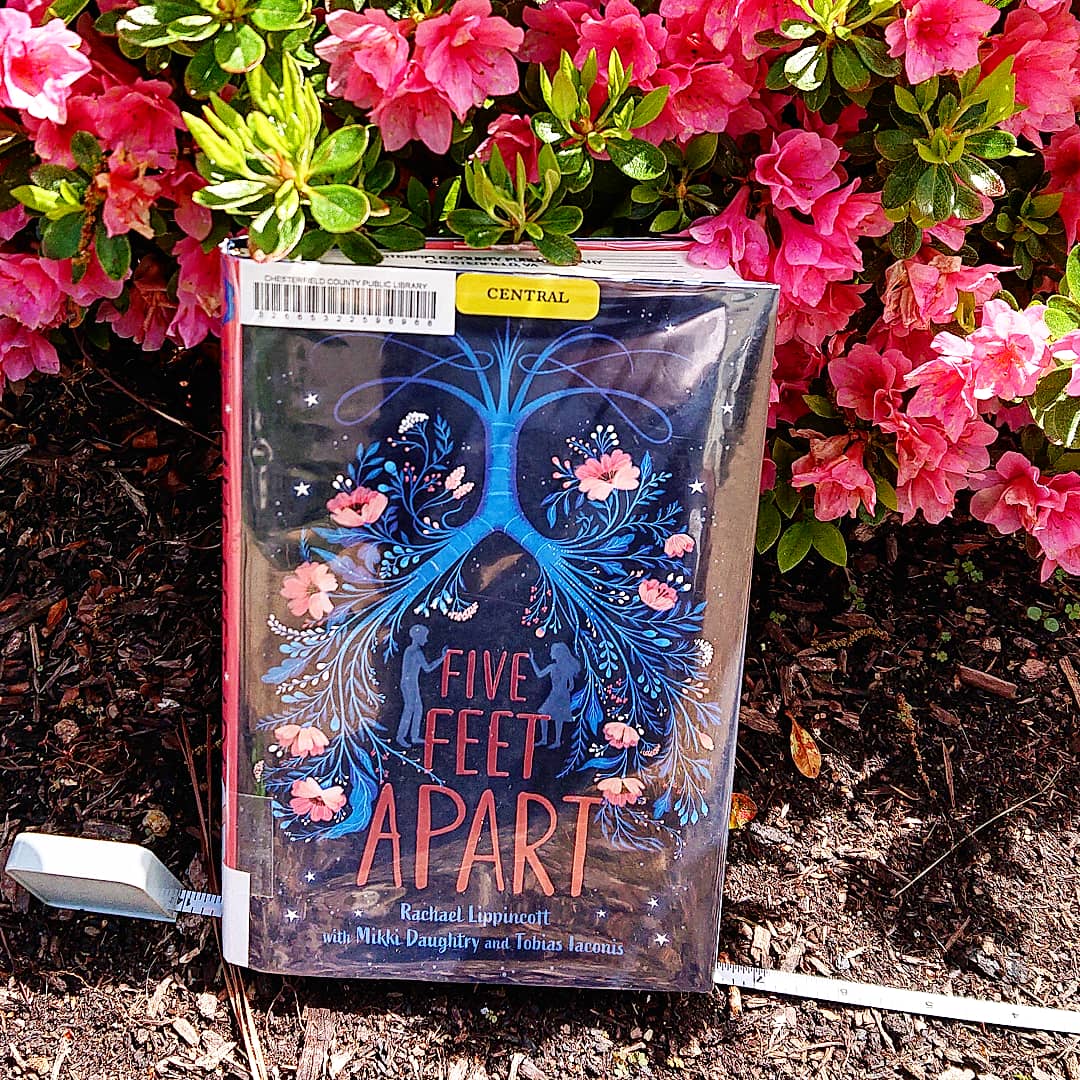
 

Review: Five Feet Apart by Rachael Lippincott

Alexis: Read 4/18/19

I was hesitant to read this. I put it on hold at the library so I would have time to think about it for a while, and a month later, I got an email that I could pick it up. And I decided, you know what? Why not!

For those of you who don’t know, last year, my lung spontaneously partially collapsed twice, a couple months apart. After the second one, I had surgery to adhere my lung to my chest wall so that it won’t ever happen again. But because of this, Five Feet Apart was super relatable for me. I found myself knowing how horrible it is not to be able to breathe, to literally feel your lung keep you from taking a deep breath as it fills your body with pain.

That being said, I do not have cystic fibrosis, and I can’t begin to know what it feels like to have a terminal illness. But this book brought back a lot of memories and feelings, and I identified with parts of Stella and Will’s ordeal.

Now, onto the review. I don’t have much to stay about the book other than well done. This is definitely this generation’s The Fault In Our Stars. The story is told from two different perspectives: Stella’s and Will’s. I love alternating POV’s and I found it worked really well for the story. And while I wasn’t a huge fan of Stella or Will’s characters at the beginning, I really enjoyed their journeys and their full character arcs by the end.

The writing style is very conversational. I enjoyed how the authors had the characters use so much modern technology because it felt very true to people/teenagers in real life. I will say that yes, parts of this book are cheesy, and yes, I guessed the ending halfway through. But Stella and Will’s relationship moves at an appropriate pace. I liked all of the characters’ backstories and motivations.

All in all, I think this is a solid YA read that achieves awareness of cystic fibrosis while telling a good story. I’m excited to watch the movie!

VERDICT: 4 ½ stars

Review: Cruel Beauty by Rosamund Hodge

Alexis: Read 4/16/19

Why do I always really enjoy the first half of a book, only to really dislike the second half? That’s how I felt about Cruel Beauty.

Cruel Beauty is a Beauty and the Beast retelling. I’m a fan of fairytale retellings, and I actually took a seminar on Beauty and the Beast while I was in college. But what’s different about this retelling is that it blends the fairytale with Greek and Roman mythology and history.

The story is set sometime after the fall of Rome in Romana-Graecia, in a fictional land called Arcadia that was cut off from the rest of the world and held captive underground by the Gentle Lord. The Gentle Lord makes cruel bargains with the people of his land and sometimes sets his demons on them. The Greek and Roman influence was an interesting change of pace, as the original Beauty and the Beast story is from France. I love Greek mythology, and I loved the mix of Latin and Greek terms, history, and terminology. The stories told in the book took me back to my Latin classes.

In this book, the magic is called the Hermetic arts. The main character, Nyx, was trained by her father in this art, which is connected to the four elements. Nyx can use sigils to sort of control the “hearts” of each symbol. While this sounds interesting, not only was the magic never explained any deeper, but it was never useful in the story.

Here’s a basic outline of the plot: When Nyx’s parents couldn’t have children, Nyx’s father made a bad bargain with the Gentle Lord. Nyx’s mother bore twins but died in childbirth. The Gentle Lord required that Nyx be married to him, while Nyx’s sister could live free for the rest of her life. So the book opens up with Nyx marrying the Gentle Lord, who’s also called Ignifex.

I really did enjoy the first half of the book. All of the original aspects of Beauty and the Beast are there: the roses, the mirror, the enchanted castle, the question every night, and a beastly prince of sorts. Nyx’s mission is to kill Ignifex in order to save her land from his terrible reign. The first half focuses on her exploring the castle and trying to find its Hermetic hearts, which was my favorite part of the story.

I wasn’t a huge fan of Nyx, who mostly complained about her tragic fate and battled with her intense hate for her family and Ignifex. But I appreciated that she was a strong female character who made her own choices and expressed her strong emotions. Her relationship with her sister was weird, and as a twin myself, it didn’t feel like a true twin relationship, though some of it was intentional due to the characters’ circumstances. To be honest, I wasn’t a huge fan of any of the characters except for Shade.

As for the second half, there’s a really weird love triangle that didn’t work for the story. The plot starts to go downhill and then becomes convoluted. Nyx and Ignifex’s relationship is abusive, with Nyx hitting him basically every chapter and Ignifex being emotionally abusive. Nyx remembers an important plot-point only to forget about it until the very end, which was supremely annoying. There’s no clear antagonist. And the ending has a weird alternative time thing that’s even hard to describe.

I obviously have a lot of thoughts about this book. I was pleasantly surprised by the first half and disappointed in the second half. If the ending was different, this would’ve been a solid read!

VERDICT: First half: 4 stars

Second half: 2 stars

Total: 3 stars

Used Bookstore Haul

Alexis:

A bookstore where everything is $3 or under? Yes, please! I picked up four books, the max I should probably put in my suitcase, from Lucky Dog Books in Dallas, Texas. My boyfriend, who reads nonfiction/business books, found 5 books!

  1. On Gold Mountain by Lisa See
  2. Cruel Beauty by Rosamund Hodge
  3. Water Wings by Kristen den Hartog
  4. Rose’s Garden by Carrie Brown

Alexis’ April tbr Stack

🌺Alexis’ April #tbr stack🌺

Did March fly by for anyone else? I kind of wanted winter to be longer; I’m not ready for all this pollen.

FYI: All of these books are secondhand!

  1. Airborn by Kenneth Oppel
  2. Better Than Fiction, Edited by Don George
  3. Idlewild by Nick Sagan
  4. A Court of Thorns and Roses by Sarah J. Maas

Review: King of Scars by Leigh Bardugo

Alexis: Read 3/24/19

I loved the first half of this book. I loved Nikolai’s internal (and sometimes external) battle within himself. I enjoyed learning more about Zoya: her past, her innermost feelings, her motivations. And at first, I rejoiced in Nina’s chapters, especially after her ending in Crooked Kingdom.

King of Scars is told in third person from various perspectives, including Nikolai, Zoya, Nina, and a man named Isaak. I’m glad Bardugo decided on third person, as I think it worked perfectly for the world in Six of Crows, and ultimately served a better purpose than the first person of the Shadow and Bone Trilogy.

I enjoyed the masterful worldbuilding and name dropping of characters from previous books. Bardugo has really cemented the Grishaverse. And I really enjoyed how the plot was building. However, the second half started to meander. Zoya ended up being the primary character, rather than Nikolai himself. The book’s title is literally Nikolai’s nickname, and yet he sometimes gets lost in the sea of other characters.

I honestly wanted to skip over Isaak’s chapters; I felt like his information could have been revealed later and it would have served the book better, even if the the reader wouldn’t get to know him as a character. But I really just didn’t care about him.

Nina’s chapters began to feel drawn out. As much as I enjoy her as a character, I found myself wanting to stay with Zoya and Nikolai’s storylines. I almost wanted Nina’s chapters to be separated from the rest of the story, maybe as its own short book.

My primary concern, besides Nikolai not being as center stage as I wanted him to be, was where the plot ended up. It was building up to such a great place, but then the ending ruined it for me. I’ll avoid spoilers here and go more into that below.

This book definitely felt like a follow-up to the Shadow of Bone trilogy, which I didn’t like nearly as much as the Six of Crows duology. I was hoping for more of a Six of Crows feel, with the masterfully crafted plot and characters. I just wish the book had only switched in POV from Nikolai to Zoya and that the plot was…different. Even with my mixed feelings, I still love the characters and Bardugo’s world, and I flew through this book.

The first half of the book: 5 stars. Second half: 3 stars

VERDICT: 4 stars

 
SPOILERS BELOW:

I felt like most of the plot reveals in the second half of the book were a little too coincidental. Hanne just happens to be the daughter of Brum? The Saints just happen to be alive with the answers to a greater power for Zoya? And the biggest of all: the Darkling’s comeback. It felt like a cop-out to me. I wanted something as equally as dark to be the main antagonist, but I wanted something different. The Darkling’s story was supposed to be over. With all the tumultuous politics going on, I just felt like the ending could’ve gone in a different and better direction.


Review: Pachinko by Min Jin Lee

Alexis: Read 3/17/19

Well, this book is certainly a saga. It feels like three different books, because really, it is. Pachinko covers four generations of the same family, from the early 1900’s to the 80’s. The story opens with Sunja, a Korean peasant, who meets a wealthy businessman and forms a relationship with him. When Sunja becomes pregnant, she finds out that the businessman is already married. So instead, she accepts a generous offer of marriage from Isak, a sickly Protestant preacher.

The amount of detail Lee manages to pack into this book is astounding. She covers the historical and political aspects of each time period. The book especially focuses on what it means to be Korean during a time when the country is taken over by the Japanese and then later split into two. Her characters deal with the dysphoria that they feel as Koreans living in Japan, as well as discrimination. I really enjoyed learning about the history and culture of Korea, and I could really go for some Korean or Japanese food right about now!

While extremely detailed, Pachinko is written matter-of-factly, with no flowery descriptions. Lee writes from a distant, omniscient point of view. At the end of the book, Lee discusses her reasoning behind this. She says, “‘Fair’ seems like a simple word, but I think because my subject matter is so troubling and controversial, I wanted my narrator to be as objective as possible” (494). Lee certainly achieves this, as the book, especially the first half, almost reads like a historical account. At first, I found the tone off-putting. But once the book became more political, I understood the need for distance. Still, that doesn’t neglect the fact that I prefer to get more into characters’ heads and emotions. I love character-driven stories, and while this was that, I never felt too involved in the characters’ lives.

For example, Lee has a bad habit of simply stating “and then he died.” When she did this in the beginning of the book with Yoonie, Sunja’s father, I did a double-take. She nonchalantly stated his death and they hardly went into it in the next chapter, and she repeats this throughout the book. While I understand her distance, as a reader, this was very off-putting. I wanted to feel each death and life-changing event the way the characters did.

Overall, I really enjoyed this book, even if I had to enjoy it in chunks. I learned a lot about Korea’s history and the history of misplaced Koreans. I really don’t know how to rate it as a whole, as it covered so much ground.

History and detail: 5 stars

POV and writing style: 2 stars

Characters: 4 stars

Review: Caraval by Stephanie Garber

Alexis: Read 3/2/19

Unfortunately, I found Caraval so much worse than The Night Circus. I know a lot of comparisons have been drawn between the two books, so I thought I would give you my own.

The Night Circus is beautifully written, with lush and lyrical descriptions, but is very slow moving and has a sparse plot. I can’t say the same thing about Caraval’s writing. It felt middle-grade (and not in a creative way) and cliché. However, it is fast-paced and there is a layered plot. Both books have insta-love, though I have to say the relationship in Caraval actually felt more convincing.

So let’s delve more into Garber’s writing. Throughout the book, she relies on one particular, peculiar type of metaphor: the insert color was insert emotion. Here’s an example: “…a blaze of shimmery gold, the color of magic and wishes and promises of things to come” (14). Here’s another: “A ruby welt bloomed across his cheek. The color of rage and punishment” (45). Here’s a third: “…a rich cerise—the color of seduction and secrets” (660).

I usually love repetition, whether in motifs, anaphora, etc. But the repetition of these metaphors drove me crazy. They’re cliché and terrible and made me say “really??” out loud too many times. And none of them even made sense!

Another thing that drove me crazy was that half of the plot was predictable. You know from the beginning that Scarlett is going to get together with Julian. There was only one plot point towards the end that I didn’t see coming.

As for the characters, I only liked Julian, but only because he’s the only character with somewhat of an interesting personality. He’s your classic “dark and handsome but is he good or bad?” type of guy with Edward-Twilight caramel eyes: “light brown, the color of caramel and liquid amber lust” (172). The descriptions of him were super cringey.

I found Scarlett to be too whiny and annoying, and Donatella wasn’t much better. Even their names seemed to get in the way of the story; it was as if their names drew too much attention from it. It doesn’t help that Scarlett’s name is also a color, so her name is thrown around with all of the cringey color metaphors. One of the characters even says of Scarlett, “You’re so dramatic, you would’ve made a fantastic performer” (308). And god, was he right.

The dialogue doesn’t have any subtext. I absolutely hated that Governor Dragna is described as dragon-like. And I could’ve cared less about the plot of this book.

I think the one word that sums up this book is cringeworthy. I really wanted to like it, I enjoyed how the book opened up with letters, and I initially though Garber’s worldbuilding was good (in the first 10 pages). But this obviously wasn’t the book for me.

VERDICT: 1 and ½ out of 5 books

Review: Ruin and Rising by Leigh Bardugo

Alexis: Read 2/20/19

Ruin and Rising was certainly the best book of the Shadow and Bone Trilogy. I disliked Alina’s character in the first two books, and I felt like she became a more complex character in this one. Additionally, Mal had zero personality in the first two books, and he felt more real to me in Ruin and Rising, as well.

Everyone can agree with me here: Nikolai is still the most vibrant character. He has a sparkling personality and he knows what he wants. He echoes the beginning of Bardugo’s masterfully crafted characters in the Six of Crows series.

As for the plot, I feel like the first half of the book meanders. There’s a whole host of secondary characters that I didn’t really care about, except for Genya.

And time for an unpopular opinion: I don’t like the Darkling. He’s creepy, manipulative, and honestly rapey. His beauty doesn’t make up for that.

SPOILERS BELOW:

Okay, so I really enjoyed the plot twists in the second half of the book. Mal being the third amplifier? Nikolai getting turned into a monster? I didn’t see either of those coming, and it made the book more exciting!

The ending felt very Hunger Games to me: boy and girl get together and live a nice, normal life together, where they can grieve together forever. I honestly didn’t mind the ending, as I think it was the happiest ending for Alina and Mal. But Alina losing her power was anticlimactic and confusing. It felt unnecessary. Plus, she had such a good character arc by Ruin and Rising that I felt it was unfair for her to return to how she was in the beginning of the series.

Despite some of my issues with this book, I really enjoy the Grishaverse and I couldn’t put this book down. I enjoyed seeing Bardugo’s writing style evolve!

VERDICT: 4 out of 5 books