A chill Saturday morning read

Anna: I’m so excited for this chill weekend! Have you read My Sister, the Serial Killer? My library hold FINALLY came in, and I’m really enjoying the to-the-point writing style and intriguing story/mystery so far! I love stories about sisters, even murderous ones!

Support Independent Bookstores - Visit IndieBound.org

I hope you have fun (or chill!)  weekend plans?

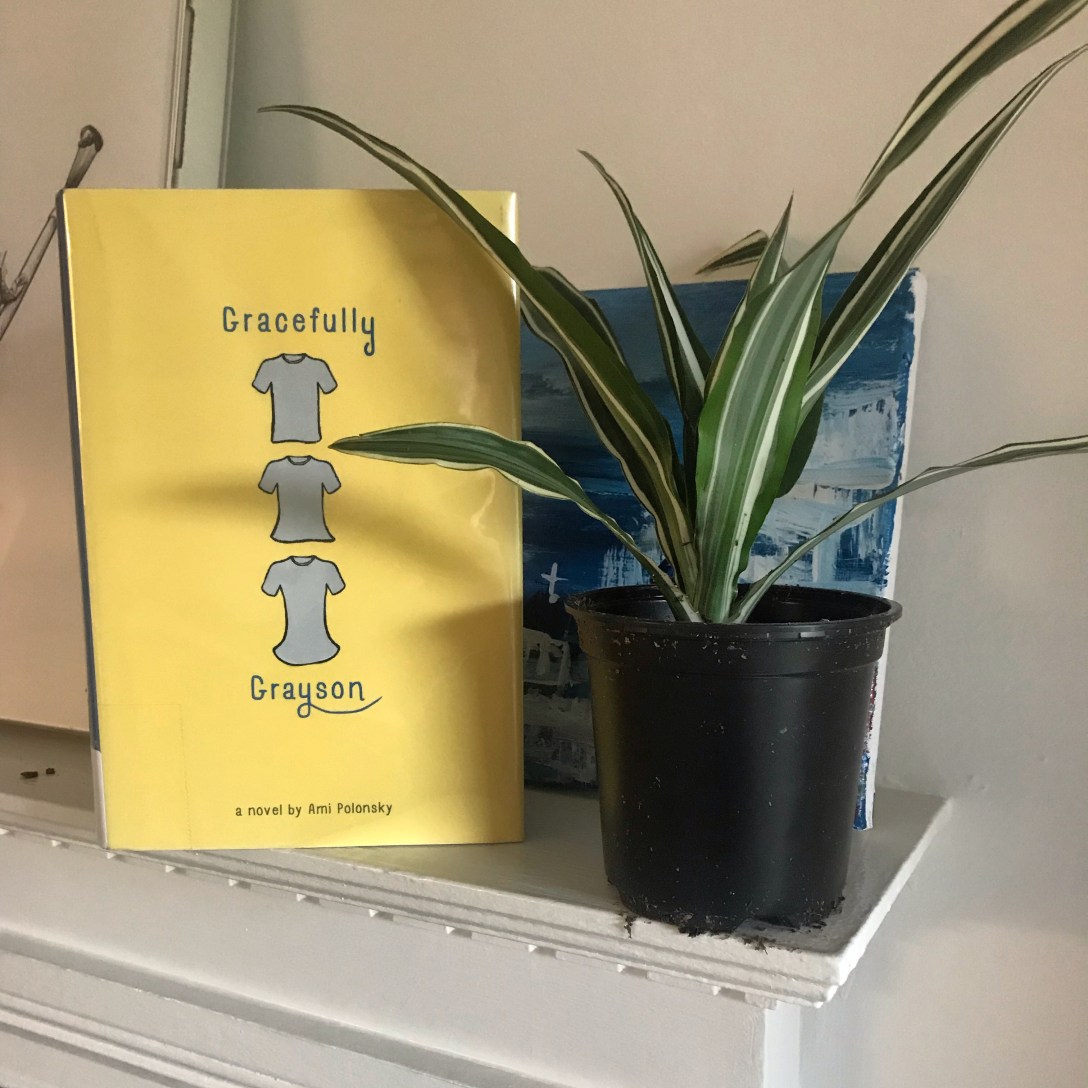
Review: Gracefully Grayson by Ami Polonsky

Book Review: Gracefully Grayson by Ami Polonsky

Gracefully Grayson is a great example of the magic of middle grade fiction. Grayson’s parents died in a traumatic car crash, and he now lives with his aunt and uncle and cousins. Grayson has always wanted to be a girl. He knows that acting this way means getting in trouble and getting bullied, so he just daydreams. That is, until he tries out for the part of Persephone, the lead part in the school play.

This book is heartbreaking because Grayson feels lost both in his gender identity and an outsider in his adopted family. Grayson is caught between many adults who believe they are acting with his best interests in heart. When Grayson’s teacher, Mr. Finn, casts Grayson as the lead female role in the play, his Aunt Sally thinks Mr. Finn overstepped his boundaries. In their own household, Uncle Evan disagrees with his wife’s actions, and hints that Grayson’s aunt and uncle might know more about Grayson than they let on. There are lots of opinions from the adults in Grayson’s life about who he should be, which made me think critically about a parent’s role in their children’s identity.

At the end of the book Grayson is still using female gender pronouns, but wears clothes meant for girls. I can’t speak from experience of course, but I think this is a believable account of a young transgender child’s journey. I say this because I also recently read George by Alex Grino and it had hardly any conflict. Everyone was instantly accepting of George and her transition, which is great, but didn’t feel realistic.

This book is everything beautiful about middle grade fiction and more. Grayson faces bullying, he’s outcast by a friend, and he’s ridiculed for his identity. The end of the book also doesn’t wrap everything up perfectly but points Grayson in a hopeful direction, which I think is important in middle grade fiction for a slightly older audience, like this one.

VERDICT: 4 books


Review: We are the Ants by Shaun David Hutchinson

“What if I don’t give a shit about the world?”

“I’d say that’s pretty fucking sad.”

“Why?”

“Because the world is so beautiful.”  

We are the Ants is a difficult book to explain and to “place”. This is technically “science fiction”, and I say technically because it blends reality and fantasy. I love that it defies genres! The reader is left to wonder what is real and what is not. I’d warn potential readers not to the read the book jacket copy, because I want them to enjoy the mystery and surprise.

Trigger warnings for self harm, sexual assault, and suicide. This is a BIG part of the book so please don’t read this if that’s something too close to home.

I felt such a connection to the characters, particularly the narrator and protagonist, Henry, a teenage boy who is faced with a big decision: should he save the world or allow it to be destroyed? When we meet him, he’s overcome with grief over losing his boyfriend.  I was so invested in his story as he comes to terms with his grief and mental instability and battles many forms of bullying and harassment. Henry’s grief and mental health manifests itself in a totally original way that I thought worked so well.

This is also just “angsty” enough to be believable but not shallow or stereotypical in any way, a problem I sometimes have “drama” in YA. We are the Ants depicts horrific reality of mental health. This book doesn’t shy away from critically examining the demands our society has on teenagers. The amazing part is that Hutchinson explores all these themes through the unique lens of alien abduction and the impending apocalypse.

We are the Ants is one of the best YA novels I’ve read in awhile! I highly recommend it!

VERDICT: 5 books!


Review: Convenience Story Woman by Sayaka Murata

Convenience Store Woman by Sayaka Murata, translated from Japanese by Ginny Tapley Takemori, is like nothing I’ve read before. This is a short, easy read that challenges everything you think about society, education, identity, and what it means to be happy and successful.

Keiko Furukura, now approaching middle age, has worked in a convenience store since she was eighteen. She loves her job, and finds value in the work she does every day. Everyone else tells Keiko that she’s wrong to feel this way, and that this makes her not normal. They tell her she can’t be truly happy unless she has a full time job, a husband, and kids. When a lazy ex-employee, Shiraha, moves in with her and people assume they’re dating, Keiko’s happy little world is turned upside down. 

This book is crazy. Keiko is a unique character and she’s so happy and innocent that it’s heartbreaking. She has adapted to mimicking the speech patterns and behaviors of others based on what she’s been told is “normal”. I’ve heard other people speculate that Keiko is psychotic—I don’t think that’s the case, and I have no need to diagnose her. I think this book is really about society’s expectations surrounding identity and success. 

I gave Convenience Store a three and a half book rating because I thought it was too short and ended too early. However, I think this unique story is something I’ll think about for a long time.

VERDICT: 3.5 books

Review: The Goldfinch by Donna Tartt

Today I’m introducing a new favorite book! Check out my full spoiler-free review on our blog (link in bio!) My mom read this years ago and tried to get me to read it at the beach, but The Goldfinch is so incredibly detail-heavy that I couldn’t get into it. After reading The Secret History last year, I decided to give The Goldfinch another try.

I’m glad I did! This book is quite a feat to get through, but it’s worth the journey a hundred times over (and it made me miss New York so much!) If you like long and sweeping coming-of-age stories, this is the book for you. Like The Secret History, The Goldfinch is especially drug-heavy and most certainly not any easy read. I knew vaguely it was about art history when I started, but I never imagined the twists and turns this would take, or the impression it would leave!

What I love most about The Goldfinch is our protagonist, Theodore (Theo) Decker. Struck by tragedy in the first chapter (and then again, and again) some would say that he has an incredibly unlucky life. He makes someone bad choices that oftentimes you want to hit him over the head and scream, “What are you doing?” It’s his own difficult life and the messy relationships with the other characters–especially Boris, Pippa, Hobie, and even Popper–that give this book such a spark of life. When it was over, I’d spent so much time getting to know the characters that I didn’t want it to end!

The Goldfinch explores fate, grief and loss, the complexities of friendship, loyalty, and morality, the price of freedom, and the importance of fine art and historical objects of meaning. By the end I felt exhausted, but in the best way.

However, this book is A BRICK, which is why I found it easier to listen to on audio. The narrator did an incredible job making each character sound unique. I never would have been able to imagine Boris’s accent if I’d read this on my own.

VERDICT: 5 books! 


Anna: Currently Reading 4/15

I’m horrible at continuing series, when when I really love the first book! Here’s an example of one I’ve neglected far too long, even though I read and loved My Brilliant Friend in 2017, I’m just getting around to reading book two, The Story of a New Name.

I love Elena Ferrante’s writing. Her characters are wonderfully complex, as are their relationships with each other. I’m about halfway through and can’t wait to (hopefully) pick up the next two soon.

What’s your favorite series?


Review: Big Stone Gap by Adriana Trigiani

This was the perfect light read as I adjusted to my new job–one that I could pick up after a long day of work before bed. A mix of Gilmore Girls and Mama Mia, I enjoyed following the adventures of Ave Maria, the “town spinster” in her mid-30s in the rural mountain town of Big Stone Gap, Virginia. After the recent passing of her mother, Ave Maria is the only Italian left. Like any other small town, everyone in Big Stone Gap know everyone else’s business. So when Ave Maria discovers some long-buried secrets about her own identity, the rest of the town is quick to find out.

Parts of this book are downright hilarious. The part when Elizabeth Taylor comes to town actually had me laughing out loud. The same goes for the dog incident and the chicken bone incident. Classic.

I love the Bookmobile, and the fact that Ave Maria loves books. I love her devotion to her town and her mother, despite their faults. I love that Ave Maria is named after a prayer. I love that, because she’s an Italian in the mountains of Virginia, no one can pronounce her name. (My name is Anna-Marie–I can relate.)

Ave Maria does get a little annoying in her stubbornness to remain single,This would have been fine if she truly didn’t want a partner, but her actions tell otherwise. Sadly, she seems more jealous and vindictive toward love more than anything else. She turns men away and insists she’s happy, only to get jealous when those men turn to other women. There are parts of her character that I like and identify with, as I mentioned above, and then there are aspects to her that get really annoying, like her inability to notice what is literally in front of her nose.

Though I enjoyed Big Stone Gap overall, there are some things I can’t get past, which I’ll call here Early 2000’s Problems. It’s kind of like when you watch Gilmore Girls or an old rom com and you’re shocked at how something that you used to regard as so wholesome is actually filled with culturally insensitive, racist, and homophobic jokes. It’s not okay, but you have to approach these things in the context of time and how far we’ve come as a society in accepting people, even since the 2000s (and Big Stone Gap takes place in the late 70s).

Also very 2000’s is Trigani’s assumption that men and women live like species from different planets. There are literally lines such as, “this is how all men are,” and likewise, “ this is how all women are,”  this just isn’t the case! Again, I think that this has to be attributed to the time period (either that, or I just haven’t read a romance in a long time). There’s also an undertone in here that men are objects to be won by women and vice versa, which presents a big problem.

Despite the outdatedness, I still did enjoy reading Big Stone Gap, and I would recommend it if you’re looking for a small town southern romance.

VERDICT: 3 out of 5 books

 
Now for some very specific things that really irked me (spoilers below)–


The fact that Jack essentially bought Ave Maria’s heart when he paid for all her Italian relatives to visit.

The fact that when the family showed up Ave Maria’s own plans were completely pushed aside.

The fact that as soon as Ave Maria cemented her love to Jack, Jack’s mom IMMEDIATELY died, because she knew Jack was in love and didn’t need her anymore.

I totally thought the best friend and band director was going to come out as gay. Maybe he still does later in the series…?

I love Pearl, except that she is the token fat smart girl who discovered makeup and it made her life better.
Review: Pachinko by Min Jin Lee

Alexis: Read 3/17/19

Well, this book is certainly a saga. It feels like three different books, because really, it is. Pachinko covers four generations of the same family, from the early 1900’s to the 80’s. The story opens with Sunja, a Korean peasant, who meets a wealthy businessman and forms a relationship with him. When Sunja becomes pregnant, she finds out that the businessman is already married. So instead, she accepts a generous offer of marriage from Isak, a sickly Protestant preacher.

The amount of detail Lee manages to pack into this book is astounding. She covers the historical and political aspects of each time period. The book especially focuses on what it means to be Korean during a time when the country is taken over by the Japanese and then later split into two. Her characters deal with the dysphoria that they feel as Koreans living in Japan, as well as discrimination. I really enjoyed learning about the history and culture of Korea, and I could really go for some Korean or Japanese food right about now!

While extremely detailed, Pachinko is written matter-of-factly, with no flowery descriptions. Lee writes from a distant, omniscient point of view. At the end of the book, Lee discusses her reasoning behind this. She says, “‘Fair’ seems like a simple word, but I think because my subject matter is so troubling and controversial, I wanted my narrator to be as objective as possible” (494). Lee certainly achieves this, as the book, especially the first half, almost reads like a historical account. At first, I found the tone off-putting. But once the book became more political, I understood the need for distance. Still, that doesn’t neglect the fact that I prefer to get more into characters’ heads and emotions. I love character-driven stories, and while this was that, I never felt too involved in the characters’ lives.

For example, Lee has a bad habit of simply stating “and then he died.” When she did this in the beginning of the book with Yoonie, Sunja’s father, I did a double-take. She nonchalantly stated his death and they hardly went into it in the next chapter, and she repeats this throughout the book. While I understand her distance, as a reader, this was very off-putting. I wanted to feel each death and life-changing event the way the characters did.

Overall, I really enjoyed this book, even if I had to enjoy it in chunks. I learned a lot about Korea’s history and the history of misplaced Koreans. I really don’t know how to rate it as a whole, as it covered so much ground.

History and detail: 5 stars

POV and writing style: 2 stars

Characters: 4 stars

Review: Burial Rites by Hannah Kent

“‘It’s not fair. People claim to know you through the things you’ve done, and not by sitting down and listening to you speak for yourself. No matter how much you try to live a godly life, if you make a mistake in this valley, it’s never forgotten. No matter if you tried to do what was best.’”

Burial Rites is historical fiction and follows Iceland’s last execution of Agnes Magnúsdóttir in 1829. Agnes has been convincted of murdering two men and is sentenced to death. While she awaits her execution, she is sent to work on an isolated family farm. Agnes has an unexpected effect on the family while she stays.

Burial Rites is very dark, but beautifully and hauntingly written. I’ve never read anything set in Iceland before, and enjoyed learning about the area and time period. This is different from a lot that I’ve read recently because from the beginning, you know what’s going to happen—Agnes is going to die. The real tension in the book is between the family, servants, and priest on the farm where Agnes resides as she awaits her impending death. There’s also the mystery of what happened that night of the two murders, and what Agnes’s role in the deaths really was.

The characters make the story. Agnes’s backstory is heartbreaking and makes her feel real. Kent made me feel sympathy for Agnes despite her murder charge.  

There are a lot of questions in this book of justice and right versus wrong. Who gets to decide when someone deserves to die? Are some people’s words more valuable than others? This can be read as an examination of the death penalty in its most ancient and barbaric forms.

Religion’s role in justice is also a prevailing theme of the book, and something I found interesting. Agnes is assigned a priest to help her find achieve absolution with God before she is executed. Agnes resists by not repenting and, slowly, begins talking as an equal with the priest. Something Agnes repeatedly questions is why she has to ask for forgiveness to a God who is allowing her to be executed.

I love historical fiction that shows the discrepancies in class, and there is a very clear class divide in this era of Iceland. Agnes is not only a murderer, but a servant accused of killing her master, which adds a level of certain guilt in the rest of society’s eyes. When she first arrives at the farm, the entire family is disgusted by her. Agnes is gradually accepted by the family despite her class and status as a convicted criminal.  

Definitely check out this fantastic debut!

VERDICT: 4 out of 5 books