Review: The Invisible Life of Addie LaRue by V.E. Schwab

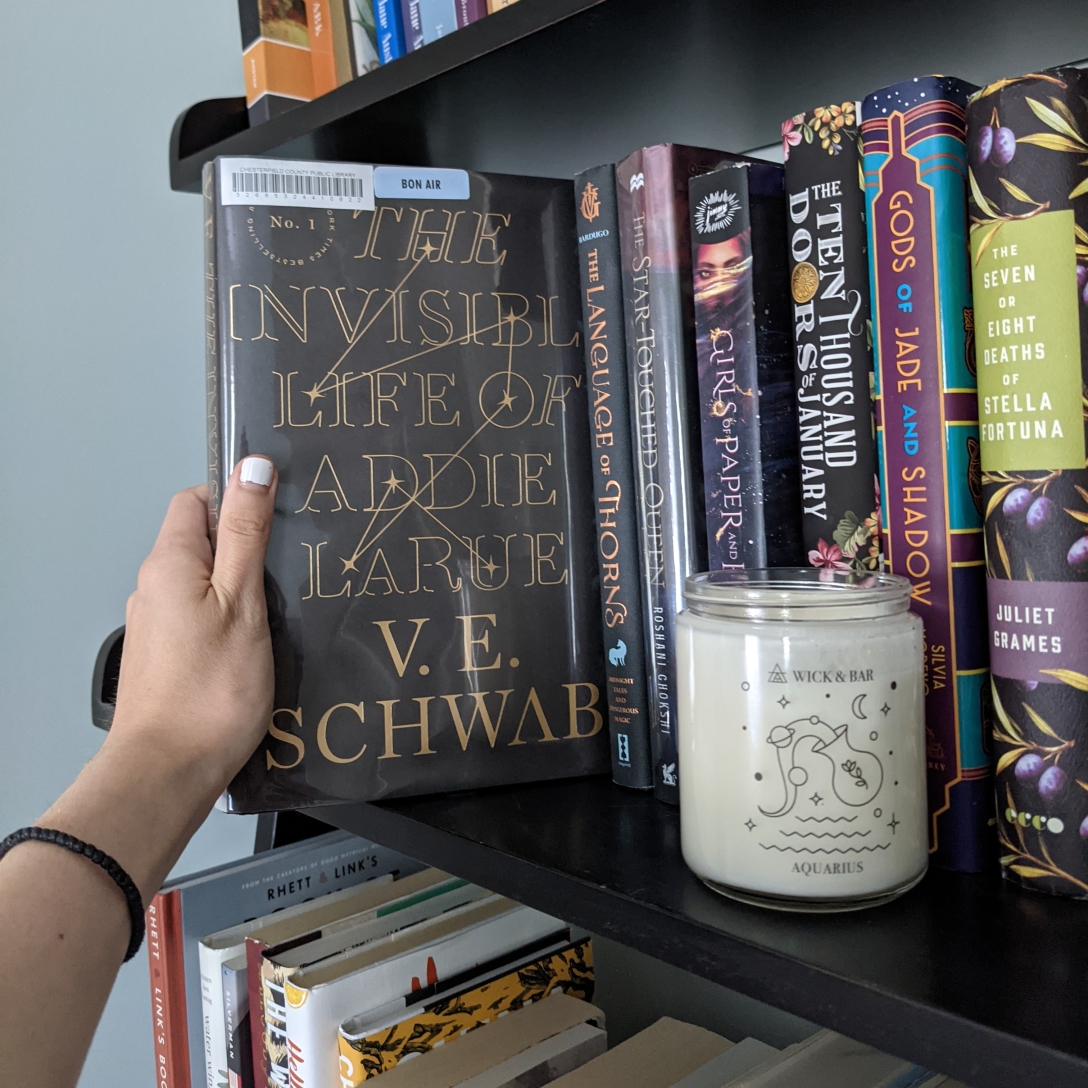
A library copy of Addie LaRue is being pulled out of a bookshelf, alongside a candle.

Alexis:

Look what I finally got from the library!

I was a little afraid to start Addie LaRue to be honest; it’s been hyped up so much that I was afraid to be disappointed.

However, I really enjoyed reading this book. Schwab’s writing is more poetic and lyrical than in other books I’ve read by her, and it sucked me into the story.

The Invisible Life of Addie LaRue follows, you guessed it, Addie LaRue. In France in 1714, Addie dreams of escaping her small village, but most of all, she’s desperate to avoid getting married. So she makes a deal with the devil. But the deal goes wrong, and not only is Addie now forgettable, she’s also immortal until she decides to give up her soul. 

While I’m not usually a huge fan of non-linear stories, including Vicious by Schwab herself, I think it actually worked well in this book. We jump back and forth between present time (2014 in this case) and Addie’s past escapades. Overall, this book is a slow-moving character study of Addie, and I enjoyed learning about her unique life. I appreciated the emphasis on art, and loved the overall atmosphere of the story.

There were a couple of things that kept this from being a 5 star read for me, however. While I like slow-moving, character-driven stories, I just couldn’t get over the fact that this book is devoid of basically any plot for the first ¾. And this book is a whopping 442 pages long. Instead, we spend most of the time following Addie as she suffers on the streets of different cities, and focusing on all the different lovers she takes up. 

There’s one sparse chapter about her being part of a war, which I feel like could’ve been a much more interesting part of Addie’s life, not to mention a much more interesting plot, yet we never see how it impacted her. Despite this being a highly character-driven story, I feel like Addie’s character never actually changes or evolves. And I guess that could be the point, couldn’t it? But not changing in 300 years?

It was also a little strange that Addie is alive for 300 years yet never makes it past Europe and the US. That, and the romance part of this book was subpar for me; the romantic interest was just not an interesting character to me. It didn’t help that the grandiose ending felt a little melodramatic.

Keep in mind that I can’t turn off the critical reader part of my brain. I guess getting your MFA and editing novels will do that to you! So even though there were parts of this book that I think could’ve been done differently, I still enjoyed the overall writing and the reading experience, and I think it’s worth a read.

VERDICT: ⭐⭐⭐⭐/5

Review: Betty by Tiffany McDaniel

Anna: If you’re looking for an emotional coming-of-age story I highly recommend Betty. Set in Appalachian Ohio, Betty and her five siblings live with their mother and Cherokee father in a dilapidated house surrounded by racism, poverty, and family secrets. This is also fiercely feminist novel, which I love. 

Betty is about sisterly love, nature, and cycles of trauma and abuse in families. When she is eleven, Betty discovers a deadly family secret that shapes the course of her life. Despite the difficult themes, this book is beautifully and lyrically written. Betty’s dad, Landon, and his storytelling the love of nature he encourages in his children are a driving force of the novel. Her mom, on the other hand, is violent and unpredictable, a product of years of being the victim of violence herself.

This is also an own-voices story, as Tiffany McDaniel is the descendants of Cherokee ancestors, and the characters in Betty are fictional accounts of real family members

Major trigger warning for sexual violence 

VERDICT: 4.5 stars

Review: Disability Visibility: First-Person Stories from the Twenty-First Century edited by Alice Wong

Anna: Why do we read? For entertainment, yes, but part of that enjoyment comes from the thrill of briefly living in and therefore learning about an experience that’s not your own. My favorite books as a kid featured fantasy worlds like Hogwarts and Narnia. As a mature reader, I still find myself reaching for different worlds, but I’m less interested in fantasy. I’m more interesting in learning about the every day lives of other people around the world.

That being said, when I kept hearing about Disability Visibility I realized there was a huge gap in my reading experience.

Disability Visibility is an essay collection edited by the activist Alice Wong. I do not identify as a disabled person, so please take my words with a grain of salt. But this book came highly rated and recommended by disabled people in the bookish community.

This book gives space to an amazing amount of different voices. The essays are about prejudice, misrepresentation in the media, accessibility, advocacy, and perhaps most importantly, just being a disabled person.

This collection also got me thinking about just how many “first person” narratives I’ve really read about disability, both fiction and nonfiction. It’s no new thing that disability has long been misrepresented in the media, especially in the issue of own voices representation. As a teenager I, unfortunately, consumed what I now call “trauma porn”, which romanticized illness and disability and killed off characters, promoting the harmful ideas that disabled bodies are better off dead. This included The Fault in our Stars and Me Before You, the movie adaptation of which casted an able-bodied actor for the role of a quadriplegic.

Now, I try to research authors before reading books, to make sure I read own voices stories. We also like to think that we’re slowly moving toward a more accepting and accessible society. I know that being an ally is more than slapping closed captions on my Instagram stories and reading just one book about disability. But I hope this is just the beginning of my disability reading and learning journey.

Review: The Bone Shard Daughter by Andrea Stewart

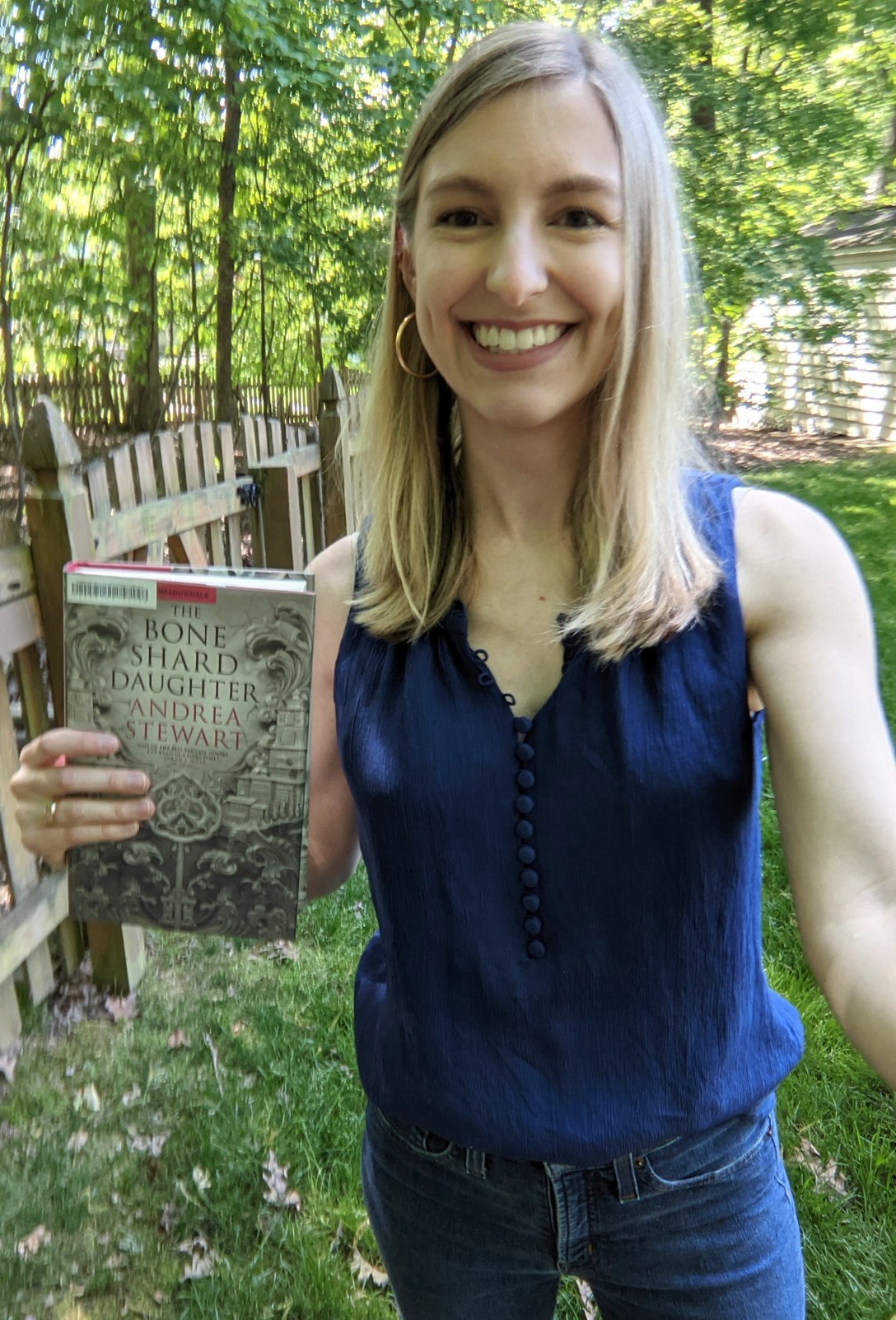
Alexis holds a library copy of The Bone Shard Daughter in front of a fence and trees.

Alexis:

At first, I wasn’t sure this book would be for me. I was unaware that it has a total of five POVs, some in first person and some in third person, something I’m usually not a fan of. The writing style is slightly more “tell” rather than “show,” and the book takes a while to set up the scene for each character.

However, I found myself drawn into this story. All of the characters have very interesting backstories and motivations, and I found their stories engaging, and the world itself to be fascinating. While Jovis’ perspective was my favorite, as he seemed to have the most personality (and more page time than the other characters, besides Lin) I never found myself bored by any of the perspectives. 

While the pacing remains fairly slow throughout the book, I hardly noticed it, because there was such an atmosphere of mystery and suspense; there were so many mysterious things working in the background that I found myself endlessly curious about, and I kept wanting to know what was going to happen!

While I sometimes struggle with the accessibility and writing style of adult fantasy, I found this book to be a great segway from my usual YA fantasy. It was also nice to see a fellow twenty-something in a book, as Lin is twenty-three.

So here’s what you need to know before going into this book:

Lin, the Emperor’s Daughter, is trying her best to get her memories back after an illness. She’s also trying to figure out what her father, who can wield bone shards, is keeping from her. 

Jovis, the Empire’s best smuggler, is on a mission to find his long-ago kidnapped wife. He finds a mysterious little otter-like creature, Mephi, who becomes his sidekick, and who quickly became my favorite!

Phalue is the daughter of Nephilanu Island’s governor. She’s a fighter who’s trying to win the hand of her girlfriend. 

Ranami, Phalue’s girlfriend, is a woman with a heart of gold who’s doing her best to make a difference in the world. 

And finally, Sand is a woman stuck on a remote island, whose job is harvesting mangoes. But she doesn’t remember why she, or the other island inhabitants, are there, how she arrived, or who she really is.

The Bone Shard Daughter is one heck of a debut, filled with political intrigue, creatures created from bone shards called constructs, and a chilling yet thrilling ending filled with twists and turns.

VERDICT: ⭐⭐⭐⭐⭐

Anna’s January Wrap Up

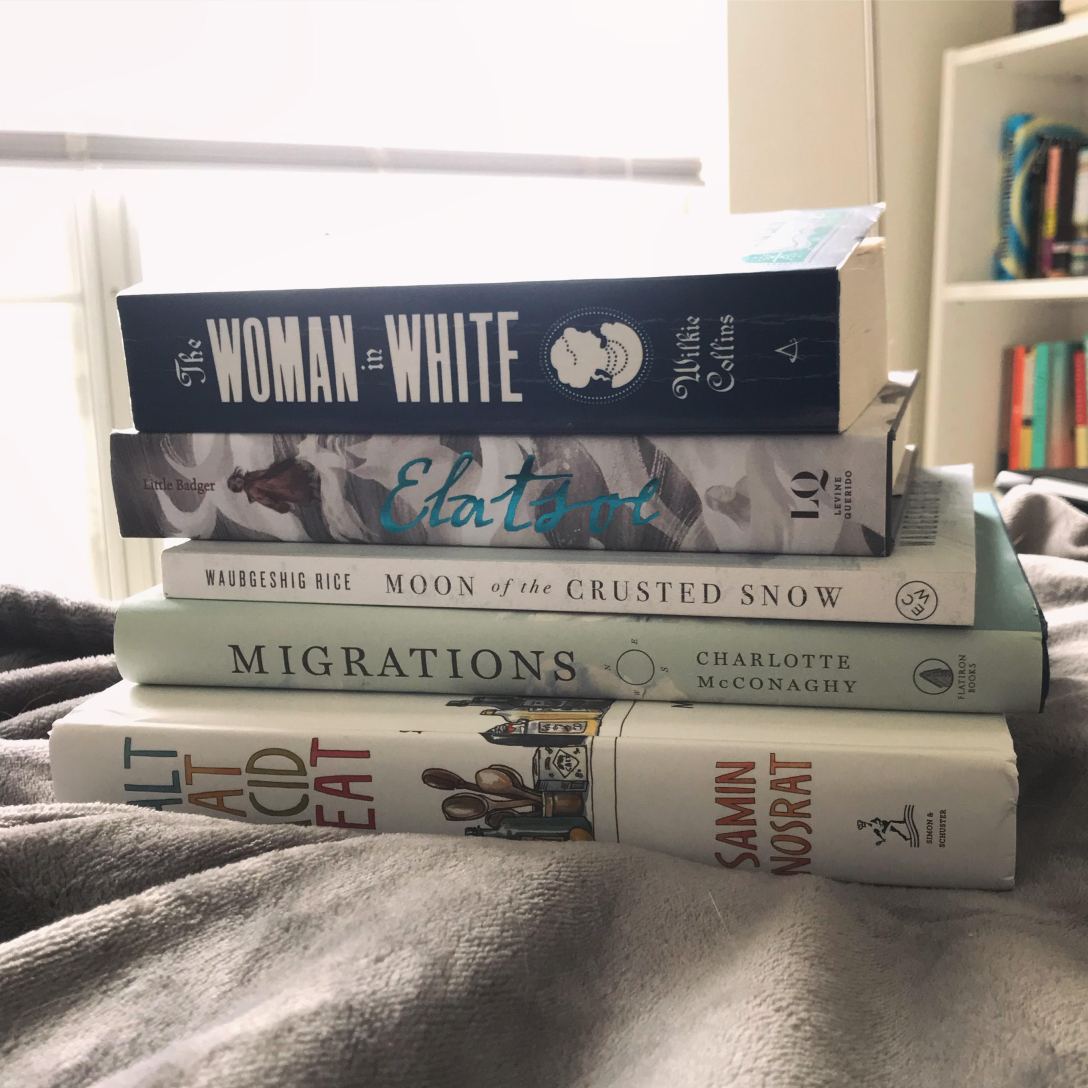
Between continuing to distance from others and the wintery weather, my reading was a major comfort and escape this month. I’m also happy with the diverse genres and authors I was able to read this month. I read two nonfiction books (one memoir and one cookbook), and two books by Indigenous authors, both of which work in favor of my 2021 reading goals. Here’s what I read: 

The Woman in White: Started off the year with an atmospheric, satisfying classic mystery. 

Elatsoe: Spooky magical YA by an Indigenious author. My only criticism is that this read VERY young to me. 

Moon of the Crusted Snow: actually a literary dystopian as promised (unlike Migrations) Written by an Indigenous author.

Migrations: The low point of my reading month. Do not recommend this one. Read my review.

Salt Fat Acid Heat: Mastering the Elements of Good Cooking: This made-to-be-read cookbook changes the food game! Check out my review.   

After the Eclipse: A Mother’s Murder, a Daughter’s Search (audiobook; not pictured); A heartbreaking memoir about the author’s mother’s murder. Also a criticism of the explorative nature of true crime as a genre. 

Review: Salt Fat Acid Heat: Mastering the Elements of Good Cooking by Samin Nosrat

Cookbook surrounded by cooking materials

VERDICT: 4 stars

Anna: This book will truly change how you cook! 

Salt Fat Acid Heat is a cookbook that is meant to be read. It first teaches you the science behind the four basic elements of cooking- salt, fast, acid, heat. There are then recipes in the back to put your skills to practice.

This book teaches you how to season from within with salt, how to properly use fat as a cooking medium or as a seasoning, how to balance meals with acid, and, finally, how to transform food with heat. 

My husband and I both love to cook, and we read this back to back, cover to cover. Samin inspired us to make immediate changes to our kitchen by investing in some new staples, reorganizing, and immediately putting her recipes and tips to the test.

Some tips of hers that I’ve been putting into practice are: to salt ahead of time and for as long as possible, to let meat come to room temperature before cooking, and to always heat my pan before adding anything. I’ve always been a fan of roasting veggies, but her simple tip of briefly boiling vegetables instead has been revolutionary!

My only complaint with this cookbook is that it is very meat-heavy. There are dozens of chicken recipes, specifically, which seems to be a favorite of Samin’s. To each his or her own, but as someone who favors vegetarianism, I’m a little disappointed with the overwhelming emphasis on meat.

Even so, I highly recommend you pick this up if you want to spice up your cooking!

Review: Migrations by Charlotte McConaghy

book with river behind it

VERDICT: 2 stars

Trigger warnings: Suicide, Sexual Assault

I’ve wanted to read Migrations since before its release. It has great ratings on Goodreads, which proves that you need to take ratings with a grain of salt. I did, however, see a 1 star review from a trusted reviewer. Because of the dystopian aspect, I wanted to read this for myself.

I was disappointed. 

The actual style of the writing is the only thing I liked about this book. It’s lyrical yet concise. But there are glaring holes in the world building and the plot. Then there’s the biggest problem-Franny.

Migrations alternates between two timelines: the past and present. In the present, almost all animals have gone extinct in the world. There aren’t many fish left, and people who still fish are hated. Franny worms her way onto a fishing ship to follow the last migration of Arctic Terns. She tells the captain she is an orithinogist, and that she thinks the Arctic terns will lead them to fish. She is right, for the most part, so she stays on the boat.

We are introduced to Franny’s tumultuous childhood in Ireland. Her mom disappeared when she was young, and she lived with her father’s mother in Australia. Back in Ireland, Franny sits in on at University and meets the love of her life- Insta love style. She and Niall marry immediately, but very quickly it’s a struggle for Franny to stay. 

Franny is the most unlikable narrator I have ever encountered. There is nothing redeeming about her. She is so chaotic that she’s not even a believable character. And the author’s excuse for her behavior? She’s a “wanderer”. She’s unable to stay in one place. Why? It’s in her blood.

SPOILERS: Franny’s defining character trait is violence. She sleepwalks and attempts to strangle Niall in her sleep. She’s in jail for  murder, and it’s unclear if it was on purposeful or not. She also managed to kill two more people over the course of the present narrative. And yet. Franny is a wonderful swimmer and saves multiple people from drowning over the course of the story as well. Her character is completely unpredictable but predisposed to destroy and leave. 

In the past, we know that Franny served time in prison. It’s eventually revealed why. She (accidently?) rammed headfirst into another car, killing Niall and the woman in the other car. Franny claims she did it on purpose. Then she reveals that she saw an owl, which distracted her from the road. Franny is an unreliable narrator, so we don’t really know. Which brings me to my next point. 

Niall, Franny’s husband, is seemingly okay with the fact that Franny will just leave him when she feels she has to. By the end, we are made to understand their relationship is like this-Franny is a wild thing, possibly a bird, possibly something else. She is untamed. Niall is a scientist and by trapping Franny, he’s able to study her closely. But Franny, being a wild thing, kills him in the end.

Franny succeeds(?) in following the birds to their last migration. destroying everything else around her in the process. She plans to spread Niall’s ashes into the sea there. She also plans on killing herself. She spreads the ashes, and then submerges herself, fully intending to end it. But she doesn’t. The book ends with her being released from prison for the second time of her life. Her dad, who has never been part of her life and who is a convicted killer herself, is waiting to pick her up. They drive off together.

Then there’s the complete and utter lack of worldbuilding. This is apparently set in the not-so-far future in which climate change and human behavior has made most animals in the world extinct. For some reason, fishermen have received the bulk of the blame for this act (maybe because there are still some fish in the ocean? It’s not very well explained). This could have been such a rich world and the extinction of the animals could have added another layer to Franny’s story. Instead, the state of the world is barely acknowledged throughout the story. 

Overall: With more developed worldbuilding, maybe I could have forgiven some of Franny’s erratic behavior in this book. Or maybe not. Either way, I don’t recommend reading this. Migration’s book description first reminded me of one of my favorite books, The Lightkeepers by Abby Geni. After reading Migrations, they can’t be compared. Save yourself the pain and read the Lightkeepers instead. 

Review: Vanessa Yu’s Magical Paris Tea Shop

Alexis:

I hate giving a book 2 stars, but this one just wasn’t doing it for me.

I liked the overall idea, and I enjoyed the descriptions of the food. 

However, the writing style was stiff and didn’t have any variety to it; it felt like every sentence was the same length. It was very much so “She said this. They did this.” 

I found the dialogue and characters to be the same. The dialogue sounded very unnatural, and it didn’t help that all of the characters talked the same way. There was no subtext to the dialogue; it was all, “I’m sorry Auntie. I didn’t mean it.” “That’s okay. I still love you, Vanessa.”

Besides that, there was a lot of name dropping. There’s a scene in the Louvre where Vanessa and her love interest dissect every piece of art. Vanessa constantly talks about how fancy her aunt is, and name drops designers left and right. At times, it felt overly elitist. 

The romance in the book was also pretty weird, including insta-love that just didn’t feel genuine to me. 

And finally, whenever the background characters heard one of Vanessa’s predictions, they always accepted them as truth. I found this odd. I’d be very weirded out if I heard a prediction about my life come out of a stranger’s mouth, and I expected there to be more conflict from this. 

I was hoping this book would be a nice, easy change of pace, but I just found it a little disappointing. 

VERDICT: ⭐⭐/5

Review: The Bone Houses by Emily Lloyd-Jones

Alexis:

The Bone Houses is a historical fantasy novel, which is quickly becoming one of my favorite subgenres. It’s set in medieval Wales, and follows two main characters: Ryn, a gravedigger, and Ellis, a mapmaker.

Due to remnants of lost magic, the dead are rising in the forest neighboring Ryn’s small village of Colbren. She and Ellis, each for their own reasons, team together on a journey to eradicate the undead, known as bone houses.

I loved every page of this book. It was dark and gritty and full of death, but the characters were a joy to read, and the dialogue was great. I love dark books that take small scenes, small moments, to let the characters relax, enjoy themselves, and crack jokes.

This story is about home, family, and loss. I loved learning the stories and Welsh-inspired folklore of the world. I loved that Ryn’s sister’s pet goat became a main character; I’m a sucker for an animal sidekick!

Lately, it’s been a little rare for me to find two characters that I’ve enjoyed reading about and rooting for, but this book was it. And I haven’t read a lot of books lately with a cringeless romance, either. I appreciated the slow-burn romance in this book, and the fact that the characters actually took the time to become close friends first. It was a subplot, and it didn’t get in the way of the main story. It didn’t feel forced in the least!

And, finally, I loved that this story was well-written. Lloyd-Jones’ prose feels almost effortless to read, while also being lush and evocative.

“She was half a wild creature that loved a graveyard, the first taste of misty night air, and the heft of a shovel. She knew how things died. And in her darkest moments, she feared she did not know how to live.”

VERDICT: ☠️☠️☠️☠️☠️/5

My Re-Read: Harry Potter and the Prisoner of Azkaban

Alexis:

I’m loving my re-read of the Harry Potter series! I’d forgotten just how intricate the world is, and it’s been a welcome break from the current 94 degree weather outside. Whew!

Harry Potter and the Prisoner of Azkaban remains one of my favorite in the series. (I may also be a little biased because it’s my absolute favorite movie adaptation in the series. I still swear that if Alfonso Cuarón had directed all of the movies with John William’s scores, they would’ve all been *chef’s kiss*).

The Golden Trio’s characterization continues to deepen, and we learn more information about Harry’s parents.

Lupin is one of my favorite characters, and I loved being introduced to him. We also get introduced to Sirius and his relationship with Lupin, Wormtail, and Harry. And the way the plot unfurls throughout the book is just perfect.

Harry Potter gif