Review: These Burning Stars by Bethany Jacobs

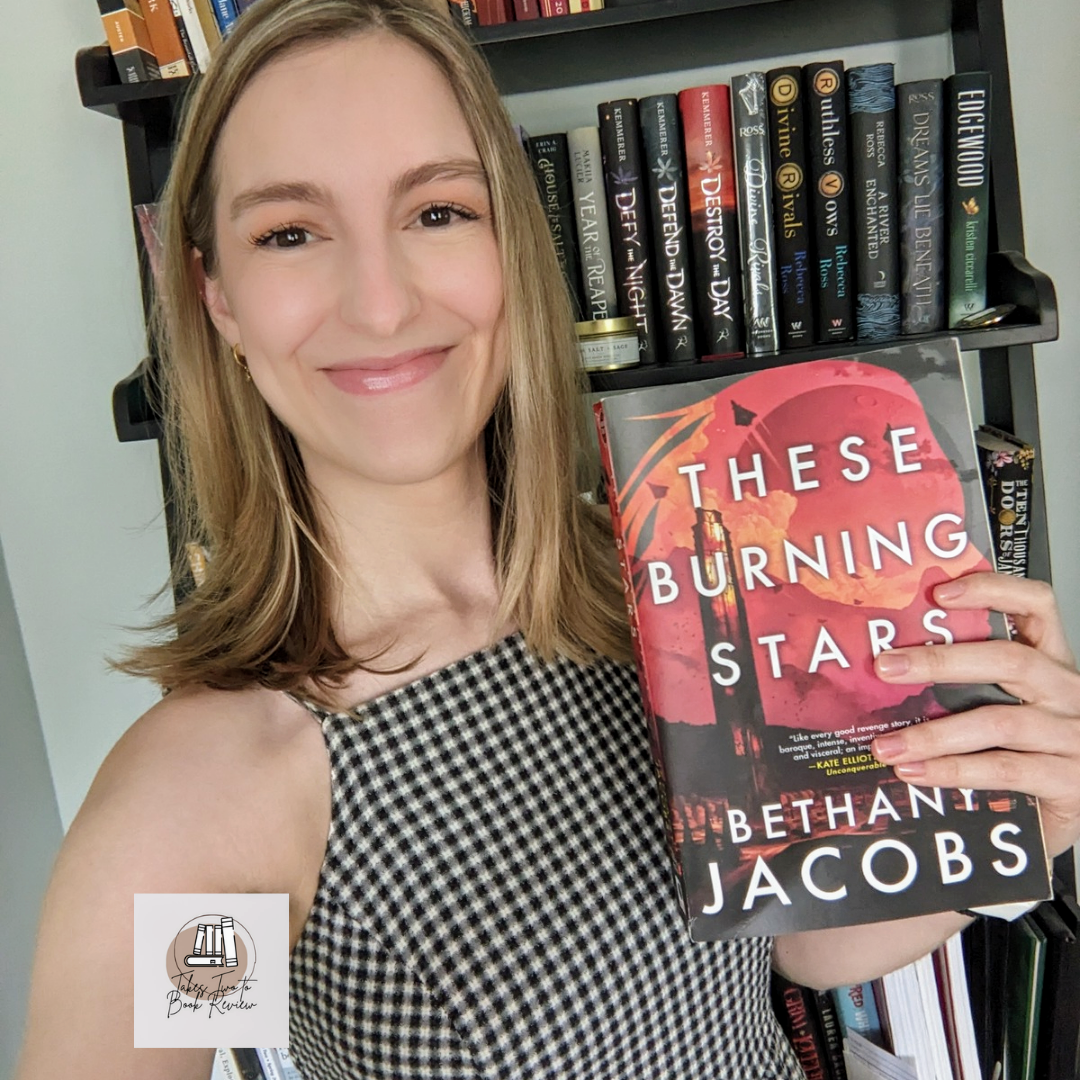
Alexis holds These Burning Stars in front of a bookshelf

Alexis:

These Burning Stars is a political sci-fi with a dark, gritty, and chaotic feel.  

The story follows three separate women: Jun—a famous hacker who finds a key piece of information that implicates the powerful Nightfoot family in a planet-wide genocide seventy-five years ago. Esek—the brutal heir to the Nightfoot empire. And Chono, a cleric who is loyal to Esek. And amidst them all is a mysterious character named Six, who Esek is determined to hunt down. 

There are a lot of impactful themes in this book. It focuses on revenge, choice, and power. I love a good political book, and I enjoyed learning about the crazy power dynamics and the history of the Kinship. Jun herself reminds me of a Jyn/Rey type of character. 

I’ve seen a lot of people say this is one of the best new sci-fi books. While I really enjoyed a lot of it and Jacobs’ writing style, I can’t say it was my favorite. It doesn’t help that the title These Burning Stars does not fit the vibe of the story and that the story itself was marketed as a space opera, yet it doesn’t really feel like one. On top of that, there are two main aspects of this book that frustrated me. 

  1. The story jumps back and forth between different timelines. On top of the different POVs, this made it a bit tedious to get through. I think some well executed flashbacks would’ve worked better and propelled the story and pace along.
  2. Some of the characters are a little too flat. During some chapters, I would think, “Wow, I feel like I know this character well.” Only for the next one to almost make the characters feel like they were in the background of their own story. Jun really intrigued me, but I feel like we got far more of Esek and Chono’s POVs than Jun’s.

That being said, there was a shocking plot twist near the ending, and this book sets up for a powerful sequel. 

If you read sci-fi, have you read this one yet? What did you think?

VERDICT: ⭐⭐⭐.5 /5 

Review: Jade City by Fonda Lee

Alexis:

Jade City was unlike any book I’ve ever read; however, it wasn’t really for me. I honestly considered DNFing it 50 pages in, but I’m glad I stuck with it!

Jade City is described as a high fantasy, and that’s not entirely true. Sure, the world is a fantasy world, based on Japan, but the use of jade, which grants the Kekonese people superhero-like powers, is really the only fantasy element. The rest of the book has a gritty, almost noir feel. The best way to describe this book is The Godfather mixed with martial arts movies.

The writing style is cool, almost business-like, but it flows well. The worldbuilding is intense, and this book as a whole is very dense, so much so that it sometimes felt like a chore to read it. That being said, I did really enjoy certain parts of this book, and Lee is clearly a master worldbuilder. 

My main critique is that I never became super invested in the characters. I enjoyed reading Shae and Anden’s perspectives the most, yet they never really shone on the page. The third person POV was too distant, and it didn’t help that each chapter was from the perspective of a new character, and there were a myriad of characters in this book. 

If you’re specifically looking for a book that’s majority fueding mobsters, with a small dash of fantasy and political intrigue, then go for it. But unfortunately, it wasn’t my kind of read.

VERDICT: ⭐⭐.5 /5

Review: Pachinko by Min Jin Lee

Alexis: Read 3/17/19

Well, this book is certainly a saga. It feels like three different books, because really, it is. Pachinko covers four generations of the same family, from the early 1900’s to the 80’s. The story opens with Sunja, a Korean peasant, who meets a wealthy businessman and forms a relationship with him. When Sunja becomes pregnant, she finds out that the businessman is already married. So instead, she accepts a generous offer of marriage from Isak, a sickly Protestant preacher.

The amount of detail Lee manages to pack into this book is astounding. She covers the historical and political aspects of each time period. The book especially focuses on what it means to be Korean during a time when the country is taken over by the Japanese and then later split into two. Her characters deal with the dysphoria that they feel as Koreans living in Japan, as well as discrimination. I really enjoyed learning about the history and culture of Korea, and I could really go for some Korean or Japanese food right about now!

While extremely detailed, Pachinko is written matter-of-factly, with no flowery descriptions. Lee writes from a distant, omniscient point of view. At the end of the book, Lee discusses her reasoning behind this. She says, “‘Fair’ seems like a simple word, but I think because my subject matter is so troubling and controversial, I wanted my narrator to be as objective as possible” (494). Lee certainly achieves this, as the book, especially the first half, almost reads like a historical account. At first, I found the tone off-putting. But once the book became more political, I understood the need for distance. Still, that doesn’t neglect the fact that I prefer to get more into characters’ heads and emotions. I love character-driven stories, and while this was that, I never felt too involved in the characters’ lives.

For example, Lee has a bad habit of simply stating “and then he died.” When she did this in the beginning of the book with Yoonie, Sunja’s father, I did a double-take. She nonchalantly stated his death and they hardly went into it in the next chapter, and she repeats this throughout the book. While I understand her distance, as a reader, this was very off-putting. I wanted to feel each death and life-changing event the way the characters did.

Overall, I really enjoyed this book, even if I had to enjoy it in chunks. I learned a lot about Korea’s history and the history of misplaced Koreans. I really don’t know how to rate it as a whole, as it covered so much ground.

History and detail: 5 stars

POV and writing style: 2 stars

Characters: 4 stars