Happy April! I hope you all have been reading some good books. One of my reading goals for this year is to pick up more adult fantasy books. I heard nothing but good things about The Will of the Many, so I grabbed it from the library.
I’m happy to say that it lived up to the hype!
The Will of the Many is one of those books where it’s good to go into it with little expectations. But here’s what you can know about it:
The main character, Vis, is such a great, well-rounded main character. He’s vicious, caring, and intelligent.
A main theme is colonialism and the evils it can bring.
The book is in first person present tense, and it serves the story well.
It’s an Ancient Roman-inspired political fantasy.
It’s partially set in an academy, which gives strong dark academia vibes.
The story has tons of twists and turns!
It has a unique magic system; the society allows a person’s strength, drive, and focus—what they call Will—to be leeched away and added to the power of those in a higher societal position.
It hits on so many hard themes, and despite the chunky page length, I was never bored. While Vis is only 17-years-old, this is definitely an adult book meant for adult audiences. That being said, it appeals to me as a mostly YA reader, as well. If you’re looking for a clever fantasy book, I definitely recommend it!
Where the Dark Stands Still is my kind of book. It’s Howl’s Moving Castle meets Uprooted with a dash of Sorcery of Thorns. I really enjoyed it, and it ended up being 4.5 stars for me.
“‘God,’ Liska pants.
‘Not quite,’ the Leszy says, watching her carefully. ‘But it’s still a better compliment than screaming the moment you see me.’
She might have rolled her eyes if she wasn’t still trembling.”
I loved the atmosphere and Poranek’s writing style. The world is Polish folklore-inspired, which I really enjoyed. It was great seeing Liska, the main character, learn and grow as a character as the book went on. And if you like Howl, well, you’ll like the Leszy, the demon of the wood.
My only critiques: The Leszy’s nickname for Liska was definitely overused, and the beginning was a little slow.
This was a great debut! If you like creepy woods, demons and spirits, and magic/forest magic, I definitely recommend it!
House of Flame and Shadow, the third book in the Crescent City series, has already been controversial in the SJM community, but I really enjoyed it!
It’s not perfect (let’s be honest—ACOTAR (A Court of Thorns and Roses) isn’t either) BUT with the magnitude of everything she had to pull together in House of Flame and Shadow, I thought it was a great, wild ride!
The stakes are high. So many things are happening and being revealed, and despite the massive page count, I was on my toes for all of it. I loved how she pulled everything together!
A lot of people don’t like Bryce, but I’m not one of them. While she’s a little hot-headed, I love a character with actual flaws—and she’s a badass! She also reminded me a lot of Aelin in this book, and a lot of the plot actually reminded me of ACOWAR, the 3rd book in the ACOTAR series.
Two of the side characters were definitely the stars of this book: Lidia and Ruhn. If you know, you know!
House of Earth and Blood is definitely my favorite of the three, and I only gave House of Sky and Breath 3 stars, so it was definitely my least favorite of the bunch. While I think the first book is honestly the best and stands perfectly on its own, I did enjoy this one. I just missed the dynamic of Bryce and Hunt from the first book.
All of that being said, I think Maas did a great job. Sure, the final battle definitely could’ve been a little longer. And sure, there are some info dumps in the first half. But Maas had a lot of things to link together, and overall, this was a great ending. (Or is it the ending? You never know with Maas!)
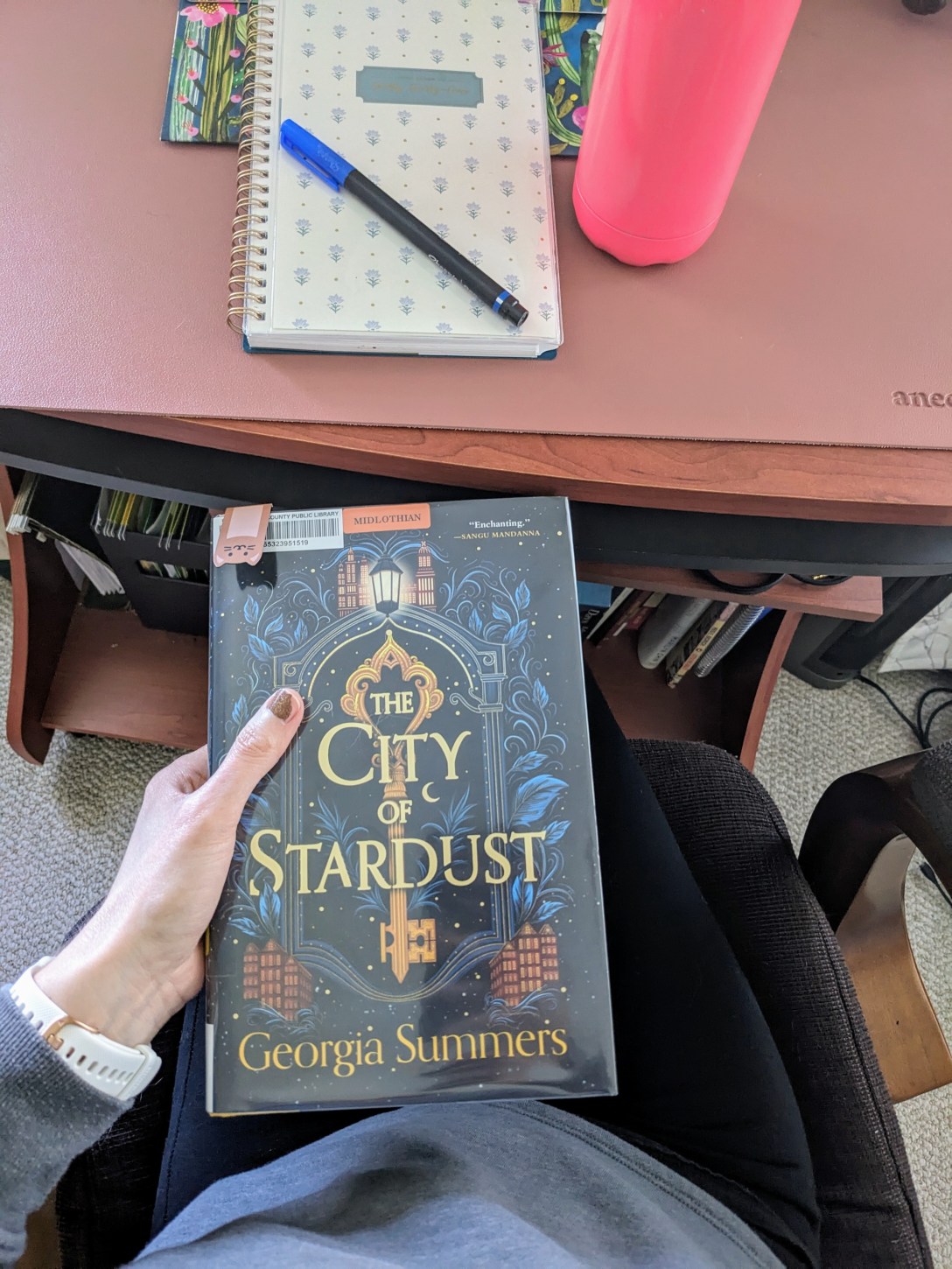
Hello! I’m a little behind on book reviews, but I’m excited to talk about one of my recent reads, The City of Stardust.
The City of Stardust follows Violet Everly. Violet’s whole life is her uncles, who keep her tucked away in the Everly house, and wondering what happened to her mother—who left to break the Everly family curse years ago. When Violet’s mother never returns, Penelope, her family’s ageless tormentor who never forgets a debt, issues an ultimatum: Violet has ten years to find her mother, or she will take her place. Violet is the last of the Everly line, the last to suffer. Unless she can break it first.
I really loved this book! It gets all the stars (or stardust) from me.
The writing is so atmospheric, lyrical, and ethereal. This is a dreamy, almost dark fairytale-like story, and on a prose level, it’s gorgeous to read!
It has so many elements that I love—it’s a portal fantasy with magical doors and magical keys. There’s a curse and angry gods. There’s a secretive, snooty group of scholars. There are mysteries that you uncover alongside the main character.
I was so surprised to see that this book only has 3.46 stars on Goodreads.
It is worth mentioning that this is a slower-paced story, and it does take about 50 pages before the worldbuilding becomes revealed and for the plot to pick up. If you like the books/comps listed below or if we have similar tastes in books, then I recommend it!
Ink Blood Sister Scribe
The Ten Thousand Door of January
The Invisible Life of Addie LaRue
Inkheart
The Starless Sea (I personally haven’t read this one, but I heard it’s similar!)
Anna: Plastic is a wildly creative and unique book that manages to do so much through its absurdist premise. It’s bizarre, entertaining, and somehow it works. Thank you to Netgalley for the early review copy, Plastic is available now!
I don’t even know if I can describe the plot in a way that does it justice. Erin is a plastic “figurine” who lives in a dystopian, technologically-advanced and seemingly superficial world. But this world is a lot darker than it seems. An eco terrorist group is at large, and bombings are frequent—all of the characters have experienced the loss of a loved one, including Erin. Erin also has a secret. Her sister, Fiona, who ran away when Erin was in high school, is one of the main leaders of the terrorist group. Erin deals with the recent loss of her father and her anger at her sister by escaping into virtual reality worlds and obsessing over her favorite TV show, Nuclear Family. This is where it gets weird: the figurines only eat boiled chicken, there is a race of waffle people—yes, people who are literally waffles—and Erin breaks out into song every couple of chapters.
Each chapter is also framed as a tv show episode, complete with descriptions of camera angles and musical numbers. The dialogue is also jarring—the figurines speak to each other in an imaginary future dialogue of English that mimics text messaging, consisting of dropped nouns and babyish slang (blummo for sad, for example).
All this takes a bit to get used to as a reader, and I resented the characters at first for seeming like such airheads. But this book is as dark as it is comedic, and by the end, even the question of why each chapter is framed like a tv show episode is answered.
Tackling big topics like eco terrorism, the future of technology, capitalism, grief, trauma and more, Plastic will undoubtedly go down as one of the most surprising and memorable books I’ve ever read.
And apparently you can listen to the songs from the book on Spotify!
Destroy the Day is the final book in the Defy the Night trilogy, and Defy the Night is one of my favorite books! It’s a classic upper YA fantasy with political intrigue, romance, and a sickness spreading through the land. The two main characters are Tessa, a Robinhood-like apothecary, and Corrick, the prince of Kandala and the King’s Justice.
I really enjoyed Destroy the Day. The story dives deeper into the world, politics, and scheming of the Kandala government. Kemmerer’s writing flows really well, and I feel like her writing style works well when switching between POVs.
Speaking of which, Destroy the Day has three different POVs: Tessa, Corrick, and Corrick’s brother, King Harristan. Harristan’s chapters end up taking up about as much of the book as Tessa and Corrick’s, which honestly, I like! I think Harristan is a great character, and he’s such a good foil to Corrick (stoic and reserved to Corrick’s more hotheadedness).
What I really appreciated about this book was Kemmerer’s talent in making me care about every single character. Usually, I’m not into new, important side characters being introduced later in a series, but Kemmerer does a great job of really showing the impact a new character has on Tessa. A couple of side characters from the second book end up having bigger roles, and I enjoyed watching them grow and help the main characters grow. I especially enjoyed the emphasis on friendship.
Another aspect I really loved about this book is the way no one is a straight-up villain. Kemmerer makes all of her characters well-rounded with solid motivations, so no character is black and white (yep—that means there are some well-written morally gray characters in this series).
Now, I have two main gripes in this book that I’ll delve into more below with spoilers. But the first one is that we get barely any scenes with Tessa and Corrick together. Yes, there are solid reasons for this, but in the end of the book, I really felt like they needed some more scenes together before the resolution. My second gripe is with an important plot point near the end that I feel like didn’t fit into two of the character arcs, which I’ll talk more about below.
All in all, I loved this finale! However, I’m still not over the ending, so I have to dock half a star (or moon, in this case) for that.
VERDICT: 🌑🌑🌑🌑🌓
SPOILERS BELOW:
If you’ve read this book already, or if you don’t care about spoilers, hello! So at the end of this book there is a heartbreaking scene of Harristan sacrificing himself for his country and his brother. While I saw this coming, I came to terms with it because I thought it fit Harristan’s character, as he would do anything to save his brother and his people.
…Until Quint, Harristan’s new boyfriend, decides to help him, and they die together. This felt a little bit too much like the “bury your gays” trope (aka gay characters tend to get killed off).
And then something felt off, and I just had a feeling that neither of them actually died. And while (ding ding!) I was right, the way it was revealed rubbed me the wrong way—Harristan and Quint escaped and survived, only to hear that Corrick had already arrived back home and been crowned king. So what did they do? They hid in a cabin with false identities. And not with the intention of saying, “Oh, hey! We actually survived and we’ll come back to the castle now.” Nope. It was to start a new, secret life.
Harristan’s main motivations were to save Corrick and to save his people. He spent this entire book earning the people of Kandala’s trust back, only to decide to push the burden of being king onto his nineteen-year-old brother, who the people trusted even less than Harristan. You just can’t tell me that it’s in character for him to just say, “Too late! Just spread the lie that we died,” AND let his brother believe it for a long time before managing to slip him a note.
Anyway. Did I still love the book? Yes. It just sucked that this was the twist at the end because I didn’t feel like it fit into Harristan’s character arc—not to mention Quint, who is Corrick’s best friend.
Lesson: Don’t bury your gays! Even if they come back from the dead.
Anna: Bear (out June 25, 2024) is a modern day fairytale-like story (and tragedy) of two sisters on a Pacific Northwest island who are buried in debt working demanding service industry jobs while taking care of their dying mother. I was excited to read this after enjoying Julia Philips’s debut, Disappearing Earth, last year.
This one is very different but still just as character-focused. I found the beginning a little bit slow, but once it picked up, I had to know what happened.
Sam has always allowed her older sister, Elena to take charge of their financial responsibilities and physical care when it comes to taking care of their mother. She’s also always trusted that she and Elena had a plan when their mother finally died—sell the house and escape the island that has held them captive for their whole lives. Then a bear arrives on the island and everything changes.
One of the most interesting things to me about this book is that you think you can trust Sam, just Elena and the vision she believes Elena has laid out for them. But in the end, you find out that Sam really knows nothing about her sister. Even the plan for their future that Sam clung to throughout the book is stripped away. It all goes back to the arrival of the bear on the island. But is it really the bear that caused this change in the sister’s relationship, or did they never really know each other at all?
I also love the “woman gone wild” trope that is explored here.
The ending is jarring and dark in a way that I didn’t expect, even though the rest of the book was equally as depressing. It will make you wonder what in the world it’s really saying about sisterhood, death, grief and poverty. I feel the twist at the end works even though part of me isn’t even sure if the bear ever existed at all. After all, Bear reads like a dark fairytale. It makes sense it ends like one too.
I read 101 books in 2023, which is the most I’ve ever read in a year!
My favorite books of the year weren’t all published in 2023, and these are in no particular order. In addition to either flying through them or savoring my experience while reading them, all of these stuck in my mind throughout the rest of my reading this year.
I really went back to my literary fiction roots. My favorite books of the year were written by women and, in addition to being beautifully written, the majority of them deal with issues of girlhood and motherhood, feminism, sexuality, and sexual violence.
My favorite books of 2023
BRIEFLY, A DELICIOUS LIFE by Nell Stevens
I KEEP MY EXOSKELETONS TO MYSELF by Marisa Crane
THE FEMALE PERSUASION by Meg Wolitzer
VLADIMIR by Julia May Jones
BODIES OF LIGHT by Sarah Moss
PARABLE OF THE SOWER by Octavia Butler
ELSEWHERE by Alexis Schaitkin
THE GUEST by Emma Cline
MOTHER IN THE DARK by Kayla Maiuri
PENANCE by Eliza Clark
THE RACHEL INCIDENT by Caroline O’Donoghue
MY LAST INNOCENT YEAR by Daisy Alpert Florin
Honorable mentions outside of literary fiction
Middle grade: SKUNK AND BADGER by Amy Timberlake
Thriller: MAGPIE by Elizabeth Day
Fantasy: A FIRE ENDLESS by Rebecca Ross
My 2024 Reading Goals
My goals for 2024 are to read more memoirs, prioritize reading more diverse authors and perspectives, and read and review more advanced reader copies on Netgalley. Other goals include being a responsible reader—supporting my local Indie bookstores, local library, and continue preaching to people to stop buying books on Amazon. Other than that, I don’t have a numbers goal—I’ll just see where the year takes me!
Divine Rivals is one of my all-time faves, so it’s an understatement to say I was looking forward to its sequel, Ruthless Vows.
Rebecca Ross’s writing is always lyrical and gorgeous—and it was in Ruthless Vows, as well. I really loved reading this book, but my favorite was definitely the last 3/4. Without going into spoilers, it was heartbreaking, and I loved seeing Iris embrace her badass self.
I docked off a star for 1 main reason:
The pacing in the first half felt off. Certain parts felt too drawn out, and I expected this sequel to be faster paced and more action-packed than the first book, considering the buildup in Divine Rivals and the war.
It’s worth saying that I normally really despise the amnesia trope, but it’s a testimony to Ross’s writing skills that I think she 100% pulled it off.
All in all, I really enjoyed this book, and I’m glad it had a satisfying ending! I’m also grateful that I was able to read this book while I was on my winter vacation.
If you’re looking for a beautifully written upper-YA low fantasy book with WW1 vibes, a war between gods, magical letter writing, and romance, then I highly recommend this duology.
Was I the first person to put Iron Flame on hold at my library? Yes, yes I was.
Hi, everyone! It’s been a while again. Work and life have been busy, but I’ve been reading as much as ever.
I recently read Iron Flame, the much anticipated sequel to the dragon fantasy/romantasy book Fourth Wing.I had heard some mixed reviews from other reviewers, so I was interested to see what I thought.
Well, I liked it! It’s hard to review a sequel without giving away anything, but I’ll go over some key points.
Things I Liked:
I enjoyed the worldbuilding. Fourth Wing was definitely more of an all vibes, no worldbuilding kind of book, so I’m glad that Yarros delves deeper into the world in Iron Flame.
Dragons! There are a lot more dragons in this book, and more facts and lore about dragons are revealed. There’s also a good dragon-related plot twist.
The ending. Yarros is clearly good at writing a good cliffhanger, which can be a plus or minus for readers. For me, I think she actually does a good job of making you anticipate the next book in the series without making the cliffhanger itself super frustrating. There is also, yet again, another good plot twist at the end.
Things I Didn’t Like As Much:
The romance. To be fair, the romance wasn’t my favorite part of Fourth Wing, either. But Xaden somehow manages to feel more toxic in Iron Flame, and a large aspect of this book centers on a point of contention—which feels like it purely exists just to add tension to their relationship.
Overall, I definitely don’t think this was a bad sequel, and I also don’t think it felt rushed or unedited. It just wasn’t as fast-paced or romance heavy as the first book. I think this series is worth a read if you’re looking for a fun, action-y series that doesn’t take itself seriously, and if you don’t mind modern dialogue in fantasy books. Plus, dragons!




 takes two to book review