Review: Redemptor by Jordan Ifueko

A copy of Redemptor lies on top of a book journal. Both are lying on an autumn colored scarf on a gray blanket.

Alexis: 

As I’m sure you all already know, Raybearer was one of my favorite books of 2020. I found the worldbuilding, the prose, the characters, and the plot to be unique, beautifully written, profound, and impressive, especially for a debut novel.

So obviously, I’ve been looking forward to Redemptor; I even reread Raybearer in preparation. 

I can’t imagine writing a sequel to such a celebrated first book, especially when under deadline. And I’ll go ahead and say I really did enjoy Redemptor, and it’s a solid four-star read from me. However, it just wasn’t what I expected, and the story didn’t rope me in as tightly as the first book.

Without spoiling anything, I was looking forward to getting to know the cast of characters better. For some background, Tarisai, the main character, is part of a group of twelve people anointed to Dayo, the prince. They’re bonded together forever as a found family of sorts through Dayo’s ray, which also allows them to speak telepathically to each other.

In Raybearer, we obviously don’t get to spend a lot of time with more than a handful of the anointed siblings. Even though I loved all of the characters we did get to know, I knew there was room to learn more about Tarisai’s relationships with the rest of them. 

However, instead, we get a whole new cast of characters thrown at us. Even though I half-expected this from the way the plot was set up at the ending of the first book, it was a little disappointing to me. I loved the first cast of characters so much that it was hard for me to care about the new ones. I’m glad we got to know Kirah, one of Tar’s anointed sisters, more. But Sanjeet and Woo In, two of my favorite characters, didn’t appear nearly enough in this sequel, and I really felt their absence (especially since there was this weird sort-of love triangle but not really thing happening for part of the book?).

Despite that, the plot felt a little slow moving in the first half. Thankfully, the second half was awesome and had a great ending!

I love that we got to hear from Dayo more, and his asexual representation was great. I loved Tar’s journey to the Underworld, even if it felt short compared to the rest of the book. I loved, as usual, Ifueko’s worldbuilding. 

I think what I’m saying is this: I enjoyed this book. Just don’t go into it with extra lofty expectations.

VERDICT: ⭐⭐⭐⭐/5
Alexis’ August Wrap Up

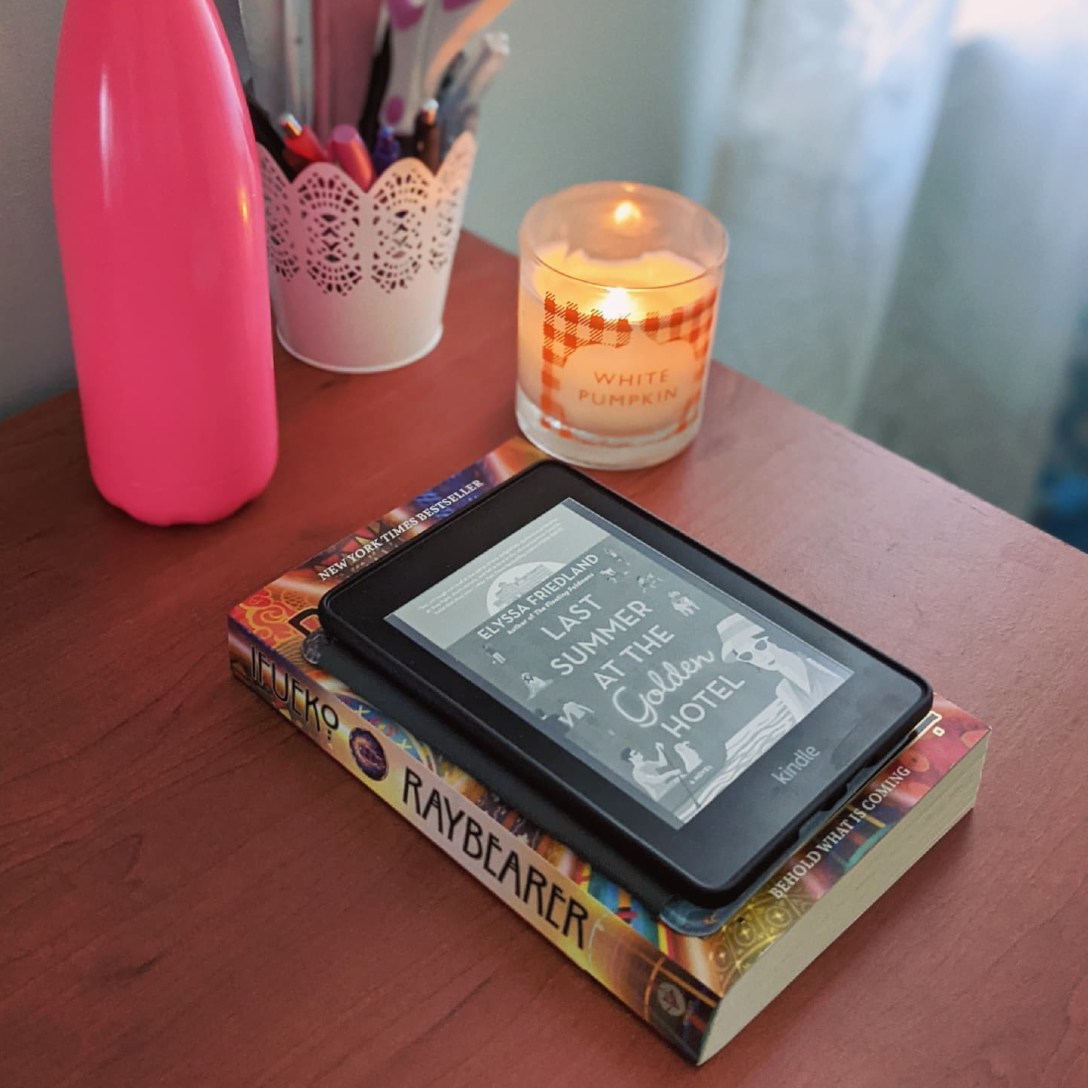
A kindle sits on top of a paperback copy of Raybearer on a desk. A lit white pumpkin candle sits behind it, next to a cup of pens and office supplies and a pink water bottle.

Alexis:

Well, I read seven books in August! This has definitely been a good reading year for me; I actually surpassed my Goodreads goal of reading 50 books this year in August, too.

I re-read two books this month: A Court of Mist and Fury and Raybearer. Both were still 5-star reads, and I’m happy that I bought copies of both of them to add to my personal library.

I read one 4-star book: The Crown of Gilded Bones. While I haven’t given star ratings to the other books in the Blood and Ash series, I enjoyed the additional worldbuilding and Poppy’s character arc, and it definitely felt like a 4-star read.

I read two 3-star books: Realm Breaker, Tweet Cute, and Last Summer at the Golden Hotel.

Realm Breaker is a high fantasy read. I found the prologue to be confusing, and I had a hard time getting into the beginning of the story. While I loved some of the characters, there were a lot of POVs, the world and worldbuilding felt kind of generic, and I just wasn’t blown away when I finished reading it.

I actually read Tweet Cute on my Kindle while traveling. It’s a YA rom-com, which definitely isn’t my usual genre. This was a fun read, with a LOT of cheese puns. It bounces back and forth between the POVs of Pepper and Jack. I enjoyed reading about Pepper’s love of baking, and I enjoyed reading about an app that Jack created called Weazel. However, the main plotline of this book is a Twitter feud, and I found that it got a little annoying and boring for me. But if you like fluffy reads and drama, then I think you might enjoy it.

I also read Last Summer at the Golden Hotel while traveling. It mentioned Dirty Dancing, one of my favorite movies, so I had to pick it up! Turns out the only similarity is the setting. This book is wholly about family drama. Two different families own the Golden Hotel, and we get to see from a ton of different POVs (which usually isn’t my thing; it keeps me from connecting to the characters, and this was no different). While this book was definitely interesting, I think it dragged on a little too long, and had some melodramatic parts. It also focused a lot on the difference between generations, which I also wasn’t a huge fan of. (Maybe I need to stick to my favorite genre from now on!)

And finally, I read one 2-star book: Ariadne. I already wrote a review on it, so you can check that out here!

Anna’s August Wrap Up

I didn’t read as much as I normally do this month, but that’s okay! I was busy going to the beach and filling my weekends with other end of summer experiences. 

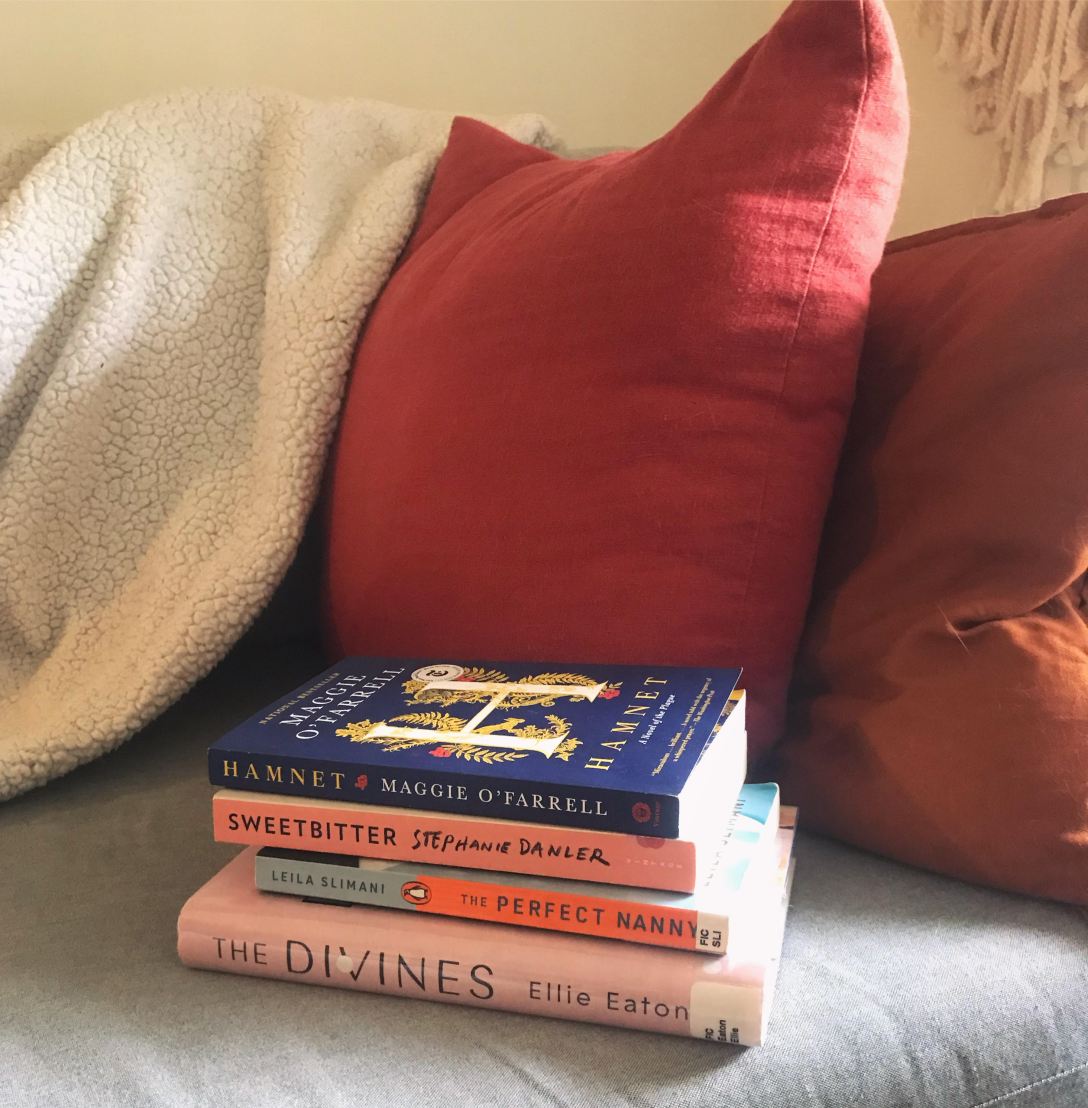
I finally read Hamnet this month, and loved it as much as everyone else did! It’s a lyrical written story about grief and Shakespeare’s (fictionalized) family. This is exactly what I’m looking for in literary fiction- beautiful writing and expertly written characters. Maggie O’Farrell clearly did her research on the Shakespeare family, but she also tells an original story that stands on its own. Hamnet is also the first book that made me cry in years.  

I liked the descriptions of food and NYC in Sweetbitter, but overall it was too slow & way overwritten. My favorite thing about this book is what I learned about working in the restaurant/food industry, specifically fine dining. If you can get through Tess’s overly naive and heady descriptions of her life after randomly moving to New York City, you’ll learn about the inner-workings  and politics of running a famous restaurant. Seriously, this girl doesn’t know anything about New York City (or life) when she gets there. Yet somehow she’s likable, sexy, and a protegee at her job? What saved this book for me, as someone who lived there for a year and worked in two unforgiving industries (publishing & retail), is the love/hate descriptions of working your butt off living in New York City. 

The Perfect Nanny was the most underwhelming thriller I’ve read all year. Translated from French, this book has a lot of half-baked ideas and proclamations about motherhood, race, and class. All these ideas and themes were underdeveloped. 

But the biggest problem I had with The Perfect Nanny is that it’s a thriller, and yet there was no surprise or twist. At the very beginning of the book, we learn that a French couple’s nanny, Louise, has killed their two children. Spoiler alert, she did. And there’s no nuance to why she did it. I also didn’t find Louise’s character very believable. There’s not nearly enough to justify her mental breakdown at the end.

I love a good campus novel with a mystery and vapid teenage girls, and The Divines didn’t disappoint. This one has surprisingly low/poor reviews on Goodreads. Maybe people don’t like it because it’s slow-paced and the characters are extremely dislikable. Although that description also fits the much-loved The Secret History by Donna Tartt French, and I thought The Divines was better. What I really liked about this book was how the reader learns about Joe’s experiences and trauma at boarding school affected her adult life. This book also takes an interesting look at how memories can change over years and how people remember the same events differently. 

I also read Moonflower Murders (not pictured), the second book in the Susan Ryeland series by Anthony Horowitz, which was just as good as the first! I don’t want to spoil anything from book one, Magpie Murders, but these books have some of the most masterful plotting I’ve ever read. They’re also both murder mysteries within a muder mystery. I really hope there will be a book three! 

With August ending, I can’t wait to officially kick off my fall reading in September!

Review: Ariadne by Jennifer Saint

A hand holds a library hardcover copy of Ariadne over a gray blanket. A stack of books, including Circe and Percy Jackson, sits behind it.

Alexis:

It’s disappointing when you don’t end up liking a book you were looking forward to.

I love myth retellings, especially Greek myths. As someone of Greek heritage myself, I find it fascinating that my ancestors wove such intricate, and often brutal, tales about the world around them, and I’ve loved learning about Greek myths ever since my Percy Jackson days and my Latin classes! 

I almost DNFed this book 50 pages in, but decided to stick with it. Ariadne follows, you guessed it, Ariadne. In Greek mythology, and in this book, Ariadne is the Princess of Crete. Hero Theseus arrives in Crete after offering himself up to be sacrificed in place of a child to go through King Minos’ labyrinth, and face the Minotaur, a half-bull, half-human creature. For Ariadne, she falls in love with Theseus at first sight, and she devises a plan to help him make it safely through the maze.

The book is mostly from Ariadne’s POV, but also features the point of view of Phaedra, Ariadne’s little sister. However, the dual POVs did not work for me. The voices were too similar, and while I liked Phaedra’s storyline at first, it quickly did a nose dive. I felt like both she and Ariadne didn’t have good character development.

Despite being in first person, I didn’t feel like I got to know Ariadne as much as I wanted to. And honestly, though not too slow-paced, the story bored me. I felt like it kept leading up to something, to a big event, but it never did. 

And the ending. Oof. Saint definitely went the Greek tragedy route, without modernizing this story, telling a different version, or fleshing it out enough. Unfortunately, I don’t think this book added anything to Ariadne or Phaedra’s voices or stories.

VERDICT: ⭐⭐/5

Review: Girls of Paper and Fire by Natasha Ngan

A paperback copy of Girls of Paper and Fire is being held in front of a pool.

Alexis:

Whew, this book was darker than I expected; it centers around sexual abuse.

As a member of the lowest cast, the Papers, Lei is human. But because of her golden eyes, Lei is stolen from her home to become a Paper Girl—a concubine for the Demon King. 

I liked the sapphic romance that developed, though it felt a little insta-love to me. The worldbuilding was interesting, but this book was definitely tough to get through at times because of the dark themes. That being said, the best thing about this book is how well Ngan handled the dark themes. She depicted the upper caste, called the Moon caste, well by making them grotesque and sometimes beautiful through Lei’s eyes. Reading about the demons/Moon caste was also uncomfortable at times, especially since they’re described as humanoid animals. But through the grotesque demons, the castes, and the horrors of the Paper Girls, Ngan hammered themes of survival, rebellion, and sexual abuse/violence.

While I liked the plot, some plot points would’ve worked better if revealed earlier. Because the main plot was introduced late in the story, the beginning felt a little slow and meandering in comparison.

If you can handle dark themes, and are looking for a sapphic YA fantasy with strong female characters, then I think this one will work for you.

VERDICT: ⭐⭐⭐/5

TW: Sexual abuse/violence/rape, sex trafficking, a forced medical exam, physical abuse, animal death, war themes

Review: Sorcery of Thorns by Margaret Rogerson

A Kindle copy of Sorcery of Thorns is being pulled out of a black bookshelf, with a candle resting behind it.

Alexis:

Sorcery of Thorns is one of those books that I had no interest in reading. Why? For some reason, I got it into my head that I wouldn’t like Rogerson’s writing style. But when I saw that the e-book was available through my library, I thought, Why not?

The beginning was a little slow, and it took me a while to get into it. But this story really is a love letter to books, and I love the way Rogerson describes the beautiful libraries. I love how the books are alive, sometimes lovely and sometimes gruesome. I love how Elisabeth, the main character, can talk to the books. 

The characters in this story really shine. Nathaniel is a sorcerer who Elisabeth stumbles upon (actually, she nearly kills him when she accidentally topples an entire bookshelf). His dialogue is hilarious, and his character is so well-rounded and fun to read. His demon/servant, Silas, is an equally great character, as stoic as Nathaniel is snarky; it also helps that he can turn into a cat.

Despite the wonderful characterization, sometimes I wanted to know more of Elisabeth’s internal thoughts, but if you’re looking to read about a tall, bookish, sword-wielding character learning to navigate the world around her, she’s your girl.

This was so close to being a 5 star read. However, the story did go on a little long. I also wasn’t the biggest fan of how Rogerson executed the ending, which felt like a deus ex machina, on top of being rushed in comparison to the rest of the book. However, I loved the characters and I enjoyed reading this so much!

VERDICT: ⭐⭐⭐⭐/5

Review: Wild Beauty by Anna-Marie McLemore

Alexis holds a hardcover copy of Wild Beauty in one hand while standing in front of a fence and a forest.

Alexis:

Happy Friday, everyone! This week felt like it flew by.

I’ve just been consuming books lately, so I’m a little backed up on book reviews. But it’s time to talk about Wild Beauty.

I’ve been meaning to read McLemore’s books for a while now; she’s known for her magical realism books and her lyrical writing. And one of the best aspects of this book is her lush, lyrical writing. I love the way she describes the flowers and the gardens of La Pradera. I love magical realism, and reading this book often felt like reading a dream.

The plot: The Nomeolvides women are not like other women. They can create flowers with only their hands—but they’re also cursed. They can’t leave their magical garden estate of La Pradera without getting sick. And on top of that, if they fall in love too deeply, their loves disappear into thin air. But then a boy named Fel appears at La Pradera one day. And Estrella, one of the Nomeolvides girls, tries to help him figure out who he is and where he came from. 

I liked the bixeual representation, and the collection of girls was fun to read about, even if they tended to blend together. I do wish I got to know Estrella’s character even more; Fel was definitely the standout character to me, and the only one who felt like he had a real backstory and motivation. 

As much as I enjoyed McLemore’s writing and imagery, this book was very, very slow moving. And I don’t mind slow-moving, character-driven books. However, oftentimes, this book didn’t read like a book. I’m not sure what it felt like most of the time; maybe a long-form narrative poem? 

Besides the chapters from Fel’s POV, this book has no plot until the last quarter or so. And what surprised me was that the plot was amazing. It was so interesting, and made so much sense in the context of the book, that I found myself a little annoyed. Why didn’t McLemore weave this plot in earlier instead of describing flowers or the girls dancing and conversing for the hundredth time? The ending was powerful, and the way the plot unraveled was wonderful. I just wish it was present in more of the book. 

VERDICT: ⭐⭐⭐/5

Review: Life’s Too Short by Abby Jimenez

A library copy of Life's Too Short rests on a table in a coffee shop next to a gray notebook with a pen laying on top. Alexis' hand holds a cup of black iced tea next to the book.

Alexis:

Last year, my most surprising read was The Happy Ever After Playlist by Abby Jimenez. While I like a good romance every once in a while, I don’t usually read rom-coms. So when I heard that Life’s Too Short was coming out, I knew I had to read it. 

What’s cool is that these two books are part of a series, so there are recurring characters that make appearances. 

In Life’s Too Short, we follow Adrian, a lonely lawyer, and Vanessa, a travel YouTuber who unexpectedly becomes the caretaker of her half sister’s baby. I really enjoyed the dual POVs, and as with The Happy Ever After Playlist, Jimenez’s writing sparks on the page, especially her funny and snappy dialogue. 

I also appreciate that Jimenez tackles big themes and problems. Rom-coms often only focus on romance and comedy, but Adrian struggles with his estranged dad and a phobia, and Vanessa struggles with a dysfunctional family and ALS, which runs in her family and killed her sister. They feel like real people with real problems.

As much as I enjoyed this one, as well as the slow-burn romance, it’s very structurally similar to The Happy Ever After Playlist. However, unlike the previous book, I found myself guessing the ending of Life’s Too Short, and I also found it cheesy. On top of that, the book seemed to focus a lot on Vanessa and her relationship with her dad and her family, which is great and all, except that I found myself not really caring about her family members as characters. Instead, I kept finding myself wanting Jimenez to focus more on Adrian and Vanessa. It also felt like Grace, the baby, only made an appearance in the beginning of the book.

And finally, I guess because Vanessa is a YouTuber, some of the language in this book feels very internet-culturey. It tended to take me out of the story, especially because Jimenez kept repeating “Aaaand” and drawing out words unnecessarily. 

Overall, this was still a fun read. But The Happy Ever After Playlist is my favorite so far!

VERDICT: ⭐⭐⭐

Pub day spotlight: The Temple House Vanishing by Rachel Donohue

Anna: Happy publication day to The Temple House Vanishing by Rachel Donahue! Thank you @algonquinbooks for sending me an arc of this book in exchange for an honest review.

Set in a boarding school in an old Victorian house in Ireland, scholarship student Louisa quickly becomes enamored by classmate Victoria and their charismatic art teacher, Mr. Lavelle. Louisa struggles to fit in with her rich classmates, but as she becomes closer to Victoria and Mr. Lavelle, something even darker is underfoot. 

25 years later, an unnamed journalist investigates Louisa’s disappearance. It’s widely accepted that Louisa willingly ran away with Mr. Lavelle, but as the journalist becomes more entangled with the case, it’s clear something much worse happened.


The Temple House Vanishing evokes major My Dark Vanessa and The Likeness vibes. This is a quick, smart, and atmospheric read that explores love, friendship, obsession, race, class, and the ways in which men in positions of power take advantage of young women. I did find the perspective from the journalist a little lacking and would have liked more character development there. We learn little about her own life, besides that she grew up on Louisa’s street and Louisa once babysat her. The only thing we know is that she is a workaholic. I thought something might happen with her intern, who gets a lot of dialogue, but that turns out to be a dead-end in the plot. Then there is also an artistic choice in the epilogue involving a ghost that I found a little strange and a bit cheesy.

But overall, I can’t say no to a spooky boarding school mystery, and this is another one of those.

Review: From Blood and Ash by Jennifer L. Armentrout

A Kindle copy of From Blood and Ash rests on a cream-colored blanket next to a white mug with a matcha latte.

Alexis:

Okay, so this book is hot garbage. But it’s enjoyable hot garbage. 

Think a refashioned Twilight; throw in some werewolves and two types of vampire type things. Although, this book honestly has way more plot and worldbuilding than Twilight ever did. 

The first half was a little slow as it set up the world, Poppy’s character, and Poppy’s role in the world. The writing is honestly not great, though it did improve as the story went on (and as I managed to turn off my critical reading brain). But there were just some strange sentence structures and a lot of “telling” over “showing” in the first half, especially.

Plus, there were typos. I don’t know if it was just in the e-book version, but on page 305, for example we have: “Of course, you do.” Why is there a comma after of course?? Later on, we have: “He was an Atlantian, His people…” There were others, too, but I tried not to keep track of them all. After all, that’s not the author’s fault.

There were a lot of plot twists that were obvious from nearly the very beginning of this story, and Armentrout throws in very heavy-handed foreshadowing that doesn’t help. The romance is very Twilight-y in that there’s a power imbalance, and Hawke’s character is morally grey (and at times creepy, hello Edward).

Okay, then why did I say this was an enjoyable read? Because the dialogue is dynamic and snappy. There’s a lot of well-written tension. And once you get past the not-so-subtle foreshadowing, I found the world and the world’s history interesting. Plus, reading about flawed, morally grey characters always intrigues me, and it kept the pages turning. Despite Poppy having some pretty dumb moments, I enjoyed her POV and found her an interesting character, and I was glad that her character knew how to fight. 

My enjoyment while reading this book? Nearly 5 stars! But the writing comes in at about a 2. I’m not sure I want to rate this one overall, but I guess that would fall in at about a 3.5. You can bet I still want to read the series, though! Too bad I have to wait about 7 weeks to read the next book from my library.

Anyway, if you can turn off your critical reader brain and you’re looking for a Twilight meets A Court of Thorns and Roses kind of read, then you might like this.