Review: Children of Blood and Bone by Tomi Adeyemi

Alexis: Read 1/9/19

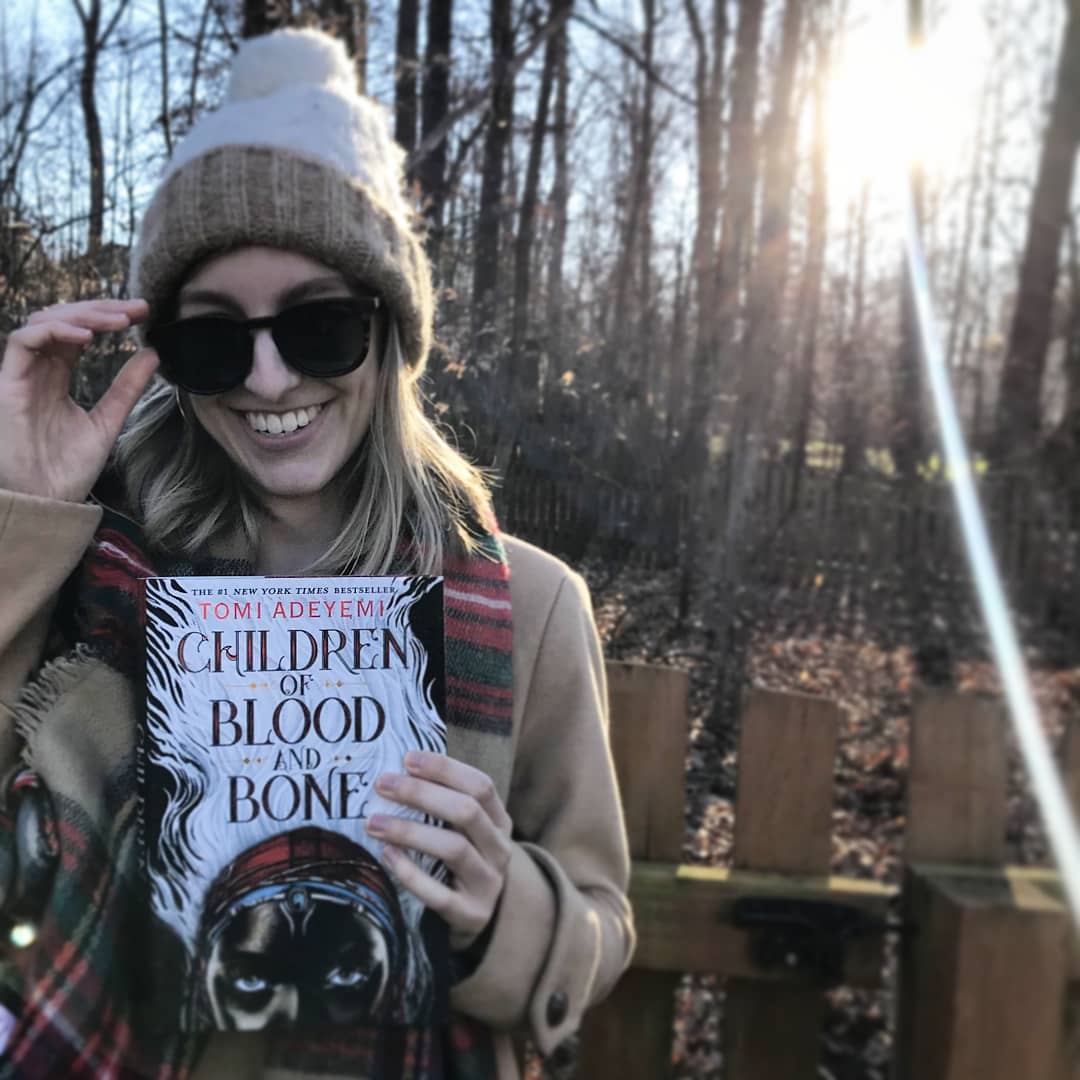
Children of Blood and Bone, despite being a thick book, is super fast-paced. The plot is always moving, which I appreciated as I read. Adeyemi does a good job of explaining how the magic system works, and I enjoyed learning about all the gods and the maji’s connections to them. Sometimes multiple perspectives can be hard to pull off, but I really enjoyed reading from all the different perspectives, and the shifts never pulled me out of the book.

As for the characters, I’ll be honest: I’m not a huge fan of Zélie. She sometimes felt like a Katniss Everdeen character. However, I connected more with her as the book went on. I enjoyed Inan’s character until about halfway through the book. As for Amari and Tzain, I always enjoyed reading from their points of view. At times, the plot was a bit predictable, but not enough that I didn’t continue to enjoy reading the story. There was a love-at-first-sight storyline, and though I normally hate this YA trope, I thought Adeyemi used it to her advantage.

About a quarter way through this book, I realized something: parts of this book mirror Avatar: The Last Airbender.

Zélie is very similar to Katara. When she is young, her mother is killed in a raid because she possessed magical powers. Zélie possesses these same powers and she grows up wanting revenge. She has an older, non-magical brother, Tzain, who just wants to protect her. Zélie meets an Aang-like character, Amari: a girl who was trained how to fight from an early age, but who needs to learn to get past her peaceful side.

Amari’s older brother, Inan, the prince, has a good heart but is misguided. He wants his father’s approval but he has to betray those he loves in order to achieve it, just like Zuko. The father is definitely a Fire Lord Ozai type of character.

There is a temple “made of air” which connects maji to their gods. This temple was mostly destroyed in a raid in which a genocide happened.   

Despite these similarities, Children of Blood and Bone is an original book. I I loved the diversity and the magic based on Nigerian mythology. I also admired Adeyemi’s creativity—the characters ride on giant, horned lions and leopards, called lionaires and snow leoponaires.

Overall, this book was wholly engrossing and I had a hard time putting it down. And for that reason I can’t rate it any less than 5 books. I’m excited for the sequel!

VERDICT: 5 books

Review: Everything Under by Daisy Johnson

This is a DUAL Review!

“I’d always understood that the past did not die just because we wanted it to. The past signed to us: clicks and cracks in the night, misspelled words, the jargon of adverts, the bodies that attracted us or did not that, the sounds that reminded us of this or that. The past was not a trailing behind us but an anchor.” -Daisy Johnson, Everything Under

Anna: Read: 12/17/18

I like lots of things about this book. l love Daisy Johnson’s writing style and enjoyed reading about Gretel’s complicated relationship with her mother. I love character driven “what happened” narratives, and this one intrigued me from the start.

This is a very ambitious book that tackles mother and daughter relationships, dementia, sexuality, adoption, abandonment, and homelessness. I was left with the the feeling that there was too much going on. There’s lots of good tension throughout the book with what happened to Marcus, and with the Bonak.

I really enjoyed the parts with Gretel’s mother and I wasn’t sure the point of making it the retelling of a certain myth that you figure out later in the book. The modern retelling didn’t enhance the story in any way. Coincidence is definitely a theme here that is a big part of classical myth, but I’m not sure I entirely bought the ending. It was beautiful writing all the way through, but it just felt too random and jarring.

Alexis: Read 12/22/18

I’m mostly going to agree with Anna here. Johnson’s writing style is lyrical and ethereal, made more so by the lack of quotation marks and her plentiful metaphorical descriptions. As for the genre, I would describe this as a modern magical realism book. Half the time, I wasn’t sure if what Gretel and her mother see and talk about is real or just in their heads.

I liked the emphasis on words, whether Gretel and her mother’s words or the very real words of Gretel’s work as a lexicographer. Overall, I enjoyed learning about Gretel and Sarah’s relationship. Marcus was an interesting character, and he felt more real to me than either Gretel or Sarah, though I’m not sure certain if him being trans worked for the book as a whole. On the other hand, Fiona’s character felt real and raw, and I felt that she was a better representation of a trans character than Marcus. I also wasn’t really a fan of the jumping around in point of views; it interrupted the flow of the book for me.

VERDICT: We both had similar mixed feelings about this book, and give it a solid 3 out of 5 books.   

Review: The Poppy War by R.F. Kuang

Alexis: Read 11/22/18

Yesterday, I finished The Poppy War by R.F. Kuang.

I loved the first half. It reminded me of a mix between The Hunger Games, Game of Thrones, and Avatar: the Last Airbender. On her website, R.F. Kuang even mentions that ATLA and Game of Thrones were some of her inspirations.

This brutal book deals with every heavy theme you can think of: genocide, addiction, experimentation, rape, death. Despite being a high-fantasy book, I found many aspects of the war in the latter half of the book to be extremely realistic.

This is because Kuang is a genius. She graduated from Georgetown and is now studying at Cambridge. She’s studying Chinese studies, and you can tell. I was amazed at her worldbuilding. Kuang knows everything about the world she’s created. The book describes the hierarchy, the history, the mythology, you name it. She talks about it. She describes it in detail. She fully understands the world she’s created, and I admired that from the very start of the book. I love the way she based the world off of Chinese history. This includes fascinating aspects like martial arts and mythology. But it also includes the dark side of history. And I love a good dark book.

I generally like the main character, Rin. She is established out-right: we know what she wants and how she’s going to get it. We know her motivation. But Jiang is my favorite character. His personality is the most well-defined, and I love all of his quirks. I love a good quirky, underestimated character. To be honest, I didn’t really care about any of the other secondary characters, though Altan annoyed me in the second half of the book.

Something is lacking in the second half. Even though the plot is still well-defined, too many new elements are thrown together too fast. A whole new crew of characters are introduced. Characters from the first half come in and out. And some huge decisions are made. It isn’t rushed; it takes place over a couple hundred pages. Yet for some reason, it feels jumbled. To be fair, the entire second half is war. War is a mess; war is a jumble. This Poppy War is brutal and messy and isn’t for the fair-hearted reader. But the way Rin acts in the second half almost turned me off from her (I mean that was kind of the point, but still). Her actions and way of thinking are justified in the world, but that doesn’t mean I like the direction her character is going. 

Overall, I enjoyed this book. I loved the messy history and the mythology of the world. I will definitely read the rest of the series in the future, but it just wasn’t a 5 star read for me.

VERDICT: 4 out of 5 books