Anna’s April Wrap Up!

Anna: I’m excited to share my April wrap up! This month included not one, but TWO five star books for me! Im currently finishing up three books that didn’t make it into this wrap up (classic). I’m also still loving memoir and middle grade!


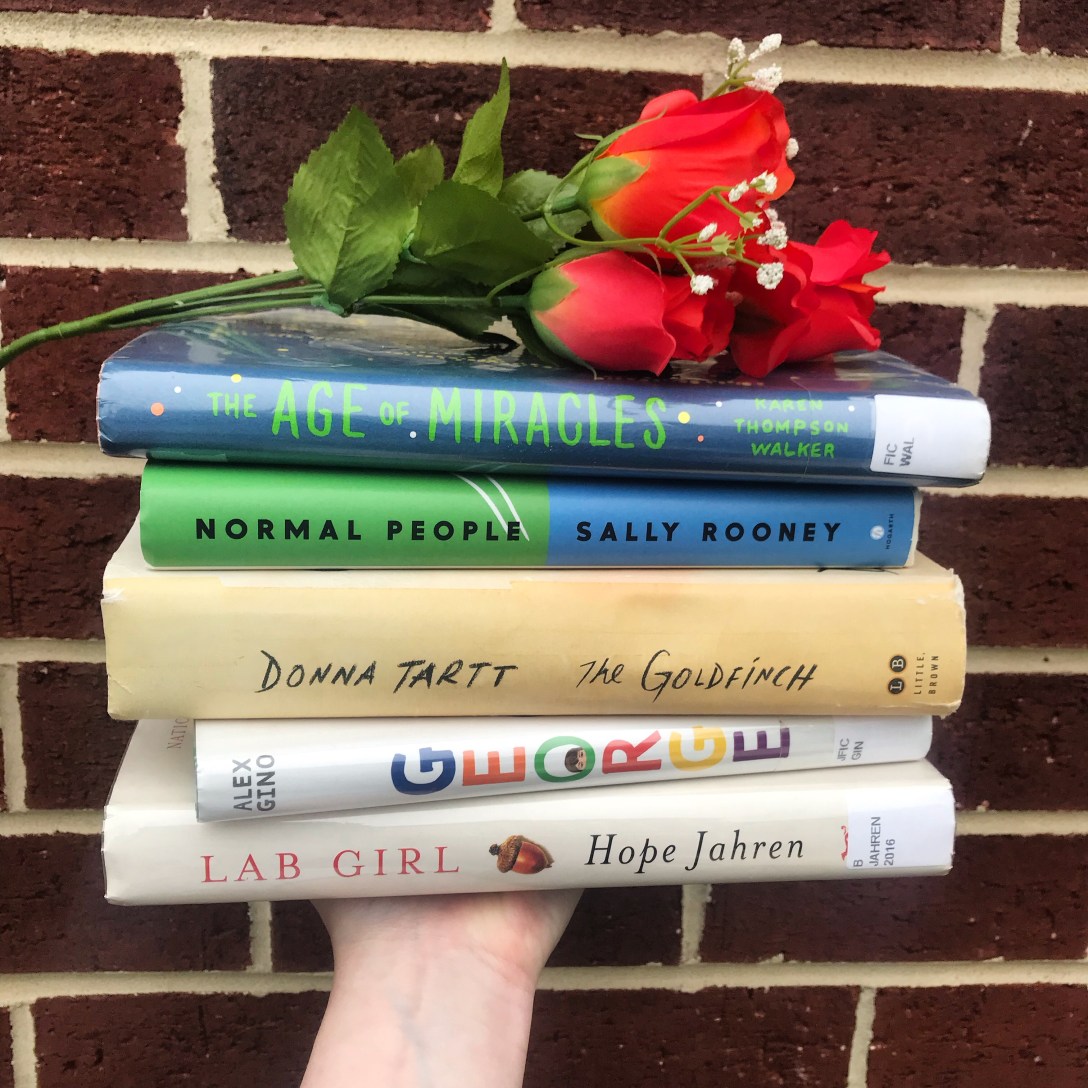
Lab Girl by Hope Jahren: 4 books

George by Alex Gino: 3.5 books

The Goldfinch by Donna Tart: 5 books

Normal People by Sally Rooney: 5 books

The Age of Miracles by Karen Thompson Walker: 3 books


What books did you love this month?


Review: The Goldfinch by Donna Tartt

Today I’m introducing a new favorite book! Check out my full spoiler-free review on our blog (link in bio!) My mom read this years ago and tried to get me to read it at the beach, but The Goldfinch is so incredibly detail-heavy that I couldn’t get into it. After reading The Secret History last year, I decided to give The Goldfinch another try.

I’m glad I did! This book is quite a feat to get through, but it’s worth the journey a hundred times over (and it made me miss New York so much!) If you like long and sweeping coming-of-age stories, this is the book for you. Like The Secret History, The Goldfinch is especially drug-heavy and most certainly not any easy read. I knew vaguely it was about art history when I started, but I never imagined the twists and turns this would take, or the impression it would leave!

What I love most about The Goldfinch is our protagonist, Theodore (Theo) Decker. Struck by tragedy in the first chapter (and then again, and again) some would say that he has an incredibly unlucky life. He makes someone bad choices that oftentimes you want to hit him over the head and scream, “What are you doing?” It’s his own difficult life and the messy relationships with the other characters–especially Boris, Pippa, Hobie, and even Popper–that give this book such a spark of life. When it was over, I’d spent so much time getting to know the characters that I didn’t want it to end!

The Goldfinch explores fate, grief and loss, the complexities of friendship, loyalty, and morality, the price of freedom, and the importance of fine art and historical objects of meaning. By the end I felt exhausted, but in the best way.

However, this book is A BRICK, which is why I found it easier to listen to on audio. The narrator did an incredible job making each character sound unique. I never would have been able to imagine Boris’s accent if I’d read this on my own.

VERDICT: 5 books! 


Review: Sugar Run by Mesha Maren

This review is spoiler-free and from both of us!

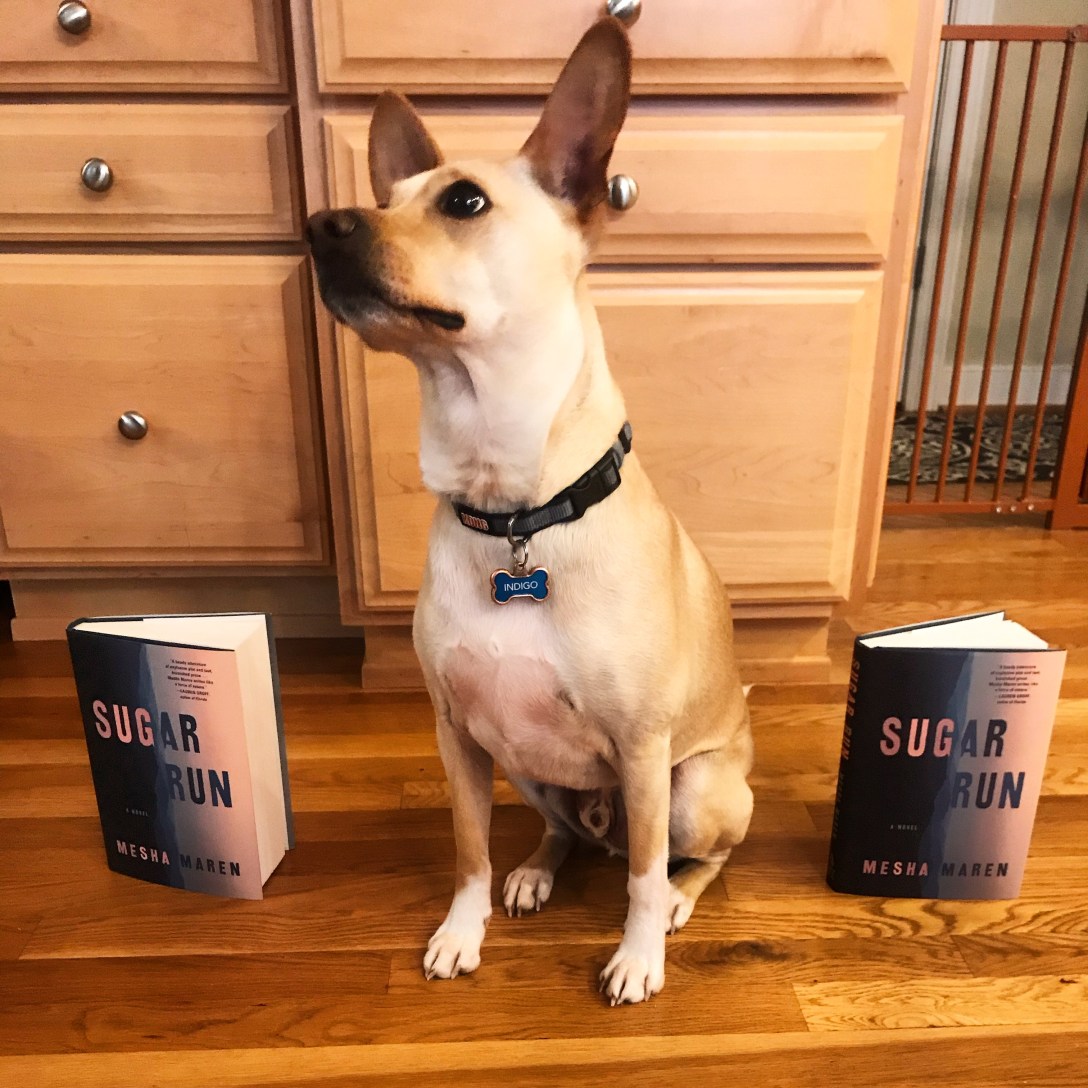
There is a dog in this book, so that’s our excuse for featuring a very confused Indy in this.

Alexis:

I’m thankful I had the opportunity to hear Mesha Maren discuss her book, because I feel like I really understood her vision. In Sugar Run, Jodi, the main character, is just released from prison, where she served eighteen years. She enters into a relationship with a young mother named Miranda, and their lives become tangled together. It’s a story of hope and hopelessness.

I love Maren’s lyrical writing style. Her writing has such a hard realness to it. She writes lush descriptions as she paints life in West Virginia. As Maren discussed in her talk, her book is hard to categorize. It’s a noir, crime, Southern Literature, and LGBTQ novel. But this is one of the great things about it: it’s a collage of genres, and it works.

This is a dark book that deals with vices to the max. It deals with crime, murder, sex, and lots of drugs. All of the characters are flawed, and make really bad decisions, yet I cared about them. The first half of the book is more character driven, while the second half is more plot heavy. The chapters alternate between the present (written in past tense) and the past (written in present tense) which I thought worked really well.

VERDICT: 4 out of 5 books


Anna:

Like Alexis, I’m so happy we had the opportunity to meet Maren at the Fountain Bookstore here in Richmond. Hearing an author discuss her book and writing process always enriches my understanding of it as a reader. The way Maren described her characters before I’d read about them made me more invested as a reader.

Maren’s writing is exactly what I love about literary fiction, even though, as Alexis said, this is a blend of genres. It is so dark and violent, but it is beautifully and breathtakingly written and full of nature imagery. The characters are well drawn out and real.

The violence in the lives of all the characters contrast so starkly with Jodi’s obsession with the rural landscape of her homeland. Her love of West Virginia mirrors themes of stability and nostalgia in Jodi’s life. It also offers commentary on the ways humans inflict violence on the earth, as the horrors of fracking is something frequently discussed.

The ending of books is something I’m constantly disappointed by, and, happily, this was not the case with Sugar Run! I thought the conclusion of both the interwoven timelines is so well done, and, most importantly, believable. Maren’s pacing is perfection.

During her talk, Maren touched a bit on the book she’s writing next, and you can bet I’ll be picking that up when that comes out!

VERDICT: 4 out of 5 books

Review: The Pisces by Melissa Broder

Anna:

This book is crazy…but very smart. Following the breakup with her long term boyfriend, Lucy takes up her sister’s offer of living in her beach house in Venice Beach for the summer and house sitting her sister’s beloved dog. There’s only one requirement- she must attend a sex addiction group therapy. But she leaves that all behind when she meets the fantastical and beautiful merman named Theo.

The first thing to know going into this book is that it features lots and lots of sex. Honestly, this book probably has the most explicit sex scenes I’ve ever read. That’s all I’m going to say about that, but I can’t review this without acknowledging that that’s a substantial part of the book.

There are pretty much spoilers throughout the rest of the review.

I hated Lucy from the start and had trouble feeling any sympathy for her throughout. First of all, she’s definitely taking advantage of her graduate program by putting off her book on Sappho that the department is paying for. When she meets Theo she finally starts writing the book again. The department likes the new direction, but pulls her funding and suggests she pursue a trade publisher instead, which I found hilariously karmatic.

From the first chapter, Lucy continually judges and puts down other women based on their appearance. She nicknames two women in her group Butterface and Cickenhorse, and even wishes for her ex’s new girlfriend to have a miscarriage. This made me wonder if Broder is intentionally calling to attention Lucy’s woman-hating behavior or being unfeminist for the sake of being funny.

Dominic the diabetic coonhound is by far the best character in the book, and I loved the descriptions of Lucy bonding with him when she first get to Venice. And then Lucy has to go and kill him. She gives him high doses of tranquilizers so she can have uninterrupted sex with Theo. I automatically dock a point from my rating if a dog dies in a book. I understand that he represents unconditional love, but I’m sick of the dead dog/loss of innocent trope and resented that he had to die.

Okay, okay. Here are some things I did like. I was really impressed by the use of the unexplained specs in Sappho’s work as a parallel to the blankness and emptiness Lucy feels without love and sex in her life. This shift to meditation on classical thinking complicated and difficult to follow, but ultimately succeeded, and there were some beautiful paragraphs about myth, love and emptiness.

I also really liked the dark twist ending with Theo. This worked really well, because the reader is left to wonder if Theo really existed at all, or if he was a symbol for suicide/depression/abuse. And, ultimately she says no to the fantasy of Theo and saves herself.

But kills the dog.

I think the story has merit, but I found some of the details gratuitous and anti-feminist, and the characterization frustrating. I feel like I need to read middle grade or something to cleanse my palate now.

Verdict: 3 out of 5 books

Review: Conversations with Friends by Sally Rooney

Anna: Read 11/26/18

I couldn’t stop reading this. It’s safe to say that I’m in love with Sally Rooney’s writing style- it’s exactly what I want in literary fiction with a modern setting. I also think it’s an accurate representation of my generation. It’s an accomplishment when a book involves technology without taking away from the quality of writing. Everything about this book feels so real. It captures the ideas and ideals of my generation so well, from fluidity when it comes to sexuality, to how frustrating it can be, as a full-time student, managing finances, friendships, and mental health.

I loved Frances as a character. All of the characterization was rich and complex, but especially the main four- Frances, Bobbi, Nick and Melissa.The relationships were complicated and meticulously fleshed out, and the dialogue felt so realistic. I was impressed by the way Frances and Nick’s arguments were written, even over email. This book is aptly named Conversations with Friends as the complexity, frequency, and realness of these dialogues is something that defines this book. These characters actually have real, interesting conversations, which is something I appreciate. There’s nothing worse than fake, fluffy conversation.

Here are some things I didn’t like.

(Below is where the spoilers live!)

I loved this book all the way through, but it would have had even more of an impact without the last chapter. The fact that it implied that Frances is going to enter into a “relationship” with Nick again takes a way a bit from the chapters before.

Frances’s endometriosis diagnosis was a bit strange. I think reproduction problems are important to talk about in fiction, and too often periods aren’t even mentioned in literature, even in explicitly feminist fiction. Though I really appreciated that aspect, I wasn’t exactly sure of its purpose in the plot. All that comes to mind is that Frances being sick interfered with her fixing things with Bobbi and Nick. It also made her think about youthfulness, womanhood, and pregnancy in a different way, especially since she thought she was having a miscarriage when she first experienced the painful symptoms. I wait to read other people’s full reviews until after I write my own, so I will be looking into other takes on this when I finish writing this.

I thought Bobbi was really annoying. She felt so condescending and controlling over Frances, even at the end when Frances had grown a lot and developed her own “real personality.” I liked how complicated and undefined their relationship was, but I couldn’t get over how preachy and elitist Bobbi is throughout the book.

A huge pet peeve I have is how easy it was for Frances to get published. There is NO WAY that her story would have been published in a prestigious journal AND that she was paid royalties for it. Frances wrote the story in one sitting, sent it in unedited, AND it was the first prose she had ever written in her life. As writers and as someone who has worked in publishing, Alexis and I and are very familiar with the publication process. Maybe it’s easier to get published in a journal in Ireland, but I doubt it.

It was funny reading about Frances interning at a literary agency, because I did that. I can say that part was realistic!

This book does so many great things and I enjoyed reading this so much that I am still considering bumming it up a rating, despite the unsatisfying ending. I can’t wait to read Normal People by Sally Rooney soon!

VERDICT: 4 out of 5 books

Review: The Child Finder by Rene Denfeld

Nov 13 The Child Seekers

Anna’s review: Read 11/12/18

In The Child Finder by Rene Denfeld, Naomi, a private investigator, specializes in finding lost children. She returns to the snowy landscape of her home state of Oregon to take on the case of a young girl, Madison, who went missing in the forest where her family went to find a Christmas tree. But as Naomi learns what happened to Madison, the events of her own traumatic past begin to come to light.

I’m conflicted by this. There were so many beautiful and harrowing parts of this book. Obviously it deals with difficult themes like abduction, pedophilia, rape, and death, which were all handled respectfully by the author. Denfeld herself is a licensed investigator, and you can tell she knows what she’s writing about.

The biggest problem I had with this book is the huge discrepancy in the quality of writing. Half of the writing style was beautiful and lyrical, especially the scenes from the point of view of the snow girl. I found this sections horrifying but masterfully written. You could feel the coldness creeping into your bones, as well as the desperateness of the child’s situation.

The other half was written so differently that it didn’t even feel like I was reading the same book! For example, there is a line on page 72 that reads, “Her stomach rumbled, reminding her that she soon would be hungry.” There are other lines like this that are so jarring that I kept noticing them as I read and this impacted my overall opinion of it.

I found the romance between Jerome and Naomi particularly cringey. Their dialogue was cheesy, and Jerome’s character is as flat as a pancake. This is where I felt the most distracted by the different writing style, since the rest was so dark.

The other problem I had is Baby Danforth case that Naomi randomly takes on in the middle of the book. Though I know, realistically, a investigator would probably be working on multiple cases at a time, I found this whole case horribly distracting. The only reason I can think to include this is to show that Naomi’s searches can end badly.

Then there’s the characterization of Naomi herself. Naomi is also a “snow child.” She was abducted as a young child and, as a coping mechanism, she has repressed the memories of the traumatic events. As a result, Naomi is reserved and often cold. She left the safety of her foster home, the only place she felt love, because of her fear of closeness and intimacy. Throughout the course of finding out what happened to Madison, Naomi finally remembers the events of her own abduction. I understand that Naomi’s acceptance of Jerome’s love represents part of her healing, but I think I would have enjoyed this book a lot more if the romance hadn’t been included at all. There’s also Ranger Dave, who fell in love with Naomi within days of meeting her, which I found completely random.

Something I really enjoyed was the aspect of fairytale retelling, especially the ones that turned childhood innocence on its head. This dark play with cruelty and innocence is one of the biggest successes of this book. Snowy rural settings are typically my favorite books settings, and The Child Finder was satisfyingly atmospheric.

Ulitmately, I was disappointed by this. I loved the parts with the snow child but was disappointed by some of the rest. This had so many great reviews that I expected to love it. I just can’t look past the discrepancies in the writing and the cheesy romance.

VERDICT: 3 out of 5 books

Alexis: Read 9/2/18

I read this book a couple months ago. I had read one of Denfeld’s books before, The Enchanted, which I had a hard time getting through, but which ended up stuck in my mind. I prepared myself for a dark read with The Child Finder and dug in.

Denfeld’s writing style and descriptions struck me. I even took the time to write down a quote: “Like a leaf that drank from the morning dew, you didn’t question the morning sunrise or the sweet taste on your mouth. You just drank.” Denfeld’s descriptions always surprised me, whether from her word choice or from the contrasting, stilted way she delivered them.

While, like Anna, I found some of her sentences to be a bit off, ultimately the writing style served the purpose of the book. Denfeld was descriptive where she needed to be and off-putting when she needed to be. Three of the main characters deal with life-altering issues, and the writing style reflects their troubled thoughts and feelings.

I agree that Naomi and Jerome’s adult relationship feels forced; however, their relationship as children made sense. But was the distance felt between the two adult characters because of Naomi’s isolationist behavior, or was it because Denfeld’s characterization didn’t step up to the plate?

The chapters from Madison’s point of view, when she’s being held hostage, are brilliant, and I agree with Anna that Denfeld obviously knows what she’s talking about. The realism of the kidnapping, mixed with the almost dream-like quality of the snow child, left an impact on me.

VERDICT: 4 out of 5 books