
Review: Etta and Otto and Russell and James by Emma Hooper

Alexis:

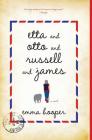
I read Etta and Otto and Russell and James last year, and I immediately added it to my favorite books list and gave it 5 stars! But I read so many books that, over a year later, I couldn’t remember all the details. I knew I was going to the beach, so I thought, “Why not get it for the beach and give it a re-read?”

The first time I read this, when I checked it out from the library, I didn’t realize it was magical realism. But I love magical realism, and reading it a second time, it made more sense in the story.

This book is character-driven, low on the plot, and heavy on the emotion. The book is non-linear, and switches back and forth not only in POVs (though all are in 3rd person) but also back and forth in time. It explores the relationships between three main characters: Etta, Otto, and Russell. Etta and Otto are married, and Russell is their longtime friend. In the present day, they are all old farmers in Canada. One day, Etta decides to trek across the Canadian wilderness in order to see the ocean for the first time.

In the past, Otto grows up on a farm, and Russell, his neighbor, becomes his best friend. Later, Etta becomes a school teacher while Otto goes off to fight in WWII.

Hooper is a wonderful writer. She’s also a musician, which gives her writing a rhythmic and lyrical feel that I love. Hooper also excludes quotation marks in her dialogue, which adds to the magical realism feel of the book.

Overall, this is a quietly powerful book. At its core, it’s about both a physical and an emotional journey through the Canadian landscape and the characters’ pasts. It explores war, family, and farming, with a talking coyote thrown in there for good measure. If you love magical realism, lyrical, poetic writing, and character-driven stories, I highly recommend it!

VERDICT: 5 stars
Support Independent Bookstores - Visit IndieBound.org

Review: Warlight by Michael Ondaatje

Anna: Read 12/13/18

I have mixed feelings about this book. I really enjoyed the beginning, which follows siblings Rachel and Nathaniel after their parents mysteriously leave them in the care of a guardian. I love a good coming-of-age story. The beginning is also when the relationship between the characters had the most tension and intrigue.

I then struggled through the second half of the book, which focuses on Nathaniel uncovering his mother Rose’s backstory. This is where I lost interest, as the narrative completely lacked the suspense of the first half. The complete lack of characterization of Rose, coupled with the lack of empathy we feel for her as a reader in the first half when she leaves her children without explanation, made me uninterested in her life and career.

Something that surprised me about this book, and something that I liked, is the fact that it is set in the near-immediate aftermath of World War II. Going into reading this, I had assumed it was set during the war. I enjoy World War II fiction, but feel that this is an important and overlooked time period, especially since none of the characters were soldiers so it featured no war scenes.

Perhaps I would have enjoyed this more if the second half mimicked the dark and atmospheric half of the first. I just didn’t connect with any of the characters, besides Nathaniel. I just couldn’t, no matter how hard I tried, feel any connection to their lives. And I particularly disliked the twist about the Darter near the end. The story also left a couple loose ends, which felt like an attempt at depth; however, it just further highlighted how undeveloped the characters felt to me.

VERDICT: 3 out of 5 books

Review: The Tattooist of Auschwitz by Heather Morris

Alexis: Read 12/10/18

This is a hard book for me to rate. The story, as are all Holocaust stories, is dark, harrowing, and resonant. This is a story of survival and love. It focuses on Lale and Gita, who manage to fall in love amidst the horrors of Auschwitz.

Parts of the novel hit me hard. It’s impossible to read a book about the Holocaust and not come away emotionally affected by it. The knowledge that this was not only based on a real historical event but also on the lives of two very real people played in the back of my mind as I read. I liked that it was written in present tense, which propels you into the story.

But how do you rate a book like this? The perspective is one of the most interesting parts of the book. Lale, as the Tattooist, has a higher position than most of his fellow prisoners. I was wholly involved in his storyline of using his position in order to barter jewelry for food, help feed other prisoners, and help save other prisoners’ lives. His feelings of revulsion at tattooing his own people conflict with his instinct to do what he must to survive.

Yet chunks of this book still fall flat. The writing style is awkward in places. Half of Lale and Gita’s relationship feels real and raw, and half feels stitled. In the “about the author” section of the book, it’s mentioned that Morris originally wrote this story as a screenplay, and this seems to fit with the style of some sections of the book. Near the end, it’s mentioned that Lale’s way of dealing with the horrors of his imprisonment is emotional detachment. This could be the reason for the stiltedness, as the writing could reflect Lale’s repressed emotions. However, I don’t think this was a purposeful choice on Morris’ part.  

VERDICT: 4 out of 5 stars